

As a financial planner, one of the most common oversights I see from my international clients is a failure to prepare for the unique challenges of U.S. tax law.
Many Malaysians and other non-US citizens are drawn to the dynamism of the U.S. stock market, but few are aware of a significant financial trap: the U.S. estate tax.
This makes comprehensive estate planning for US stocks owned by non US citizens not just a matter of good practice, but a crucial step in wealth preservation.
Without a solid plan for mitigating U.S. estate tax liabilities, your heirs could face a substantial and unexpected tax bill.
This guide is designed to help you in understanding U.S. situs assets and the strategies you can employ to protect your legacy for your loved ones.
Core Concepts: US Estate Tax for Non-Citizen Investors
The U.S. tax system is notoriously complex, and its rules for non-citizens can seem particularly daunting.
The foundational issue is that the U.S. Internal Revenue Service (IRS) applies a different, and much less favourable, set of rules to individuals it classifies as ‘non-domiciliaries’.
This classification can have a profound impact on how your U.S.-based assets, particularly stocks, are treated upon your death.
Defining U.S. Situs Assets & The $60,000 Exemption Threshold
The term that every non-US investor must become familiar with is ‘U.S. situs assets’. These are assets that the IRS considers to be located in the United States for tax purposes, regardless of where you, the owner, reside.
For estate tax purposes, the most common U.S. situs assets include:
- Shares of stock in U.S. corporations, held in a U.S. brokerage account or even in some foreign accounts.
- Real estate physically located within the United States.
- Tangible personal property, such as art, vehicles, or jewellery, located in the U.S.
- Certain types of debt obligations, including bonds issued by U.S. entities.
Conversely, assets generally *not* considered U.S. situs for a non-resident include shares in foreign corporations, proceeds from life insurance policies, and certain U.S. bank deposits.
The distinction is critical because only U.S. situs assets are counted towards the estate tax calculation for a non-resident.
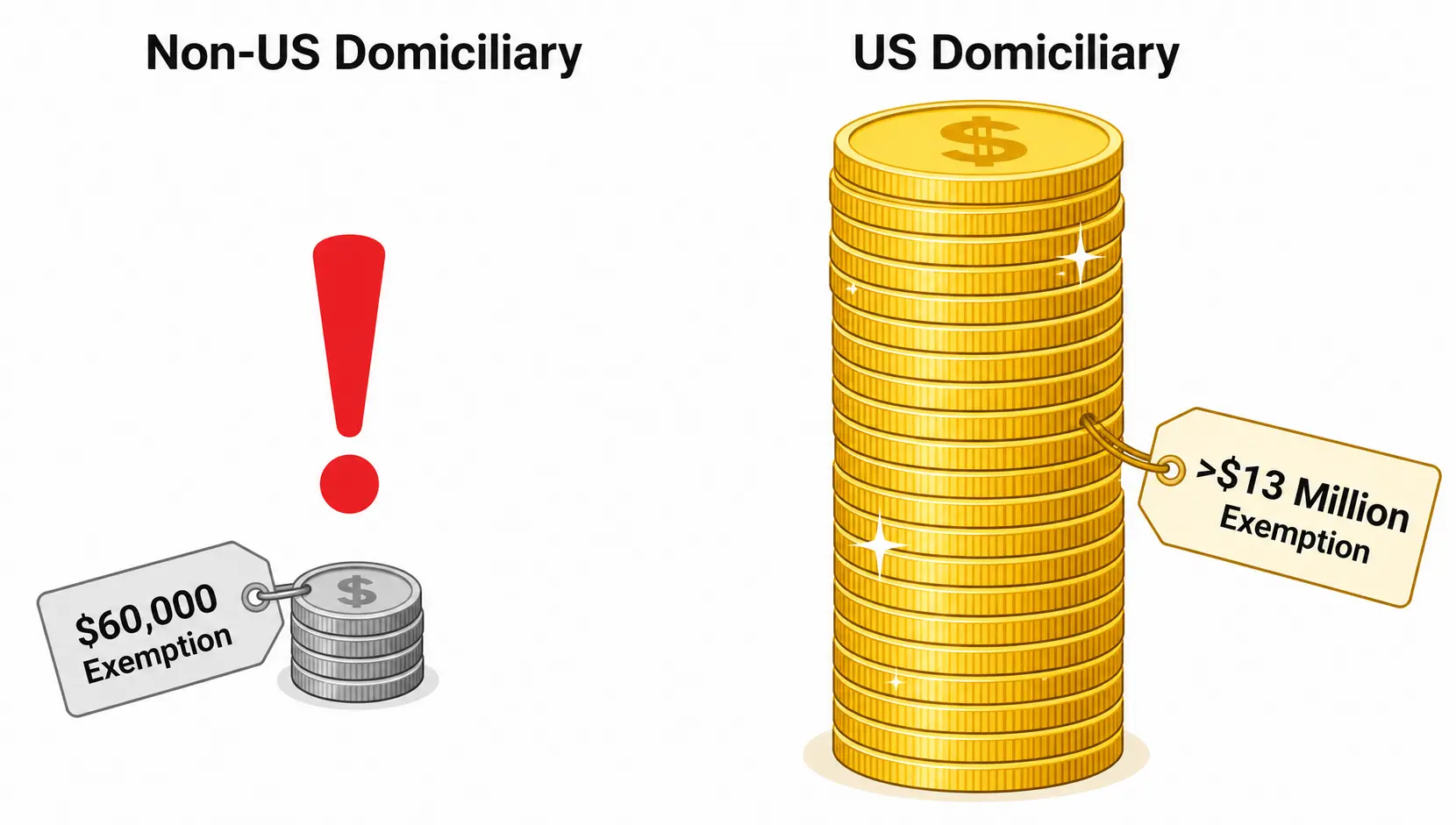
The Critical Difference: U.S. Domiciliary vs. Non-Domiciliary Rules
Understanding your ‘domicile’ is central to U.S. estate planning. It’s a legal concept that is different from residency.
You can be a resident of a country for visa or income tax purposes, but your domicile is the place you consider your permanent home—the place you intend to return to whenever you are away.
For most non-US citizens investing from their home country, like Malaysia or the UK, they are considered ‘non-domiciliaries’ by the U.S.
This distinction is crucial:
- U.S. Citizens/Domiciliaries: Are taxed on their worldwide assets but benefit from a very large federal estate tax exemption.
- Non-Domiciliaries: Are only taxed on their U.S. situs assets, but with the very low exemption of just $60,000.
Proving non-domiciliary status involves demonstrating your connections to your home country, such as owning a home, maintaining bank accounts, and having family and social ties there.
It’s about intent, not just physical presence. For a clear breakdown, resources like Investopedia provide excellent explanations of this legal concept.
Key Strategies for Mitigating U.S. Estate Tax on US Stocks
Fortunately, with proper planning, the U.S. estate tax is a manageable issue. The goal is to legally structure your ownership of U.S. stocks so they are not considered U.S. situs assets in your personal estate.
Here are some of the most effective strategies I discuss with my clients.
Strategy 1: Using a Foreign Corporation
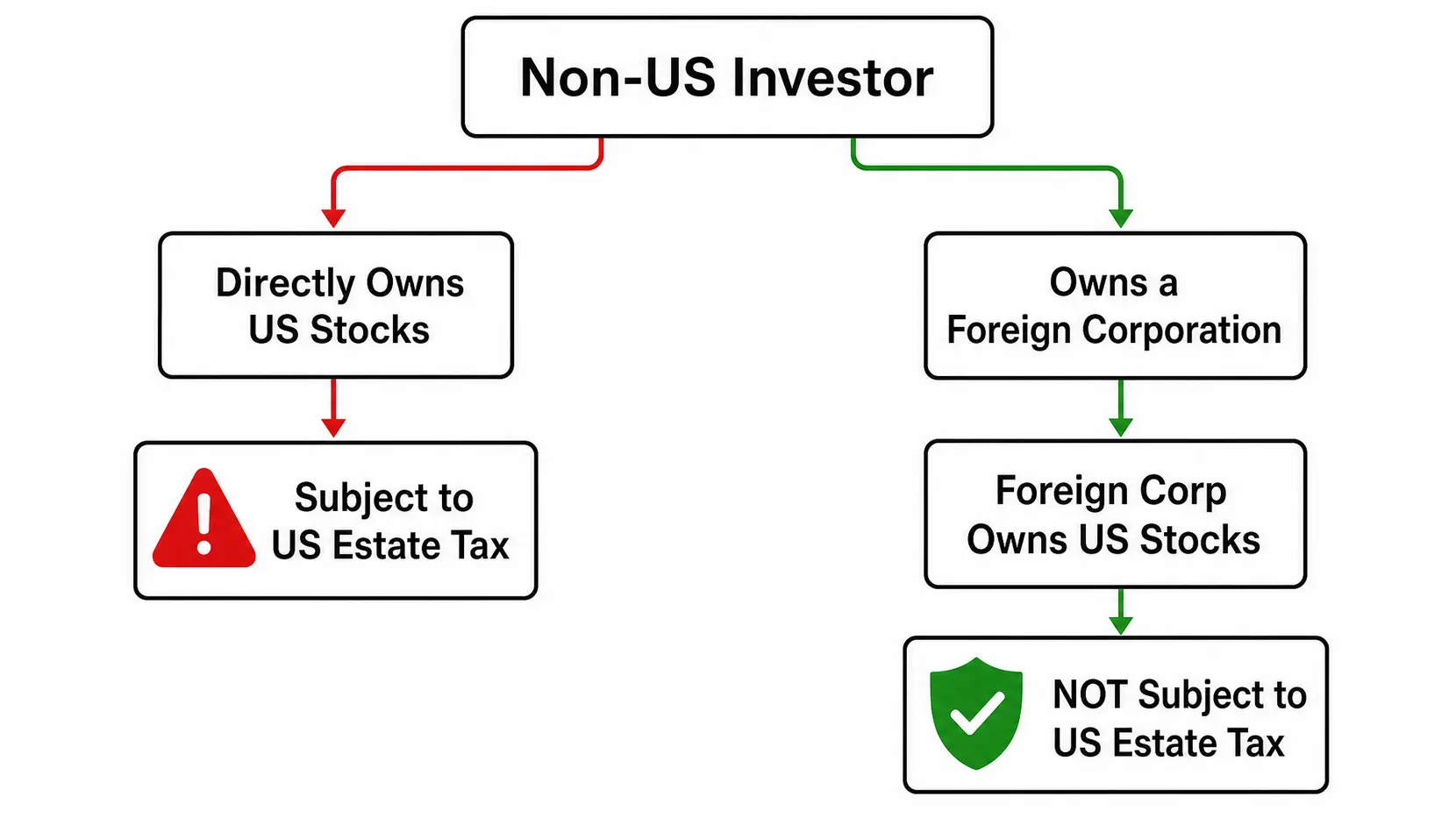
One of the most robust strategies is to hold your U.S. stocks through a non-U.S. corporation, often referred to as an offshore company.
Here’s how it works: you create a corporation in a jurisdiction with favourable laws (like the British Virgin Islands or Cayman Islands), and that corporation then opens a brokerage account and purchases the U.S. stocks.
From the IRS’s perspective, upon your death, you own shares in a *foreign* corporation, not the underlying U.S. stocks. Since shares in a foreign corporation are not U.S. situs assets, they are not subject to U.S. estate tax.
Strategy 2: Leveraging Foreign Trusts
Similar to using a corporation, you can establish an irrevocable foreign trust to hold your U.S. stock portfolio. By transferring your assets to a properly structured trust, you no longer legally own them.
The trust becomes the owner, and since it is a foreign entity, the assets held within it are not part of your personal estate for U.S. tax purposes.
This strategy can also offer additional benefits, such as creditor protection and more control over the distribution of assets to your heirs.
| Ownership Structure | U.S. Estate Tax Exposure | Complexity & Cost | Best For |
|---|---|---|---|
| Direct Personal Ownership | High (tax on assets > $60,000) | Low | Investors with less than $60,000 in U.S. assets. |
| Through a Foreign Corporation | None (if structured correctly) | Medium (setup/annual fees) | Investors with significant portfolios seeking a clear corporate shield. |
| Through a Foreign Trust | None (if structured correctly) | High (legal/setup fees) | Investors seeking asset protection and succession planning flexibility in addition to tax mitigation. |
Strategy 3: Utilising Tax Treaties
The U.S. has estate and gift tax treaties with several countries, including the United Kingdom, Germany, and France. These treaties can significantly alter the standard rules.
For example, the U.S.-U.K. tax treaty allows a UK domiciliary to use a portion of the much larger U.S. federal exemption. The amount is prorated based on the value of their U.S. situs assets relative to their worldwide assets.
If your home country has a treaty with the U.S., it’s essential to understand its provisions. A quick search for the U.S.-U.K. estate and gift tax treaty can provide the specific text and technical explanations.
Even if a treaty exists, it may not eliminate the tax entirely, and professional guidance is still needed to make a proper treaty claim.
Strategy 4: Gifting and Life Insurance
Two other tools can play a role. First, the U.S. allows non-residents to make annual gifts of U.S. assets up to a certain limit ($18,000 for 2026) per recipient without incurring gift tax.
However, this is only for certain types of property; gifts of U.S. stocks are generally taxable.
A more viable strategy is using life insurance. A non-resident can purchase a life insurance policy and use the proceeds to pay any anticipated estate tax.
The key is to have the policy owned by a person or trust outside of the U.S. estate so the death benefit itself is not subject to tax.
| Aspect | Qualified Domestic Trust (QDOT) | Standard Inheritance (No QDOT) |
|---|---|---|
| Purpose | Allows deferral of estate tax when assets pass to a non-US citizen spouse. | Tax is due immediately upon the death of the first spouse. |
| Tax Treatment | Estate tax is deferred until the surviving spouse withdraws principal or passes away. | Assets above the $60,000 exemption are taxed. |
| Requirements | At least one trustee must be a U.S. citizen or U.S. bank. Strict IRS rules apply. | No special requirements, but results in immediate tax liability. |
| Who It Helps | Specifically for married couples where the surviving spouse is not a U.S. citizen. | Does not provide any special protection for a non-citizen spouse. |
For individuals married to a U.S. citizen, or who have a non-citizen spouse but a more complex situation, a special type of trust known as a Qualified Domestic Trust (QDOT) can be invaluable.
This allows assets to pass to a non-citizen surviving spouse while deferring the estate tax until that spouse’s death. You can find detailed regulations on the IRS page for QDOTs.
Frequently Asked Questions
1. What is the US estate tax rate for a non-resident alien?
The tax is progressive. As of 2026, for a non-resident’s taxable estate (the value of U.S. situs assets above the $60,000 exemption), the rates start at 18% and climb to 40% for amounts over $1 million.
This means a significant portion of your assets can be taxed away if you do not plan accordingly.
2. Are my US brokerage account shares considered ‘U.S. situs assets’?
Yes, unequivocally. It does not matter if you opened the account from Malaysia, the UK, or anywhere else.
If the shares are of a U.S.-incorporated company (like Apple, Microsoft, or Google), they are considered U.S. situs assets and will be included in your U.S. taxable estate. This is one of the most common and costly misunderstandings I encounter.
3. How can a tax treaty between my country and the U.S. affect my estate plan?
A tax treaty can be a game-changer. It can increase your exemption from the low $60,000 amount to a potentially much higher, prorated amount based on the large U.S. exemption.
It may also re-classify certain assets, or provide a credit for taxes paid in your home country. You must consult with a professional who is familiar with the specific treaty between your country of domicile and the United States.
4. Can I just hold US-focused ETFs from a non-US exchange to avoid this tax?
This is a more complex area. Holding a European-domiciled ETF (like one on the London Stock Exchange) that invests in U.S. stocks is generally a way to avoid direct ownership of U.S. situs assets.
In this case, you own shares of a foreign fund, not the U.S. stocks themselves. However, the structure of the fund matters.
It is crucial to use UCITS-compliant ETFs or similar regulated foreign funds, as they are specifically designed with these cross-border tax issues in mind.
David Lim’s Final Thoughts
Sources & Methodology
David Lim strictly relies on primary regulatory data and authoritative official information to ensure accuracy. Data cited in this guide is sourced from:
*Disclaimer: The content of this article represents the personal views of the author (David Lim) and is for educational and reference purposes only. It does not constitute professional investment or financial advice. Trading and investing involve significant risk; proceed with caution.*
