
In my decade of navigating the forex and CFD markets, I’ve seen the aftermath of traders tangling with unregulated entities. The allure of quick profits can be a powerful siren song, but it often leads to catastrophic capital loss. This guide is built on a simple principle: survival first. Learning how to report an illegal financial broker to Bank Negara Malaysia is a critical piece of that survival strategy. It’s not just about seeking recourse; it’s about protecting the integrity of our market. Before you even consider a new trading platform, you must know how to verify whether a broker is legitimate and understand the process for submitting a complaint or report to BNM if you encounter a fraudulent operation.
Danny’s Insight: “The market is ruthless enough without adding counterparty risk from a shady broker. Your first and most important trade is choosing a regulated partner. Everything else is secondary. Never commit a single dollar until you’ve done your due diligence. It’s the only stop-loss that’s 100% effective against fraud.”
Step-by-Step: How to Officially Report an Illegal Broker to BNM
Pro Tip: To report an illegal financial broker, your primary tool is Bank Negara Malaysia’s BNMTELELINK service, accessible via the eLINK online form. The goal is to provide a clear, evidence-backed report that gives the regulators a solid foundation to act. Be methodical and unemotional in your submission.
Lodging a formal complaint is a structured process. Think of it as building a case file. The more organised and thorough you are, the more effective your report will be. The authorities are dealing with numerous cases, and a well-prepared submission stands out and is easier to process.
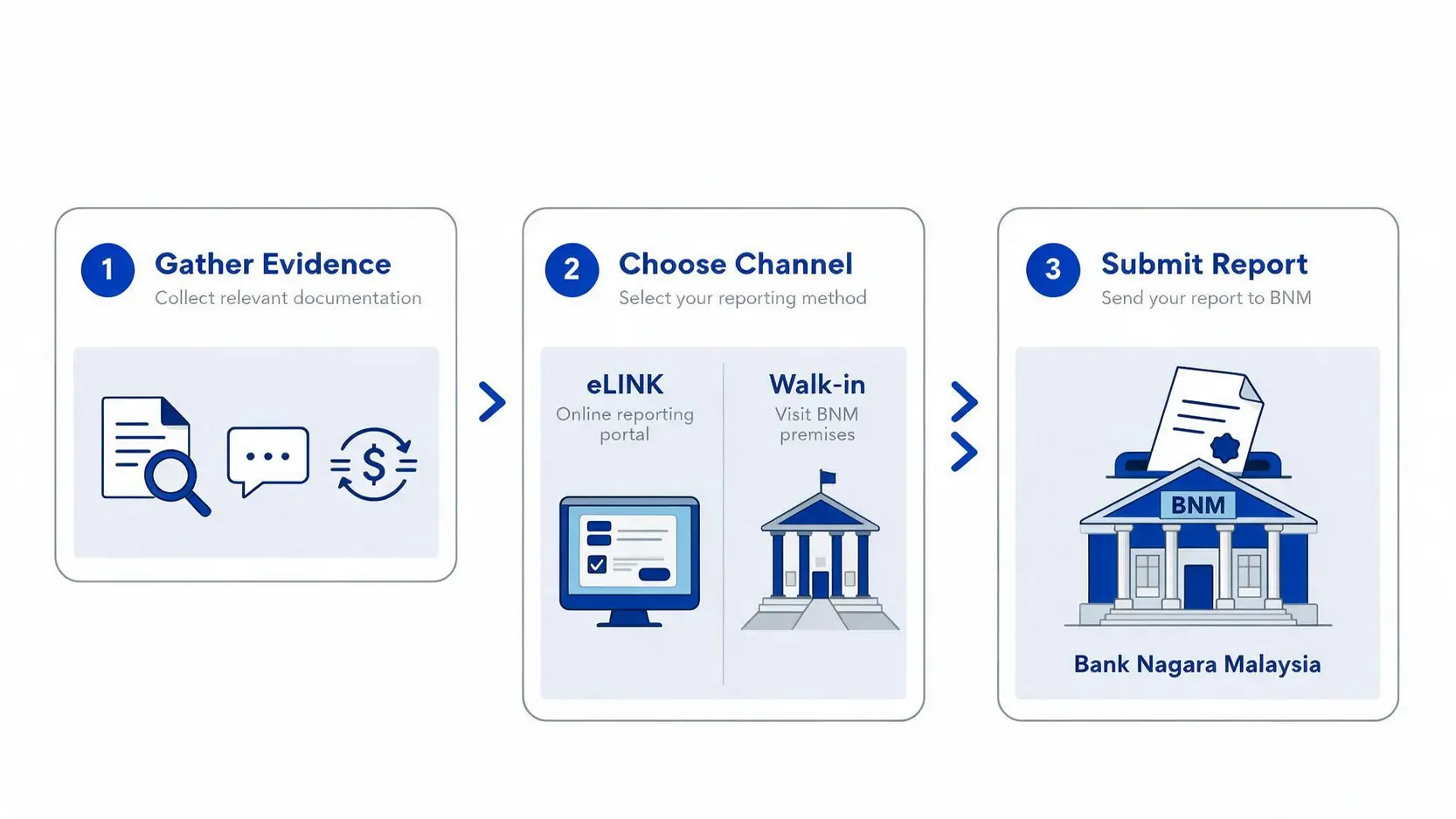
Gathering Your Evidence: What Information Do You Need?
Before you even open the complaint form, you must assemble your evidence. This is non-negotiable. A report without evidence is just an allegation and carries little weight. Your goal is to create an undeniable record of your interactions and the broker’s activities.
- Broker Details: The full name of the company and any individuals you communicated with. Include their website URL, physical address (if known), and any registration numbers they falsely claimed to have.
- Communication Records: Compile every email, WhatsApp message, Telegram chat, and a log of phone calls. Take screenshots. Do not rely on the platform’s chat history, as they can delete it. Export and save everything.
- Transaction History: Document all deposits and withdrawal attempts. This includes bank transfer receipts, credit card statements, and cryptocurrency transaction IDs (hashes). Highlight the destination accounts.
- Trading Platform Activity: Take screenshots or screen recordings of your trading account dashboard, open positions, and any evidence of platform manipulation (e.g., sudden spread widening, price freezes during volatile news events).
- A Chronological Narrative: Write a clear timeline of events. For example: ’15 July 2026: Initial contact via Facebook ad. 20 July 2026: Deposited $1,000 via bank transfer. 05 September 2026: Requested withdrawal of $500. 10 September 2026: Withdrawal rejected, account manager ‘Alex’ requested a 20% ‘tax’ payment.’
Submitting a Complaint via BNM’s Official Channels (eLINK, Walk-in)
Once your evidence is compiled, you can proceed with the official submission. BNM provides clear channels for this purpose.
| Channel | Description | Pro Tip |
|---|---|---|
| eLINK (Online Form) | This is the most efficient method. The online form guides you through the required information and allows you to upload your supporting evidence directly. You will receive a case number for tracking. | Use the chronological narrative you prepared as the main text for your complaint description. Attach your compiled evidence in a single, well-organized zip file if possible. Access it here: BNM eLINK Complaint Form. |
| Walk-in (BNMLINK Centres) | You can visit a BNMLINK Customer Service Centre in person. This may be suitable if you have physical documents and prefer face-to-face interaction. | Bring all your evidence, both in digital format (on a thumb drive) and hard copies. Be prepared to explain your case clearly and concisely. |
| Telephone | You can call BNMTELELINK at 1-300-88-5465. However, this is better for initial enquiries. For a formal report on an illegal broker, you will be directed to use the eLINK form to provide evidence. | Use the phone line to clarify any doubts about the reporting process before you submit your formal complaint via eLINK. |
Risk Warning: The primary purpose of reporting to BNM is to alert the authorities to take action against the illegal entity and prevent them from harming more victims. It is NOT a process for fund recovery. The chances of recovering your capital from an unlicensed, offshore entity are extremely low. Any trading capital sent to such brokers should be considered at total risk.
Before You Report: How to Verify a Financial Broker’s Legitimacy
The best way to win the game is to avoid playing on a rigged field. Before you wire a single cent, perform your due diligence. This is not optional; it’s a fundamental part of capital preservation. In Malaysia, the regulators provide powerful tools to help you with this.
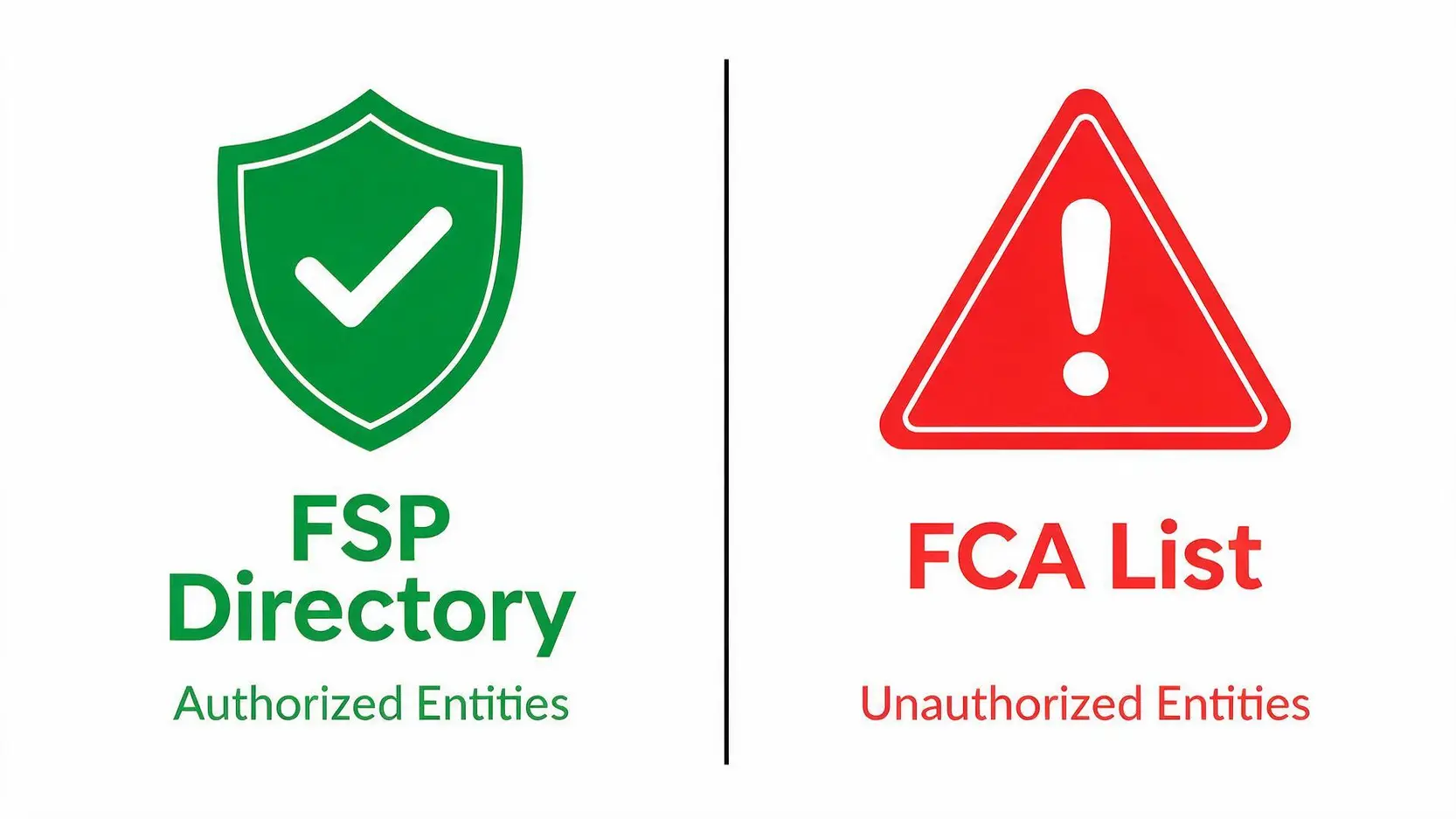
Checking the BNM Financial Consumer Alert (FCA) List for Unauthorized Companies
The FCA List is your first line of defence. It is a directory of companies and websites that are not authorised to offer financial services or products in Malaysia for which a license is required. Think of it as the market’s ‘blacklist’.
How to Use the FCA List:
- Visit the official list: BNM Financial Consumer Alert (FCA) List.
- Use the search function to enter the name of the broker or its website.
- If the entity appears on this list, stop all communication immediately. They have been flagged for operating without the necessary approvals.
Consulting the Financial Sector Participants (FSP) Directory for Licensed Entities
The FSP Directory is the inverse of the FCA list. This is the ‘whitelist’ – an official register of all institutions that ARE licensed and regulated by Bank Negara Malaysia. An entity’s absence from this list is a major red flag.
How to Use the FSP Directory:
- Navigate to the directory: BNM Financial Sector Participants (FSP) Directory.
- Search for the company name. A legitimate institution regulated by BNM will be listed here.
- Be aware that many scam brokers use names that are confusingly similar to licensed entities. Always cross-reference the website and contact details.
| Feature | BNM Financial Consumer Alert (FCA) List | BNM Financial Sector Participants (FSP) Directory |
|---|---|---|
| Purpose | To list entities that are NOT AUTHORISED by BNM. | To list entities that are LICENSED AND AUTHORISED by BNM. |
| Interpretation | A ‘blacklist’. If a broker is on this list, do not engage. | A ‘whitelist’. Your potential broker should be on this list. |
| Action | Check this list to see if a broker has been flagged. | Check this list to confirm a broker’s claim of being regulated by BNM. |
In addition to BNM’s lists, you should also check the Securities Commission Malaysia (SC) Investor Alert List, as the SC regulates capital markets products like stocks and bonds, and their list often includes entities running illegal investment schemes.
Identifying the Red Flags of an Illegal Financial Broker
After years in the market, you start to see the patterns. Scam operators are rarely original; they just adapt their tactics to new platforms. Recognizing these red flags is a skill that will protect your capital far more than any trading indicator.
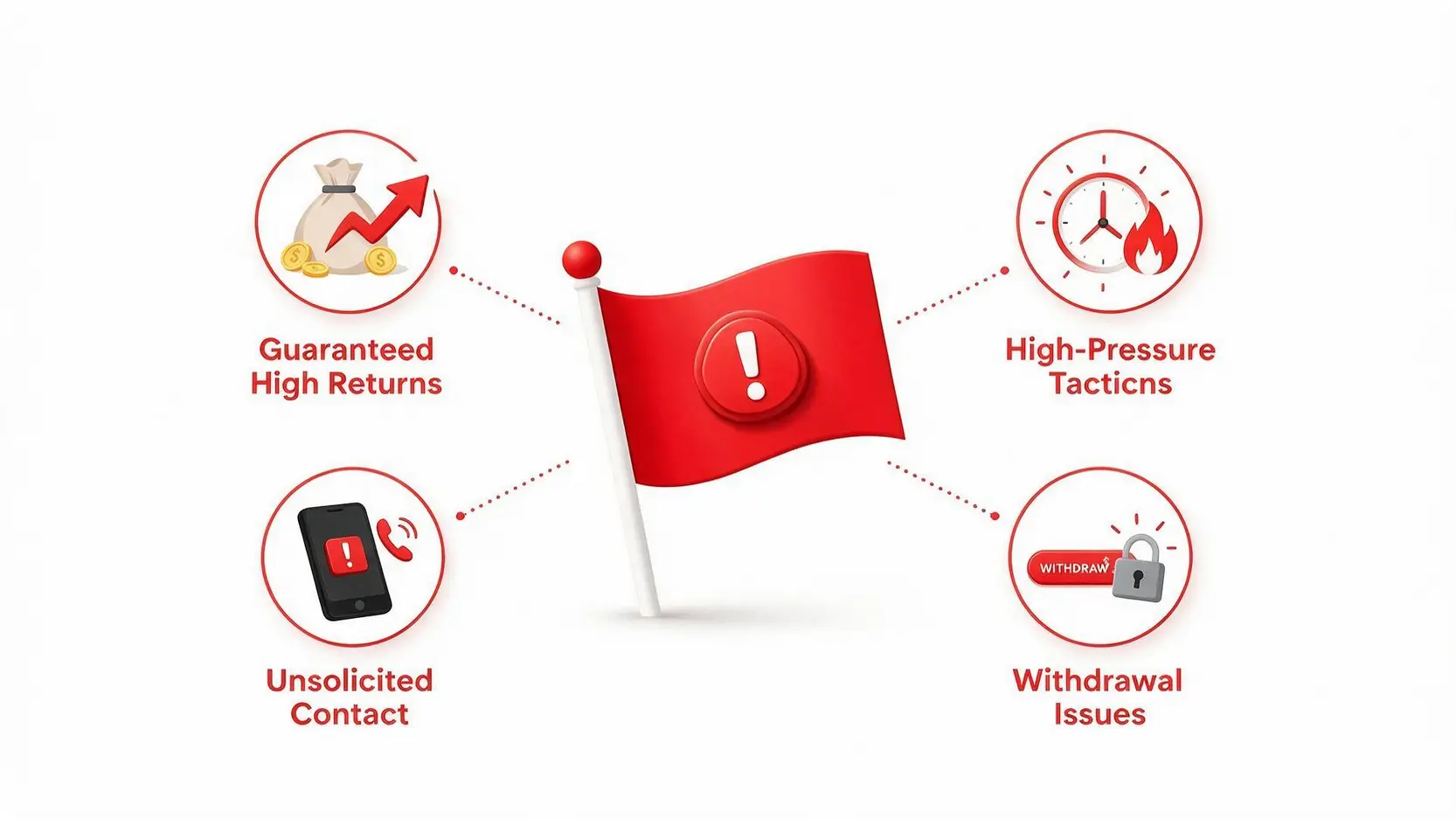
Common Tactics and Promises of Unlicensed Investment Schemes
Danny’s Insight: “The market offers no guarantees, only probabilities. Anyone who promises you a ‘guaranteed’, ‘risk-free’, or ‘impossibly high’ return is not a broker; they are a con artist. Professional trading is about managing risk, not avoiding it. The moment you hear a promise that sounds too good to be true, you are hearing a sales pitch, not a financial proposition.”
- Guaranteed High Returns: Promises of 10% profit per month or doubling your money in a short period are hallmarks of fraud. Real market returns are variable and involve risk.
- High-Pressure Sales Tactics: A sense of urgency, such as ‘This offer is only available for the next hour!’ or ‘You need to deposit more now to get into this special trade!’. A legitimate broker provides information and allows you to decide in your own time.
- Unsolicited Contact: Cold calls, unexpected emails, or social media messages from ‘gurus’ or ‘account managers’ are a massive red flag.
- Difficulty with Withdrawals: This is the ultimate test. They may allow a small, early withdrawal to build trust. When you try to withdraw a larger amount or your full capital, you will face excuses, delays, and demands for more money (e.g., ‘taxes’, ‘fees’, ‘commissions’).
- Vague Regulatory Status: They might claim to be ‘globally regulated’ or use logos of well-known regulators without providing a specific license number that you can verify on the regulator’s official website.
Understanding What Constitutes an Illegal Foreign Exchange (Forex) Trading Scheme in Malaysia
This is a point of significant confusion. In Malaysia, the legal framework for foreign exchange is very clear. Engaging in forex trading is not illegal, but the entity you trade with matters.
Core Principle: Under the Financial Services Act 2013, only licensed commercial banks, Islamic banks, investment banks, and international Islamic banks are permitted to deal in foreign currency. This means that any platform allowing you to trade forex that is not one of these licensed entities is likely operating outside of Malaysian law, and you will not have recourse or protection from BNM.
This is why you will not find popular retail forex brokers in the BNM FSP Directory. While they may be regulated in other jurisdictions (e.g., Cyprus, Australia, UK), they are not licensed to onboard Malaysian residents for forex dealing under BNM’s framework. Engaging with them carries inherent risks, as your funds are held offshore and are outside the protection of Malaysian law.
Risk Warning: An illegal forex trading scheme is any scheme that solicits the Malaysian public to trade forex through a platform not licensed by BNM. These schemes often promise high returns and may involve depositing funds with individuals or local companies acting as unofficial ‘payment agents’. This is an extremely high-risk activity.
Frequently Asked Questions
1. What is the difference between the BNM Financial Consumer Alert List and the FSP Directory?
Think of it as a ‘bad list’ versus a ‘good list’. The Financial Consumer Alert (FCA) List contains the names of companies and individuals who are not authorized by BNM to provide financial services. If a company is on this list, you should avoid them. The Financial Sector Participants (FSP) Directory, on the other hand, is the official list of all institutions that are licensed by BNM. A legitimate financial institution should be found in the FSP Directory.
2. Can I get my money back after reporting the illegal broker to Bank Negara Malaysia?
From my experience, the odds are very low. Reporting an illegal broker is a civic duty that helps regulators take action and protects future victims, but it is not a debt collection service. These illegal operations are often based overseas, use complex methods to move money, and are designed to be untraceable. You should operate under the assumption that any money sent to an unlicensed broker is lost. This is why due diligence *before* you invest is the only real protection.
3. What should I do immediately if I realize I’ve been scammed by a broker?
First, stop sending them money. Do not pay any ‘taxes’ or ‘fees’ they demand for withdrawals; this is just a tactic to extract more funds. Second, gather all the evidence as outlined in this guide—screenshots, transaction records, chat logs. Third, file a report with BNM via the eLINK portal and also make a police report. Finally, contact your bank to see if any transactions can be disputed or recalled, although this is often not possible. Act quickly, but stay calm and methodical.
4. Does a broker being regulated in another country make it safe for me in Malaysia?
It’s complicated and depends on your risk tolerance. A broker regulated in a reputable jurisdiction (like the UK’s FCA or Australia’s ASIC) is certainly not an ‘illegal scam’ in the traditional sense. However, because they are not licensed by Bank Negara Malaysia, your funds are held offshore. This means if a dispute arises, you cannot rely on BNM or the Malaysian legal system for protection or recourse. You would have to pursue the matter through the regulatory body and legal system of the broker’s home country, which can be complex and costly. It introduces a layer of cross-border risk that you must be comfortable with.
Danny’s Final Thoughts
I’ve seen too many promising traders get wiped out not by a bad trade, but by a bad actor. The allure of an easy path is strong, but the market does not reward shortcuts. Your first and most critical responsibility as a trader is capital preservation. This begins long before you analyse a chart or place an order. It begins with an exhaustive, almost paranoid level of due diligence on the broker you choose to partner with. Use the tools the regulators provide. Check the lists. Ask the hard questions. If a broker’s legitimacy isn’t immediately and verifiably clear, the trade is simple: walk away. There is always another opportunity in the market, but you can’t seize it if your capital has vanished.
Sources & Methodology
Danny strictly relies on primary regulatory data and authoritative official information to ensure accuracy. Data cited in this guide is sourced from:
*Disclaimer: The content of this article represents the personal views of the author (Danny) and is for educational and reference purposes only. It does not constitute professional investment or financial advice. Trading and investing involve significant risk; proceed with caution.*
