
As a market analyst, I’ve observed countless traders fixate on lagging indicators, essentially driving by looking in the rearview mirror.
True market anticipation lies in understanding forward-looking data. This is precisely why savvy forex participants closely monitor how German IFO Business Climate Index impacts the Euro.
This single report from Europe’s largest economy can dictate the directional bias for the EUR/USD, EUR/GBP, and other crosses for days or even weeks.
Understanding how to analyse its effect on the Euro is not just an academic exercise; it’s a critical tool for anticipating monetary policy shifts and market sentiment.
This guide provides a professional framework for interpreting and trading this key data release.
What is the German IFO Business Climate Index?
Pro Tip: The German IFO Business Climate Index is a high-impact, monthly survey of approximately 9,000 German businesses across manufacturing, services, trade, and construction. It serves as a potent leading indicator of economic activity, providing a snapshot of current business morale and, more importantly, future expectations. For a trader, it’s a direct glimpse into the health and sentiment of the Eurozone’s economic engine.
Published by the Munich-based CESifo Group, the IFO (Information and Forschung) Institute’s survey is one of the most respected sentiment indicators globally.
Its importance is magnified because Germany is the powerhouse of the European Union.
A slowdown or acceleration in the German economy has significant spillover effects on the entire bloc, directly influencing the European Central Bank’s (ECB) policy calculus and, consequently, the Euro’s valuation.
The anatomy of the IFO Index: Business Climate, Current Conditions, and Expectations
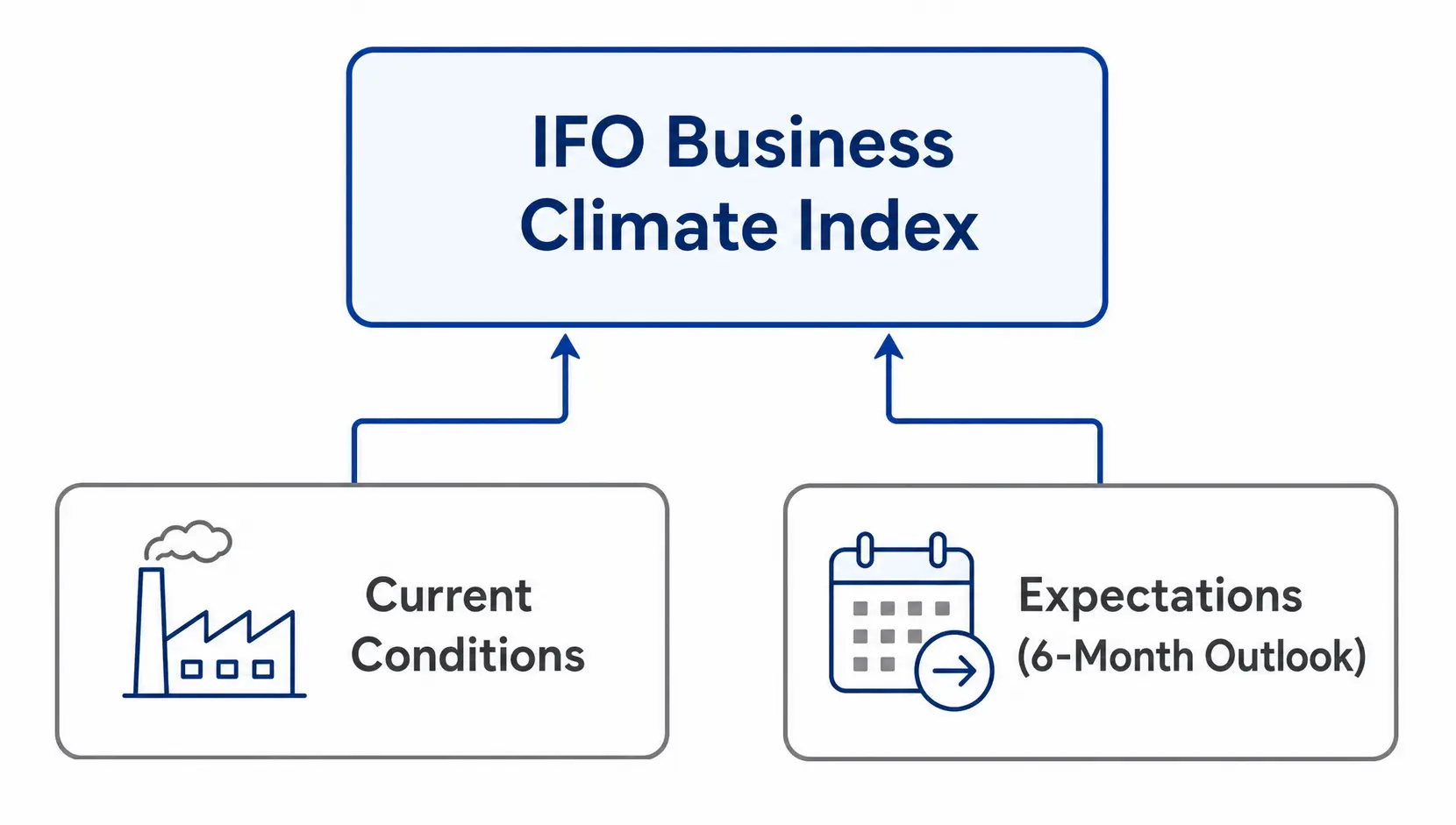
The headline IFO Business Climate Index is a composite figure, but the real analytical value lies in its three core components.
A professional analysis requires dissecting each one:
- Business Climate: This is the headline number, a geometric mean of the Current Conditions and Expectations components. It provides a comprehensive overview of business sentiment.
- Current Conditions (Business Situation): This sub-index measures how executives perceive their company’s present operational environment. A high reading indicates robust current activity, strong order books, and healthy capacity utilisation.
- Expectations: This is the forward-looking component, where businesses forecast their outlook for the next six months. For currency traders, this is often the most critical sub-index, as markets are discounting mechanisms that price in future events. A strong ‘Expectations’ reading can lift the Euro even if ‘Current Conditions’ are mediocre.
How the data is collected and why it matters for Europe’s largest economy
The IFO survey’s methodology is what grants it E-E-A-T (Expertise, Authoritativeness, Trustworthiness).
Each month, thousands of firms are asked to give a qualitative assessment of their current business situation (‘Good’, ‘Satisfactory’, ‘Poor’) and their expectations for the next six months (‘More favourable’, ‘Unchanged’, ‘Less favourable’).
The results are then aggregated and presented as a balance value, which is the difference in the percentage of positive and negative responses. The index base value is 100 as of a reference year (currently 2015).
The sheer scale and consistency of this survey make it a reliable barometer of economic health. Unlike quantitative data like GDP, which is released with a significant lag, sentiment indicators like the IFO are timely.
They offer a real-time pulse on business investment intentions, hiring plans, and overall confidence—key drivers of future economic growth.
The Direct Impact of the IFO Index on the Euro (EUR)
Pro Tip: A stronger-than-expected IFO reading typically leads to an appreciation of the Euro (EUR), while a weaker-than-expected figure exerts downward pressure. The market reaction is often immediate and can create significant volatility, particularly in the EUR/USD pair. The magnitude of the impact is determined by the deviation from the consensus forecast.
Decoding the correlation: Why positive German sentiment often strengthens the Euro
The logic connecting the German IFO index to the Euro is straightforward from a macroeconomic perspective.
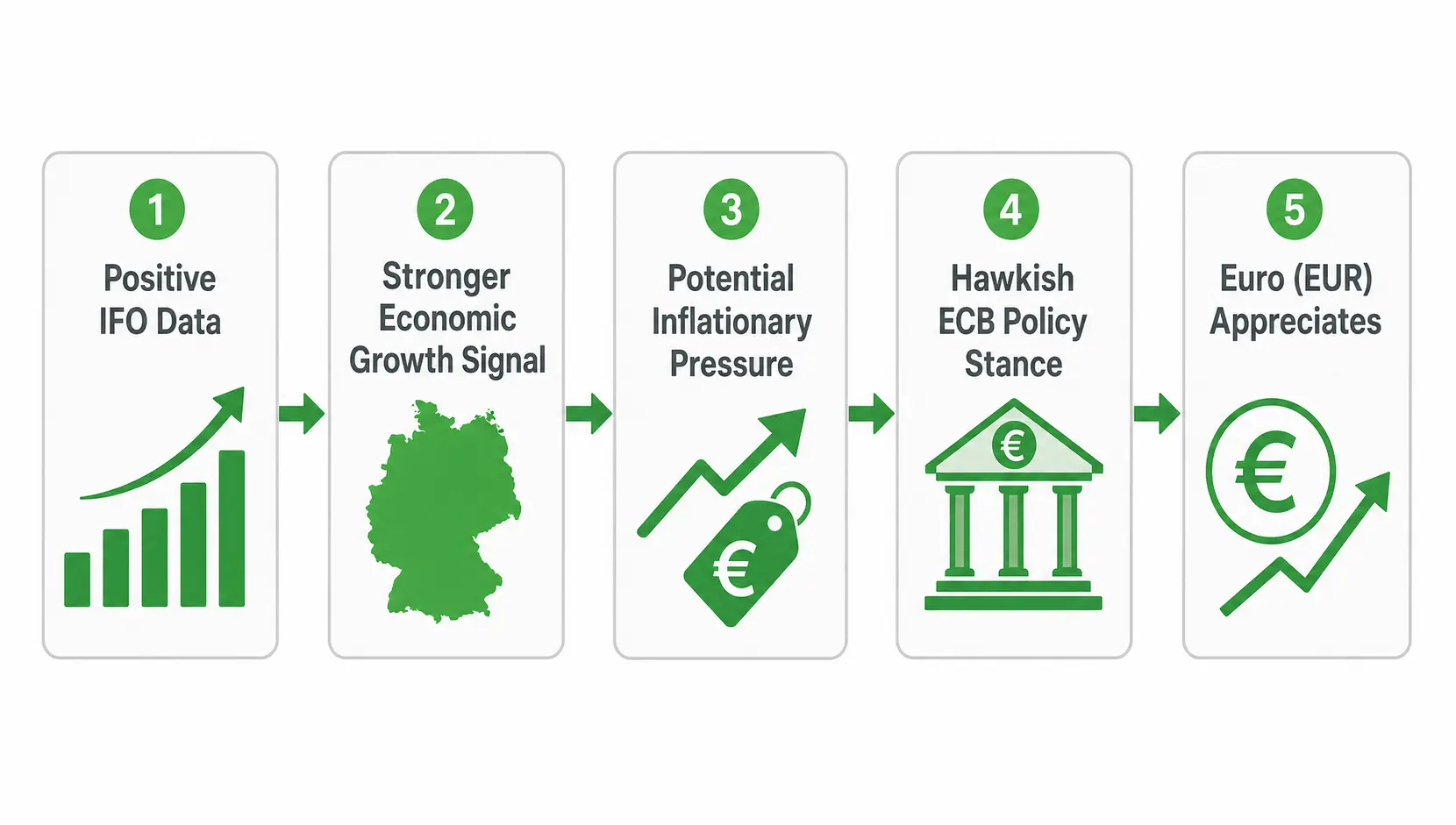
Here’s the causal chain:
- Positive IFO Data (Especially Expectations): Suggests German businesses are optimistic. They anticipate higher demand and are more likely to increase investment and hiring.
- Economic Growth Signal: As Germany’s economy accounts for roughly 25-30% of the Eurozone’s total GDP, its strength is a proxy for the health of the entire region.
- Inflationary Pressure: Stronger economic growth often leads to rising wages and consumer spending, which can fuel inflation.
- ECB Monetary Policy Implications: The European Central Bank has a mandate to maintain price stability. If a robust German economy signals rising inflationary pressures across the Eurozone, the ECB may be inclined to adopt a more hawkish stance (i.e., raise interest rates or reduce monetary stimulus).
- Currency Appreciation: Higher interest rates (or the expectation of them) make a currency more attractive to foreign investors seeking higher yields. This increased demand for the Euro causes its value to appreciate against other currencies.
| IFO Scenario | Market Interpretation | Probable EUR Reaction |
|---|---|---|
| Headline & Expectations Beat Forecast | Hawkish ECB signal. Indicates strong underlying economic momentum. | Strongly Bullish (EUR appreciates) |
| Headline Misses, but Expectations Beat | Forward-looking optimism outweighs current weakness. Market prices in future recovery. | Mildly Bullish / Bullish Reversal |
| Headline & Expectations Miss Forecast | Dovish ECB signal. Suggests economic slowdown and potential need for stimulus. | Strongly Bearish (EUR depreciates) |
| Mixed Data (e.g., Current Conditions Beat, Expectations Miss) | Uncertainty. Market may become choppy as traders weigh present strength against future fears. | Neutral / Volatile |
Analyzing market reactions: What happens to EUR/USD when IFO data is released
Let’s simulate a scenario. The consensus forecast for the September 2026 IFO Business Climate is 90.5. The data is released at 10:00 AM CET.
- Scenario A (Bullish): The actual reading comes in at 92.1, with the Expectations component showing a particularly strong jump. The EUR/USD, trading at 1.0850 just before the release, could immediately spike 30-50 pips to 1.0880-1.0900 as algorithms and traders buy the Euro. The rally may continue as the market digests the positive implications for ECB policy.
- Scenario B (Bearish): The actual reading is a disappointing 89.0. The EUR/USD could instantly drop from 1.0850 to the 1.0800-1.0820 range. The sell-off might accelerate if the report triggers stop-loss orders below key technical levels.
How to Interpret and Trade the IFO Index Release
Pro Tip: Successful trading of the IFO release hinges on context. It’s not just about the headline number, but its deviation from the market consensus, the trend of revisions from previous months, and the prevailing macroeconomic narrative (e.g., Is the market worried about inflation or recession?).
Reading the numbers: Consensus forecasts vs. actual results
Before any major data release, financial news outlets like Reuters and Bloomberg survey economists to create a ‘consensus forecast’. This forecast is the benchmark against which the actual data is judged.
The market has already priced in the consensus number, so the trading opportunity arises from the ‘surprise’—the difference between the actual result and the forecast.
| Element | Source | Trader’s Action |
|---|---|---|
| Consensus Forecast | Economic Calendars (e.g., Investing.com) | Establish the baseline expectation before the release. |
| Actual Result | Official IFO Institute Release | Compare to consensus. A large deviation (surprise) signals higher potential volatility. |
| Previous Month’s Revision | Included in the current report | An upward revision can soften the blow of a current miss, and vice versa. |
Strategies for trading the Euro based on IFO index announcements
While no strategy is foolproof, here are two common approaches for incorporating German IFO business sentiment into a trading plan:
- The Volatility/Breakout Strategy: This approach is for traders with a higher risk appetite. Just before the release, place a buy-stop order above recent resistance and a sell-stop order below recent support (a ‘straddle’). The idea is to catch the initial momentum spike in either direction. Once one order is triggered, the other is cancelled. This requires very tight risk control, as whipsaws can occur.
- The Post-Release Retracement Strategy: This is a more conservative method. Instead of trading the initial spike, wait for the first 5-15 minutes after the release. Often, the market will have an exaggerated initial reaction followed by a partial retracement. For a strong beat, a trader would look to enter a long (buy) position on a dip after the initial rally. This allows for a more favourable entry price and confirmation of the trend.
Frequently Asked Questions
1. How often is the German IFO Business Climate Index released?
The IFO Business Climate Index is released monthly, typically around the third week of the month. You can find the exact schedule on any reputable economic calendar.
2. What is considered a ‘good’ or ‘bad’ IFO reading?
A reading above 100 generally indicates optimism, while a reading below 100 signifies pessimism relative to the 2015 baseline. However, in trading, ‘good’ or ‘bad’ is almost always relative to the consensus forecast.
A reading of 95 might be considered very ‘good’ if the market was expecting 92, whereas a reading of 102 could be ‘bad’ if the forecast was 104.
3. Where can I find the official German IFO Business Climate Index data?
The official data, including historical charts and detailed component breakdowns, is published directly by the IFO Institute for Economic Research.
Authoritative financial data providers like Trading Economics and Investing.com also carry the data in real-time.
4. Can the IFO index be wrong?
Absolutely. As a survey-based leading indicator, it reflects sentiment, not hard activity. Business sentiment can be fickle and may not always translate into actual economic performance.
External shocks, such as geopolitical events or energy price spikes, can rapidly change the economic landscape after the survey is conducted, rendering the sentiment data temporarily obsolete.
Andrew Wong’s Final Thoughts
Ultimately, the German IFO Business Climate Index is a piece of a much larger macroeconomic puzzle. Its impact on the Euro is undeniable, but it should never be analysed in a vacuum.
A professional trader integrates this data point with other key indicators, such as German ZEW Economic Sentiment, Flash PMIs, and ECB rhetoric.
Market movements are a symphony of macroeconomic gravity and technical psychology; the IFO index is simply one of the most important instruments in the orchestra.
By understanding its nuances, you move from being a reactive follower of price to a proactive analyst of market-moving forces.
Sources & Methodology
Andrew Wong strictly relies on primary regulatory data and authoritative official information to ensure accuracy. Data cited in this guide is sourced from:
*Disclaimer: The content of this article represents the personal views of the author (Andrew Wong) and is for educational and reference purposes only. It does not constitute professional investment or financial advice. Trading and investing involve significant risk; proceed with caution.*
