

Have you ever watched a trade move perfectly in your favour, only for a sudden, inexplicable price spike to trigger your stop-loss and kick you out of the market, moments before the price reverses to hit your original target?
It is a deeply frustrating experience, and it often leaves traders asking a painful question: ‘Did my broker just cheat me?’.
For many who use offshore or lightly regulated platforms, the unfortunate reality is that unregulated brokers manipulate chart prices.
This practice, commonly known as ‘stop-loss hunting’, is a significant and direct threat to your capital.
As a financial planner, my primary role is to help families and individuals protect and grow their wealth for the long term. That mission starts with understanding and mitigating risks.
In this comprehensive guide, we will analyse how broker chart manipulation occurs and, more importantly, provide you with clear, actionable strategies to defend your hard-earned money from these predatory practices.
What Is Stop-Loss Hunting and Price Manipulation?
Pro Tip: Stop-loss hunting is a deliberate action by a dishonest broker to manipulate the price feed, pushing the price to a level where a large number of client stop-loss orders are clustered. They do this because, in many cases, they are trading against their clients and directly profit from their clients’ losses.
Defining Stop-Loss Hunting and Why Unregulated Brokers Do It
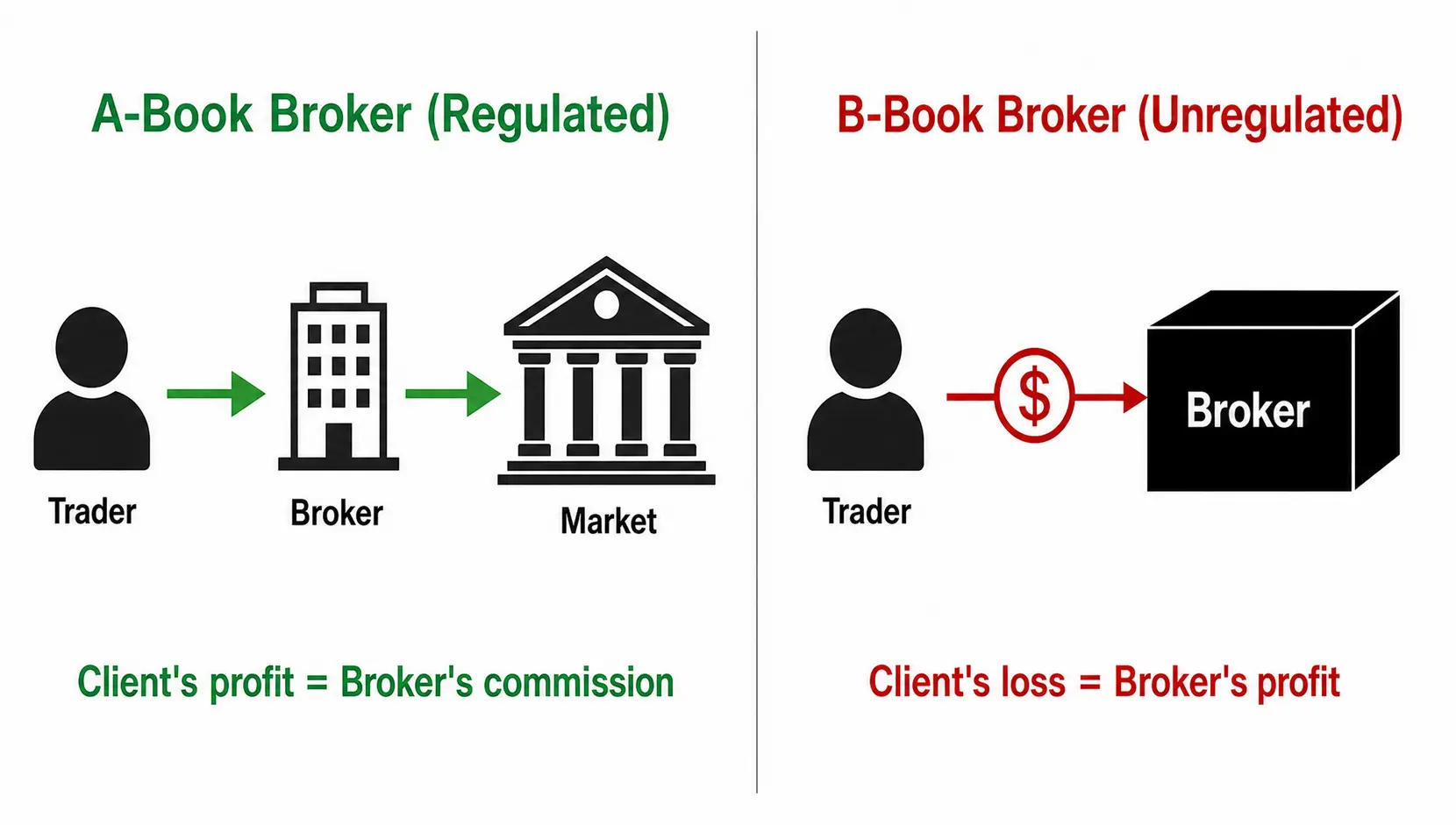
To understand the ‘why’, we must first differentiate between how brokers process orders. Reputable, regulated brokers typically operate on an ‘A-Book’ model.
They act as intermediaries, passing your trades directly to the interbank market or a liquidity provider. Their profit comes from the commission or a small, fixed mark-up on the spread.
In this model, they want you to succeed, as active, profitable traders generate more volume and, consequently, more commission revenue for the broker.
Conversely, many unregulated brokers operate a ‘B-Book’ or ‘Dealing Desk’ model. In this arrangement, the broker takes the other side of your trade.
They are your counterparty. When you buy, they sell to you; when you sell, they buy from you. Your position is never passed to the external market.
This creates a direct and severe conflict of interest. If you win a trade, the broker loses that amount from their own accounts.
If you lose, your loss is their direct profit. This is the primary incentive for them to engage in practices like stop-loss hunting—to ensure you lose.
The Difference Between Market Volatility and Intentional Manipulation
It is crucial to distinguish between genuine market movements and malicious manipulation. A sudden price swing during a major economic data release or a ‘flash crash’ caused by algorithmic trading is an example of systemic market volatility.
It affects all brokers and traders simultaneously. Think of it as a sudden, heavy rainstorm that drenches everyone in the street; it is impersonal and affects the entire market.
Intentional price manipulation is different. It is a localised event, specific to your broker’s platform. It’s like someone aiming a water hose directly at you while everyone else on the street remains dry.
If you see a long, sharp wick on your broker’s chart that triggers your stop, but that same wick does not appear on independent, third-party price feeds like TradingView or data from Reuters, you are likely witnessing manipulation, not natural market volatility.
3 Common Ways Unregulated Brokers Manipulate Charts
Summary Paragraph: Unscrupulous brokers typically employ three methods to hunt stops and generate artificial losses for their clients. These are creating artificial price spikes to clear out stop clusters, suddenly widening spreads to trigger orders prematurely, and using platform lag or slippage to prevent favourable exits. Recognising these tactics is the first step towards protection.
Technique 1: Artificial Spikes to Trigger Stop Clusters
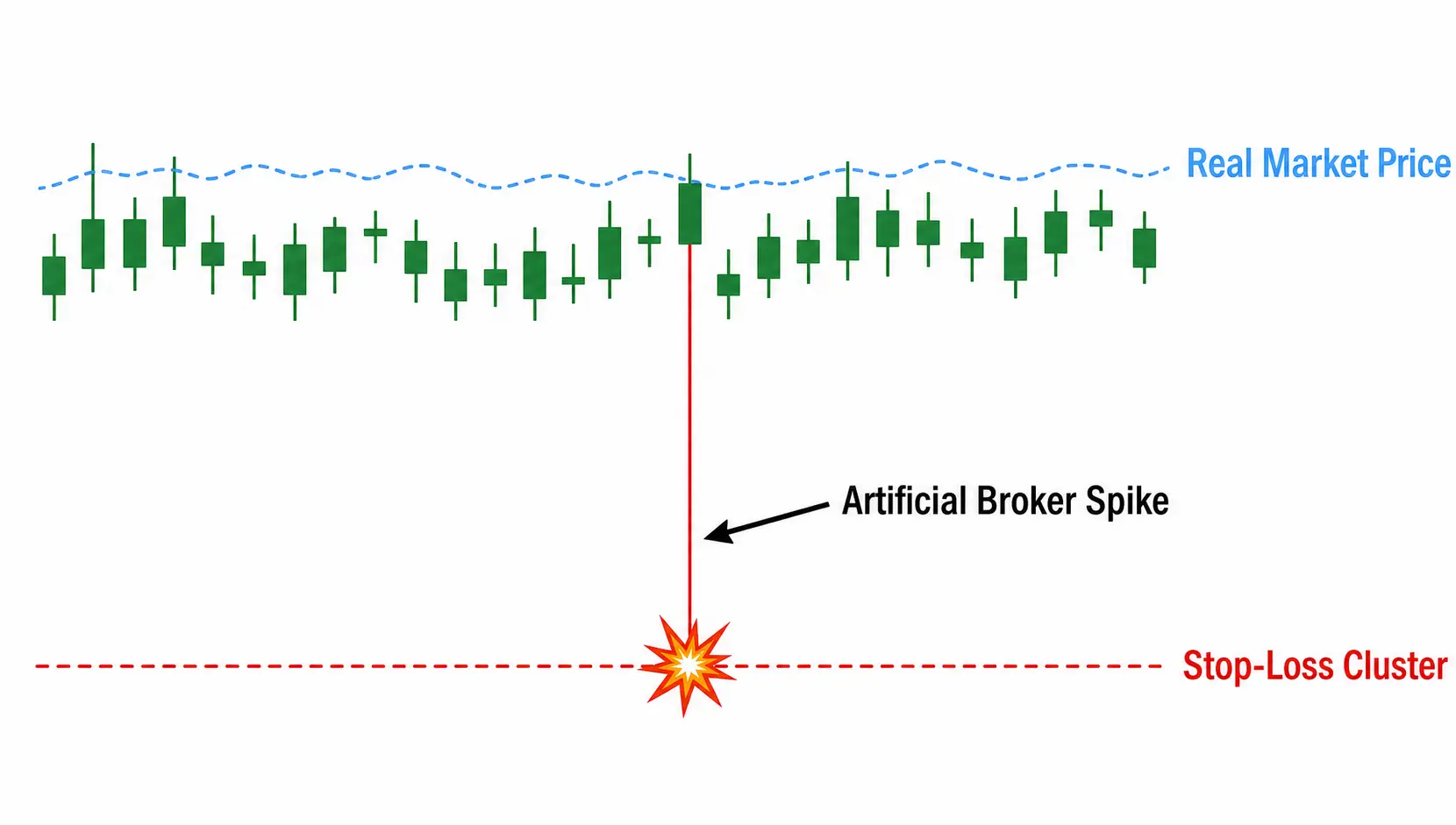
This is the most blatant form of stop hunting. Brokers know that traders tend to place stop-loss orders at predictable technical levels, such as just above a recent high, just below a recent low, or around significant round numbers (e.g., 1.10000 on EUR/USD).
The broker’s dealing desk software can see this concentration of orders—a ‘stop cluster’.
When the market price gets close to this level, the broker can introduce a momentary, artificial ‘spike’ in their price feed. This spike, often lasting less than a second, is just long enough to execute all the stop orders in the cluster.
Once the stops are triggered and the positions are closed at a loss (which is a profit for the B-Book broker), the price on their platform instantly snaps back to the true market price.
Traders are left with a closed trade and a bizarrely long candlewick on their chart as the only evidence.
Technique 2: Sudden Spread Widening
The spread is the difference between the buy (ask) price and the sell (bid) price. While spreads naturally widen during times of high volatility or low liquidity, unregulated brokers can artificially widen them at will to hunt stops.
Here’s how it works: Suppose you are in a ‘long’ (buy) position on GBP/USD and have a stop-loss order to sell if the price drops to 1.2550. Your stop-loss is a sell order, which is triggered by the broker’s bid price.
| Scenario | ‘Real’ Market Price | Broker’s Bid Price | Your Stop-Loss at 1.2550 |
|---|---|---|---|
| Normal Spread (1 Pip) | 1.25505 | 1.25500 | Triggered (Correctly) |
| Manipulated Spread (5 Pips) | 1.25530 | 1.25490 | Triggered (Prematurely) |
In the manipulated scenario, the actual market price never touched your stop-loss level. However, by artificially lowering their bid price, the broker was able to trigger your stop and close your position.
This is particularly effective for hunting stops on both sides of a consolidating market range.
Technique 3: Platform Lag and Slippage
This method is more subtle. An unregulated broker can manipulate the execution of your trades through engineered platform issues.
- Lag or Freezes: During fast-moving market events (like a central bank announcement), the platform may suddenly ‘freeze’. You cannot close a profitable trade, move your stop-loss, or take any action. By the time the platform responds, the price has moved significantly against you. The broker will blame this on ‘unprecedented volatility’.
- Excessive Slippage: Slippage is when your trade executes at a different price than the one you clicked. A small amount of slippage is normal in fast markets. However, unregulated brokers can systematically apply negative slippage to their clients. Your profitable take-profit orders might be filled with a few pips *less* profit, while your stop-loss orders are filled with a few pips *more* loss. These small amounts add up to significant profits for the broker over thousands of trades.
How to Defend Your Trades Against Price Manipulation
Pro Tip: Your most potent defence is proactive due diligence. Choosing a broker regulated by a top-tier authority is the single most effective step you can take to protect your funds from manipulation and fraud. This is non-negotiable for long-term financial safety.
The Ultimate Shield: Choosing a Reputable, Regulated Broker
From my perspective as a financial planner, this is the cornerstone of safe trading. A regulated broker is legally bound to adhere to strict standards of conduct designed to protect consumers.
Dealing with an unregulated entity is like entrusting your life savings to a stranger with no name and no address.
Key features of top-tier regulation include:
- Segregated Client Funds: Regulators like the UK’s Financial Conduct Authority (FCA) mandate that brokers must keep client funds in separate bank accounts from their own operational capital. This means the broker cannot use your money to run their business, and your funds are protected if the broker becomes insolvent.
- Fair Execution and Price Audits: Regulated brokers must demonstrate that their pricing is fair and reflects the true underlying market. They are often subject to external audits to prevent price manipulation.
- Dispute Resolution: If you have a dispute with a regulated broker, you have access to an independent ombudsman or complaints service. This provides you with real legal recourse.
- Offshore Warning: Be extremely wary of brokers ‘regulated’ in offshore jurisdictions like St. Vincent and the Grenadines. These are often just business registration centres. The St. Vincent and the Grenadines Financial Intelligence Unit has publicly stated that it does not regulate Forex trading. An ‘SVG-regulated’ broker is, for all intents and purposes, unregulated.
| Feature | Tier-1 Regulated Broker (e.g., FCA, ASIC) | Unregulated / Offshore Broker |
|---|---|---|
| Client Fund Safety | Held in segregated accounts; often insured. | Co-mingled with company funds; high risk of loss. |
| Price Feed Integrity | Audited and must be fair and transparent. | Can be manipulated at the broker’s discretion. |
| Dispute Resolution | Access to an independent financial ombudsman. | No recourse; the broker’s decision is final. |
| Negative Balance Protection | Often legally required, protecting you from debts. | Not guaranteed; you could lose more than your deposit. |
How to Compare Your Broker’s Chart with Third-Party Data Feeds
This is a practical step every trader should take, regardless of their broker. Use a reliable, independent charting platform to cross-reference prices.
TradingView is an excellent industry-standard tool for this, as it aggregates price data from multiple sources.
Here is a simple verification process:
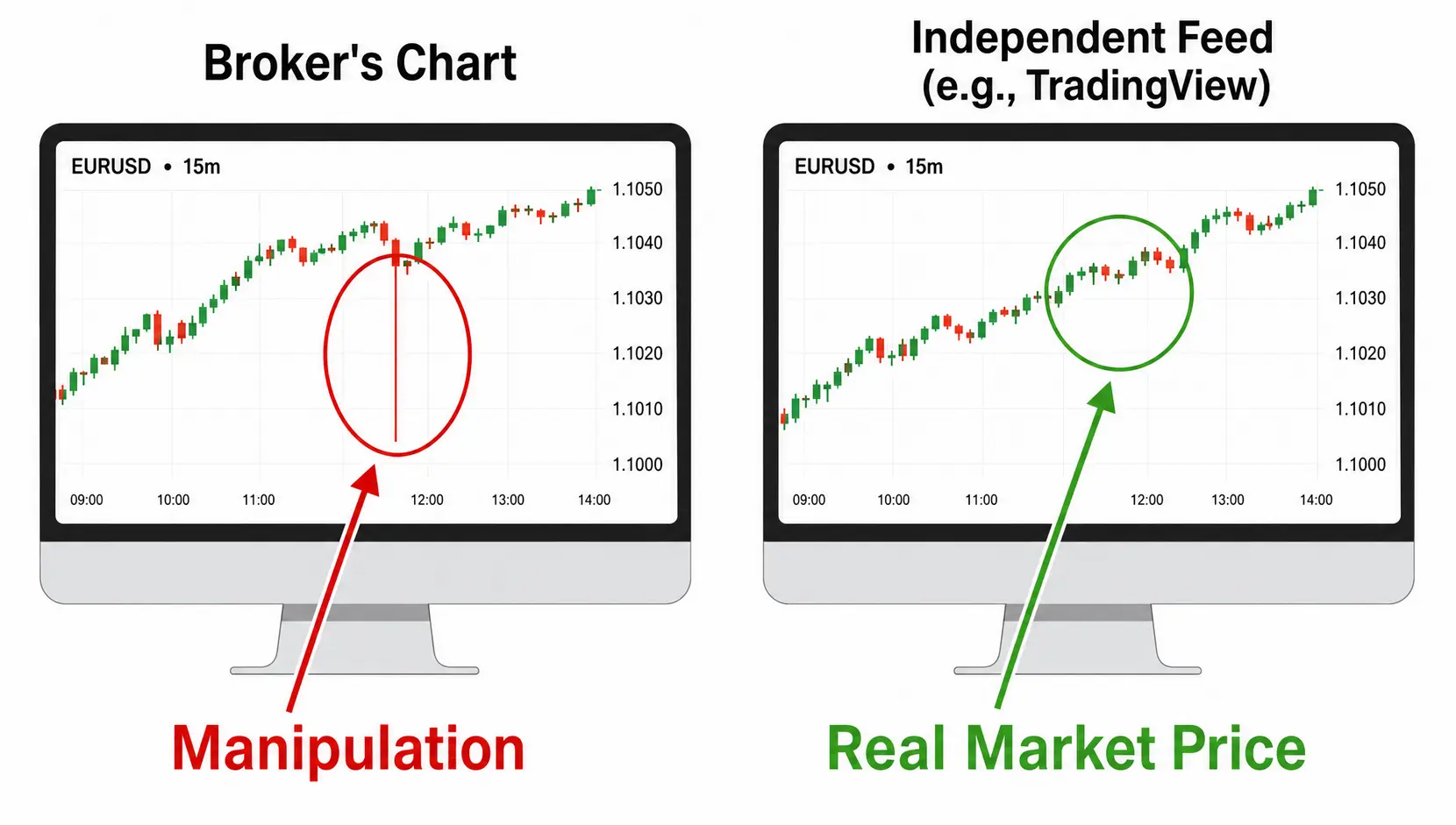
- Open your broker’s trading platform and the chart for your chosen asset (e.g., EUR/USD).
- Open the same asset on TradingView on the same timeframe.
- After a volatile session or if you suspect a stop-hunt, compare the candle wicks (the highs and lows).
- If you notice a significant price spike or drop on your broker’s chart that is completely absent on the TradingView chart, take a screenshot immediately. This is strong evidence of a price feed anomaly that warrants an explanation.
Frequently Asked Questions
1. Can regulated brokers also manipulate prices?
While no system is perfect, it is extremely unlikely and commercially irrational for a broker regulated by a top-tier authority like the FCA or ASIC to manipulate prices.
The regulatory framework includes frequent, rigorous audits and the threat of severe penalties, including multi-million-pound fines and, most critically, the revocation of their operating license.
The reputational damage and legal consequences far outweigh any potential short-term gain from manipulating trades. The core purpose of this regulation is to make such behaviour too costly to contemplate.
2. How can I prove that my broker hunted my stop loss?
Proving stop-loss hunting can be challenging, which is why prevention by choosing a good broker is paramount. However, if you suspect it, you must build a case.
First, gather evidence: take screenshots of your broker’s platform showing the anomalous price spike and your closed trade record.
Second, take corresponding screenshots from at least two independent data feeds (like TradingView and another reputable broker’s demo account) showing the price for the exact same moment. If your broker’s price deviates significantly, you have a strong starting point.
You can then submit this evidence to the broker for an explanation and, if their response is unsatisfactory, file a formal complaint with their regulatory body.
3. What is a better alternative to a standard stop-loss order?
As a financial planner, I must stress that trading without a stop-loss is not a viable alternative; it is a recipe for catastrophic loss.
However, you can be smarter about placement. Instead of placing stops at obvious levels where clusters form, consider using a volatility-based stop, such as one based on the Average True Range (ATR) indicator.
Placing your stop at a multiple of the ATR below your entry can help it survive random market noise.
Another advanced, but complex, strategy is hedging with options, but this is not suitable for beginners and requires a deep understanding of derivatives.
David Lim’s Final Thoughts
Sources & Methodology
David Lim strictly relies on primary regulatory data and authoritative official information to ensure accuracy. Data cited in this guide is sourced from:
- UK Financial Conduct Authority (FCA) – For regulatory standards and broker verification.
- Securities Commission Malaysia (SC) – Investor Alert List.
- Bank Negara Malaysia (BNM) – For financial consumer alerts and guidance.
- St. Vincent & The Grenadines Financial Intelligence Unit – Advisory on lack of Forex regulation.
- TradingView – For independent, third-party price data verification.
*Disclaimer: The content of this article represents the personal views of the author (David Lim) and is for educational and reference purposes only. It does not constitute professional investment or financial advice. Trading and investing involve significant risk; proceed with caution.*
