
As someone who’s been navigating the Forex and CFD markets for over a decade, I’ve seen my fair share of storms, from the Swiss Franc tsunami in 2015 to the COVID-induced chaos of 2020.
But a new, more insidious threat has emerged, not in the market charts, but on social media feeds. I’m talking about the explosion of counterfeit success stories.
This guide will teach you how to spot fake trading profit screenshots on social media, a skill as crucial as setting a stop-loss.
We’ll move beyond simple observations and focus on identifying visual inconsistencies in screenshots and recognizing scam tactics with fake proofs. In this game, your first line of defence isn’t capital; it’s scepticism.
Analyzing the Image: Telltale Signs of a Fake Screenshot
Pro Tip: Before you even consider the profit figures, become a digital forensic analyst. The easiest tells of a doctored image are almost always in the static details. Scammers focus on faking the money, often neglecting the container it’s presented in. A keen eye can dismantle their entire fabrication by spotting flaws in fonts, logos, and basic alignment.
The foundation of a convincing fake is a perfect replica of a genuine trading platform’s interface, like MetaTrader 4/5 or a broker’s proprietary app. However, creating a pixel-perfect duplicate is incredibly difficult.
This is where we, as discerning traders, have the upper hand.
Mismatched Fonts, Spacing, and Logos
Trading platforms are professionally developed software. Their user interface (UI) is built with consistency. Every font, every pixel of spacing, and every logo is uniform.
A doctored screenshot often falls apart under this scrutiny.
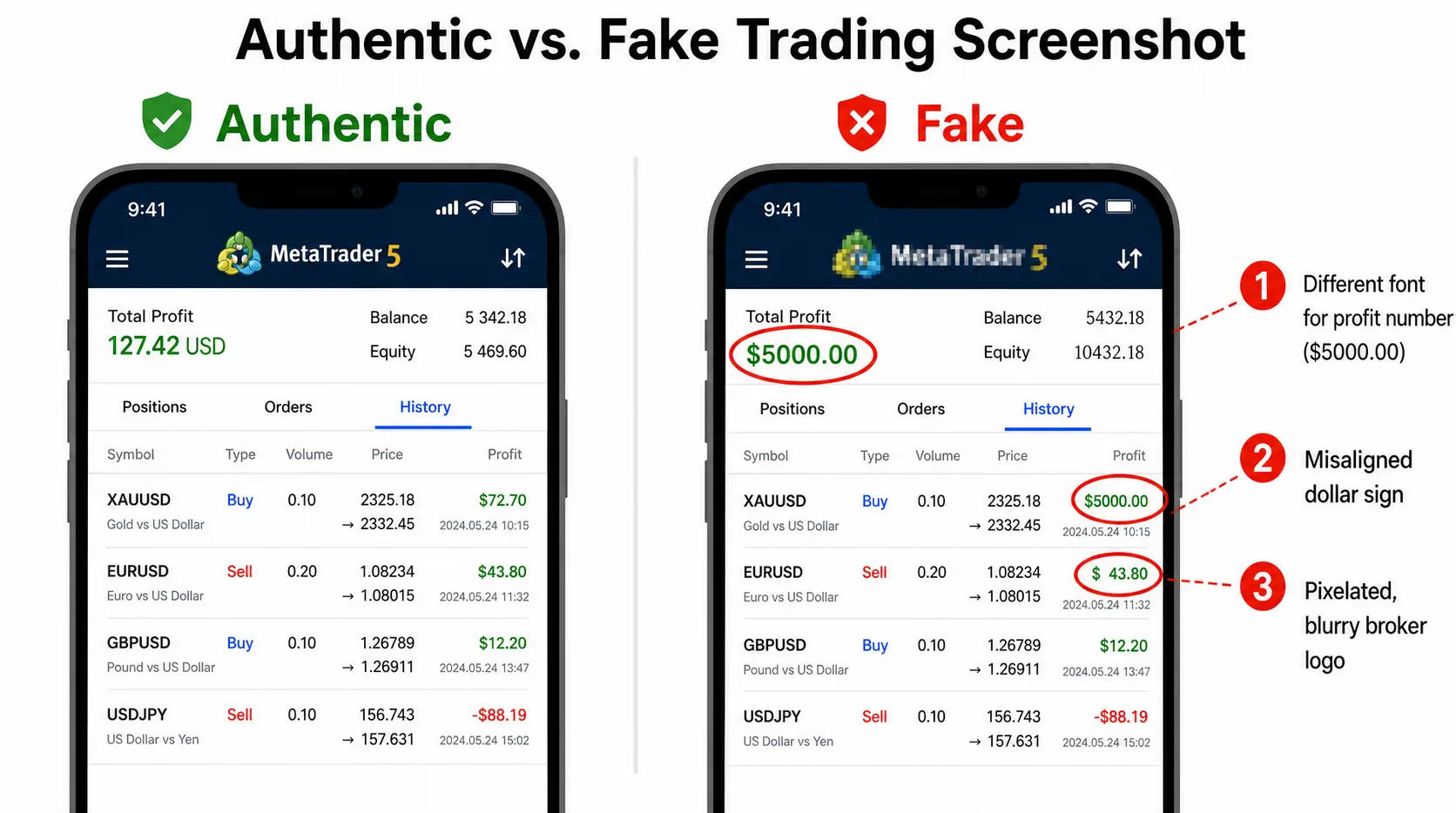
- Font Inconsistencies: Look closely at the numbers and text. Does the font for the ‘Profit’ column match the font used for the ‘Open Price’ or ‘Commission’? Scammers often use image editing software like Photoshop, and unless they have the exact font file and settings, they’ll use a close-but-not-perfect substitute. Pay special attention to characters like ‘4’, ‘7’, and the spacing between digits.
- Alignment Errors: In a real trading terminal, numbers in a column are perfectly aligned, either to the right or by the decimal point. Are the numbers in the profit column slightly out of alignment? Do the currency symbols (£, $) line up exactly? A few pixels of difference is a monumental red flag.
- Logo Imperfections: Broker logos or platform icons are often poorly copied. They might appear pixelated, stretched, or have a slightly different colour hue. A genuine application will render these assets cleanly.
Unrealistically Perfect or Repeated Numbers
The market is a chaotic environment; the numbers it produces are rarely clean. Real trading involves spreads, slippage, and commissions, leading to profits or losses that are almost never round numbers.
- The ‘Round Number’ Fallacy: A closed trade showing a profit of exactly £5,000.00 is statistically improbable. A real figure would look more like £4,987.62 or £5,012.19. This is due to the bid-ask spread—the difference between the price you can buy at and the price you can sell at. This inherent transaction cost makes landing on a perfectly round number a near impossibility.
- Implausible Consistency: A trading history showing a long list of trades all closing with profits of £100, £200, £100, £200 is a work of fiction. Market volatility ensures that even with a consistent strategy and lot size, the exact profit per trade will vary.
- Ignoring Costs: Many fake screenshots conveniently omit columns for swaps, commissions, or taxes. A profitable account statement must show these deductions. If all you see is a gross profit figure, you are not seeing the full, honest picture.
| Characteristic | Authentic Screenshot | Fake Screenshot |
|---|---|---|
| Profit Figures | Irregular and specific (e.g., £1,245.87, -£310.44) | Often round numbers (e.g., £1,000.00) or overly consistent patterns. |
| Fonts & Spacing | Consistent, crisp, and perfectly aligned as per the platform’s UI. | Mismatched fonts, blurry text, uneven spacing, misaligned columns. |
| Transaction Details | Includes commissions, swaps, and other costs. Shows both winning and losing trades. | Often omits costs. May only show an impossibly long streak of winning trades. |
| Platform Elements | High-quality, official logos. All UI elements (buttons, tabs) are sharp. | Pixelated or distorted logos. UI elements may look ‘flat’ or copied. |
Beyond the Screenshot: Contextual Red Flags of Social Media Scams
Pro Tip: A screenshot never exists in a vacuum. It is a piece of marketing material. The most critical analysis is not of the image itself, but of the narrative and intent behind the person posting it. Legitimate professionals discuss process and risk; scammers sell dreams and urgency.
Even a technically perfect screenshot can be a tool for deception. You must analyse the context in which it’s presented. The surrounding social media post, the profile’s history, and the promises being made are often more revealing than the image itself.
Promises of ‘Guaranteed’ or Astronomical Profits
This is the most significant and non-negotiable red flag. In financial markets, there is no such thing as a ‘guaranteed’ profit. Anyone who tells you otherwise is either a fool or a liar, and you should not entrust your money to either.
Look for phrases like:
- ‘Risk-free returns’
- ‘10% profit daily, guaranteed’
- ‘Join my signal group and never lose again’
These are not the words of a trader; they are the words of a scam artist preying on greed and financial desperation.
High-Pressure Tactics and Urgency
Scammers create a false sense of urgency to prevent you from conducting due diligence. They want you to act on emotion (fear of missing out) rather than logic.
- ‘Limited Spots Available’: A common tactic to create artificial scarcity. A legitimate fund or mentorship programme has a structured onboarding process, not a frantic first-come, first-served rush.
- ‘Offer Ends Tonight!’: Urgency is a sales tactic designed to bypass your rational brain. Serious financial decisions should never be rushed.
- Aggressive ‘DM for info’ Culture: They push the conversation into private messages to isolate you. This is where the high-pressure sales pitch begins, away from public scrutiny. A transparent professional is willing to have open discussions.
Common Scams That Use Fake Profit Screenshots as Bait
Pro Tip: The screenshot is just the lure. The real danger is the trap it leads to. Understanding the common fraud models that use these fakes will help you recognise the danger long before you’re asked for any money. The two dominant types are relationship-based fraud and deceptive self-promotion.
Fake profit screenshots are the billboard advertising a fraudulent enterprise. They are designed to get you ‘in the door’. Once they have your attention, they deploy well-established scam methodologies.
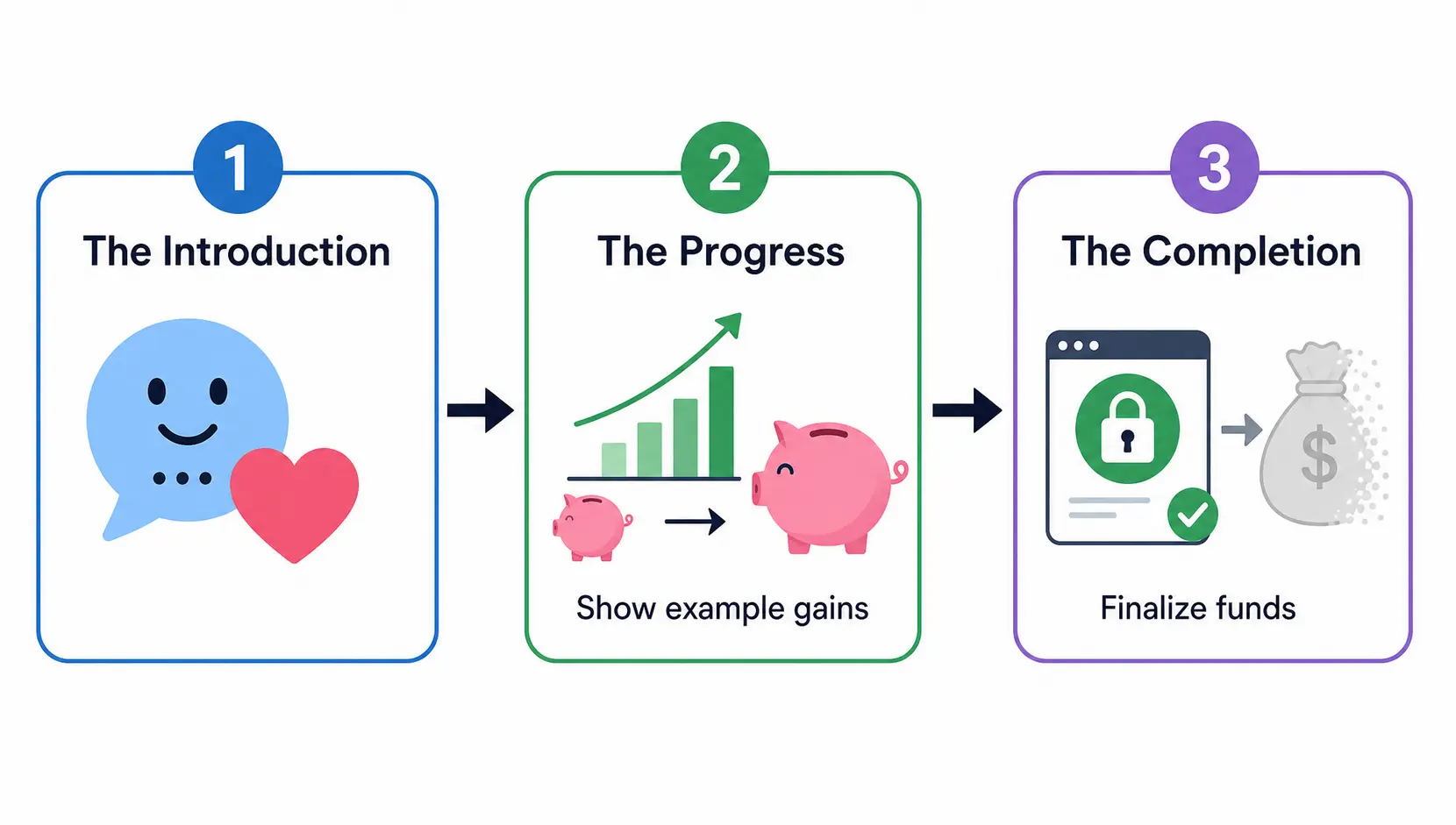
The ‘Pig Butchering’ Investment Scam
This is a particularly cruel and sophisticated scam, known in Chinese as ‘Sha Zhu Pan’ (殺豬盤). It combines investment fraud with romance or friendship grooming.
- The Lure: Scammers create fake profiles on social media or dating apps, often using stolen photos. They initiate contact and spend weeks or months building a relationship and gaining your trust.
- The ‘Fattening’: They will casually post fake profit screenshots, claiming to have a secret trading method or an ‘uncle’ who is a supposed trading genius. They are ‘fattening the pig’ – building your confidence and curiosity.
- The ‘Slaughter’: They convince you to ‘invest’ on a fraudulent trading platform that they control. Initially, they will show you massive profits on your small investment to encourage a larger deposit. Once you’ve deposited a significant amount, they will freeze the account and disappear with your money.
Fake Gurus Selling Worthless Courses
This is a more common, lower-level scam. The goal isn’t to steal your investment capital directly but to sell you an overpriced, useless product based on a false premise of success.
- The Facade: The ‘guru’ relentlessly posts fake screenshots, photos of rented luxury cars, and exotic holidays to create a lifestyle that you will aspire to. This is their marketing.
- The Product: They sell a ‘mastery’ course or ‘exclusive’ signal group for thousands of pounds. The content is almost always generic information you could find for free online, such as basic candlestick patterns or support/resistance theory.
- The Catch: The strategy they teach does not lead to the results shown in their screenshots because those results were never real. When you fail, they will blame your mindset or tell you to buy their ‘advanced’ course.
| Scam Type | Primary Goal | Method of Operation | How Screenshots are Used |
|---|---|---|---|
| Pig Butchering Scam | To steal your investment capital directly. | Builds personal trust over time, then directs you to a fraudulent trading platform. | As ‘proof’ of their personal trading success to build your confidence in their method. |
| Fake Guru Course | To sell you an overpriced, low-value educational product. | Creates an aspirational lifestyle brand on social media to attract customers. | As marketing material to ‘prove’ their strategy works and justify the course price. |
Frequently Asked Questions
1. Why do scammers create fake profit screenshots?
It’s pure psychological warfare. These screenshots are designed to trigger powerful emotions like greed, hope, and the fear of missing out (FOMO). They serve as a powerful ‘proof’ that bypasses logical scrutiny and makes their claims of easy wealth seem tangible.
For the scammer, it’s a low-effort, high-impact tool to attract victims for their larger fraud, whether it’s selling a course or stealing investment funds directly.
2. What should I do if I suspect a profile is a scam?
First, do not engage. Do not send them money or any personal information. Your next steps should be to Report, Block, and Verify. Report the profile to the social media platform immediately. Block them to cease all communication.
Then, if they claimed to represent a legitimate company, contact that company through its official channels to verify.
You should also check the investor alert lists from your local regulator, such as the Securities Commission Malaysia’s Investor Alert List or the FCA’s warning list in the UK.
3. Are there any legitimate traders showing profits on social media?
Yes, but they are qualitatively different from the scammers. A legitimate professional who shares results does so with context.
They talk about their strategy, the risks involved, the drawdown they experienced, and their overall performance over a long period—not just a few cherry-picked wins.
They often use verified third-party services like MyFXBook to track their performance transparently. Crucially, their focus is on education and process, not on selling a dream lifestyle.
4. How can I verify if a broker or financial advisor is legitimate?
Never trust a link sent to you by a stranger. Always go directly to the official regulatory databases. In the United States, use FINRA’s BrokerCheck. In the United Kingdom, use the FCA’s Financial Services Register.
These free tools allow you to check the registration status and history of firms and individuals, providing a critical layer of protection against fraud.
Danny’s Final Thoughts
Sources & Methodology
Danny strictly relies on primary regulatory data and authoritative official information to ensure accuracy. Data cited in this guide is sourced from:
*Disclaimer: The content of this article represents the personal views of the author (Danny) and is for educational and reference purposes only. It does not constitute professional investment or financial advice. Trading and investing involve significant risk; proceed with caution.*
