

As a trader who has navigated the markets for over a decade, I’ve seen many aspiring individuals jump into derivatives without a clear map.
The debate of CFD vs Futures vs Options is not just academic; choosing the wrong instrument for your strategy is like taking a knife to a gunfight. It’s a costly mistake.
This guide will provide a clear, no-nonsense breakdown of these three powerful instruments, exploring the key differences between cfd futures and options and helping you decide which is the right fit for your capital and risk appetite.
We will dissect everything from ownership and leverage to the pros and cons of trading each, ensuring you make an informed decision, not a gamble.
What are CFDs, Futures, and Options? A Quick Introduction
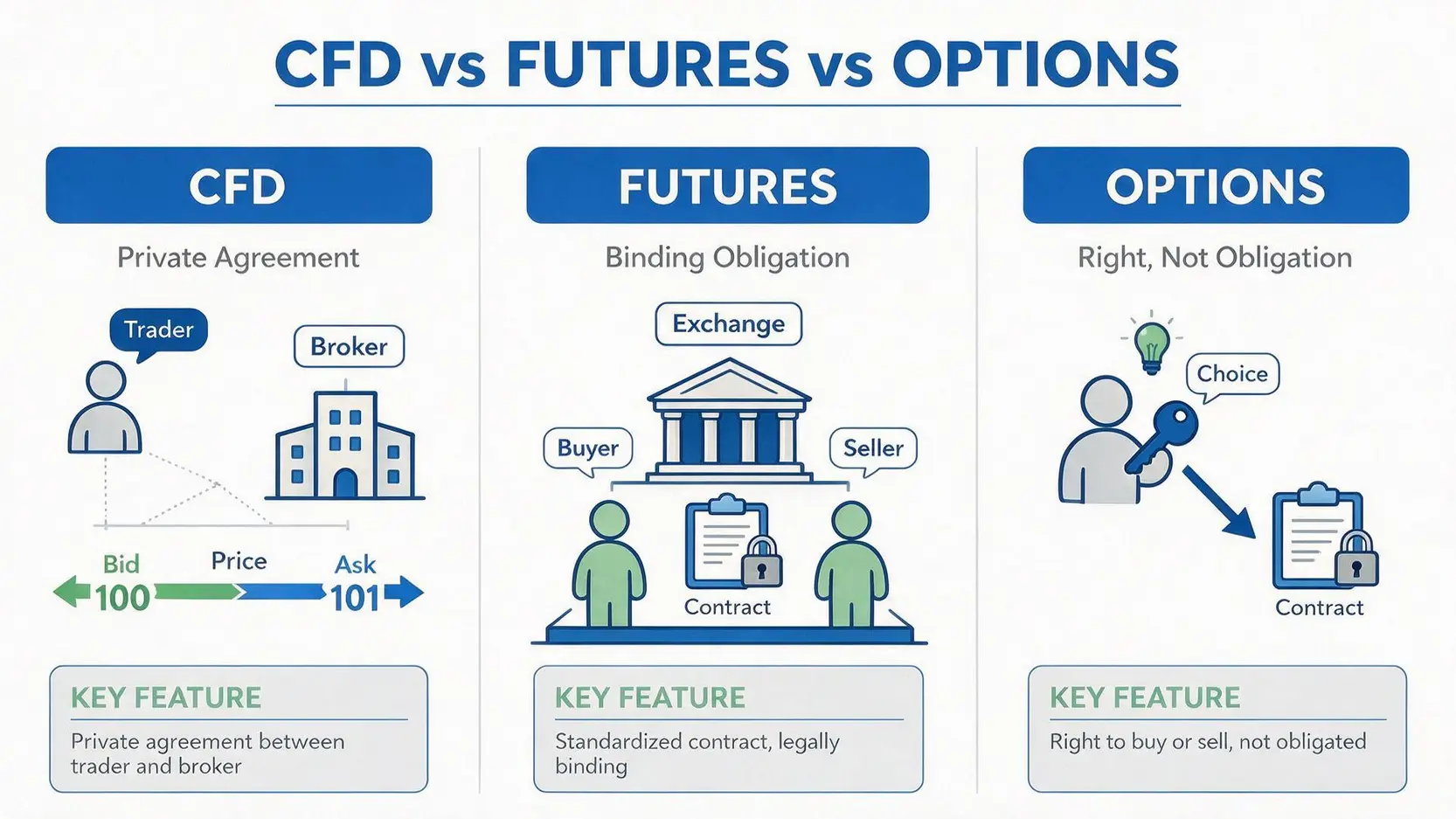
Pro Tip: At their core, all three are derivatives, meaning their value is derived from an underlying asset. The fundamental difference lies in the nature of the contract: CFDs are a private agreement with a broker, Futures are a standardised obligation to transact, and Options are a right, but not an obligation, to transact.
Before we dive deep into a head-to-head comparison, it’s crucial to understand the basic mechanics of each instrument. Getting this wrong is the first step to a blown account. Let’s break them down one by one.
Understanding Contracts for Difference (CFDs)
A Contract for Difference, or CFD, is a private financial agreement between you and your broker. You are essentially speculating on the price movement of an underlying asset without ever owning it.
If you believe the asset’s price will rise, you go long (buy). If you believe it will fall, you go short (sell). Your profit or loss is the difference between the asset’s price when you open the contract and when you close it.
Because you’re trading with a broker in an Over-The-Counter (OTC) market, CFD contracts are not standardised. This means contract sizes can be very flexible, from micro-lots to standard lots, which is appealing for traders with smaller capital.
However, it also means your primary counterparty is your broker, making broker selection paramount.
Understanding Futures Contracts
A futures contract is a legally binding, standardised agreement to buy or sell a specific quantity of an underlying asset at a predetermined price on a specified date in the future.
These contracts are traded on centralised, regulated exchanges, like the CME Group or Bursa Malaysia Derivatives.
Unlike CFDs, futures contracts involve an obligation. If you buy a crude oil futures contract, you are obligated to take delivery of that oil at expiry unless you close your position beforehand.
Likewise, if you sell, you are obligated to deliver. In practice, most speculative traders close their positions before the expiry date to realise a profit or loss without dealing with the physical asset.
The standardisation of futures contracts (in terms of quantity, quality, and delivery date) is what ensures liquidity and transparent pricing on the exchange. This is a stark contrast to the OTC nature of CFDs.
Understanding Options Contracts
An options contract offers the most strategic flexibility. It gives the buyer the right, but not the obligation, to buy (a ‘call’ option) or sell (a ‘put’ option) an underlying asset at a specified price (the ‘strike price’) on or before a certain date (the ‘expiry date’).
To acquire this right, the buyer pays a ‘premium’ to the seller (or ‘writer’) of the option.
This is the critical distinction: with options, the buyer’s maximum potential loss is limited to the premium paid for the contract.
For the seller, however, the potential loss can be unlimited if the market moves against their position, especially when writing ‘naked’ calls.
Options can be used for a wide array of strategies, from simple directional speculation (like buying a call if you’re bullish) to complex, multi-leg strategies designed to profit from time decay, volatility changes, or specific price ranges.
This makes them a powerful tool for both speculation and sophisticated risk management.
Key Differences: CFD vs Futures vs Options for Traders
Pro Tip: The quickest way to differentiate them is by asking: Do I own anything? (No for all). Is it an obligation or a choice? (Obligation for Futures, choice for Options buyers, a simple price bet for CFDs). Where is it traded? (Exchange for Futures/Options, Broker for CFDs).
Understanding the nuances between these derivatives is vital. A trader’s success often hinges on selecting the right tool for the job. Let’s dissect their core attributes in a comparative table.
| Feature | Contracts for Difference (CFDs) | Futures Contracts | Options Contracts |
|---|---|---|---|
| Ownership of Underlying Asset | None. It’s a contract on the price movement. | None, but entails an obligation for future delivery. Physical settlement is possible but rare for speculators. | None. The contract confers the right, not ownership. Can be exercised to acquire the underlying asset. |
| Contract Expiration | Typically no fixed expiry date (except for forward CFDs). Positions can be held as long as margin is maintained. | Yes. Standardised expiry dates (e.g., monthly, quarterly). Positions must be closed or rolled over. | Yes. Standardised expiry dates. The option’s value decays over time (theta decay). |
| Contract Standardization | Not standardised. Contract size and terms are set by the broker. | Highly standardised. Contract size, quality, and expiry are fixed by the exchange. | Highly standardised. Contract size (e.g., 100 shares per contract), strike prices, and expiry are fixed by the exchange. |
| Leverage & Margin | High leverage offered by brokers, leading to lower initial margin but higher risk of margin calls. | Lower leverage compared to CFDs. Requires a higher initial margin (performance bond). Marked-to-market daily. | In-built leverage effect. The cost (premium) is a fraction of the underlying asset’s value. No margin calls for buyers. |
| Market Regulation | Over-the-Counter (OTC). Regulated at the broker level by authorities like the FCA in the UK or ASIC in Australia. Not available in the US. | Exchange-traded. Highly regulated, transparent central marketplace (e.g., CME, Eurex, Bursa Malaysia). | Exchange-traded. Highly regulated with central clearing, providing transparency and reducing counterparty risk. |
Ownership of the Underlying Asset
With all three instruments, you are trading a derivative, not the asset itself. You do not own the share of Apple or the barrel of oil. However, the nature of your claim differs. A CFD is a simple cash-settled bet on price.
A futures contract is a step closer, representing a binding commitment to a future transaction of the asset. An option is a contingent claim; it’s a potential transaction that you have the choice to execute.
Contract Expiration and Standardization
This is a major divergence. Most CFDs (spot CFDs) do not expire; you can hold a position indefinitely, though you will incur overnight financing fees (swaps).
This is attractive for some, but can be a trap. Futures and options, being exchange-traded, have rigid, standardised expiry cycles. This forces a trader to have a time-bound thesis.
For options, this time decay, known as ‘theta’, is a critical factor that traders must manage. The value of an option erodes every single day, a concept many beginners fail to grasp.
Leverage, Margin, and Overall Cost
All three offer leverage, but in different forms. CFDs are known for very high leverage, allowing traders to control a large position with a small amount of capital. This magnifies both profits and losses.
Futures also use leverage but typically require a larger good-faith deposit, known as a performance bond or margin. Positions are ‘marked-to-market’ daily, meaning profits or losses are settled from your margin account each day.
Options provide a unique form of leverage. The premium you pay to buy an option is all you can lose.
Yet, this small premium can control a large amount of the underlying asset (e.g., 100 shares), offering asymmetric risk-reward profiles that are impossible with CFDs or futures.
Market Regulation and Transparency
Futures and options are traded on public, heavily regulated exchanges. This provides a high degree of transparency in pricing and volume. All participants see the same bid/ask prices.
CFDs are traded ‘Over-The-Counter’ (OTC). Your trade is with your broker, not a central exchange.
While reputable brokers are regulated by bodies like the UK’s Financial Conduct Authority (FCA) or the Securities Commission Malaysia, the pricing can be less transparent than on an exchange, and you are exposed to your broker’s specific counterparty risk.
Pros and Cons: Which Instrument Fits Your Trading Style?
Pro Tip: There is no ‘best’ instrument, only the ‘most suitable’ for your specific goal. A short-term forex speculator, a long-term commodity hedger, and a volatility strategist will each find a different instrument to be superior for their needs.
Every tool has its purpose. Using a hammer to turn a screw is inefficient and damaging. The same logic applies to trading. Let’s evaluate the strengths and weaknesses of each from a practical standpoint.
| Instrument | Advantages | Disadvantages |
|---|---|---|
| CFDs | High flexibility (small contract sizes), wide range of markets from a single platform, no expiry dates (for spot), ability to go long or short easily. | High leverage leads to high risk, potential for broker conflict of interest (OTC market), overnight financing costs can accumulate, not available in some jurisdictions (e.g., USA). |
| Futures | High transparency and liquidity, traded on regulated exchanges, central clearing reduces counterparty risk, excellent for hedging large positions. | Large, standardised contract sizes require significant capital, fixed expiry dates create time pressure, physical delivery obligation exists (though rarely taken by speculators). |
| Options | Defined risk for buyers (premium), immense strategic flexibility (hedging, income, speculation), ability to profit from various market conditions (up, down, or sideways). | Complex (many ‘Greeks’ to understand), time decay (theta) is a constant headwind for buyers, unlimited risk for naked sellers, spreads can be wide on less liquid contracts. |
The Advantages and Disadvantages of CFDs
The primary draw of CFDs is their accessibility and flexibility. A new trader can open an account with a relatively small deposit and gain exposure to thousands of markets—Forex, indices, commodities, and stocks—all from one interface.
The ability to trade in micro-lots means you can fine-tune your position size to a degree not possible with futures. However, this ease of access is their biggest danger.
The high leverage offered can wipe out an account with a small adverse price move. Furthermore, the overnight swap fees can eat into profits on long-term positions, making them primarily suitable for short-term trading.
The Advantages and Disadvantages of Futures
The strengths of futures lie in their structure and transparency. Trading on an exchange like CME Group means you are part of a level playing field. Pricing is determined by supply and demand in a central order book.
This makes them the preferred vehicle for institutions and professional traders who need to hedge large-scale price risk. The main barrier for retail traders is the capital requirement.
A single futures contract can have a notional value in the tens or hundreds of thousands of dollars, demanding a substantial margin deposit.
The Advantages and Disadvantages of Options
Options are the ultimate strategic tool. For a buyer, they offer a pre-defined, limited risk exposure with the potential for outsized returns.
This asymmetric payoff is unique. They can be used to generate income (e.g., selling covered calls), hedge an existing stock portfolio (e.g., buying puts), or speculate on volatility.
The downside is their complexity. Understanding concepts like Implied Volatility, Delta, Gamma, and Theta is not optional; it’s essential for survival.
This complexity creates a steep learning curve that can be daunting for beginners.
Which Instrument Should You Choose? A Practical Guide for Traders
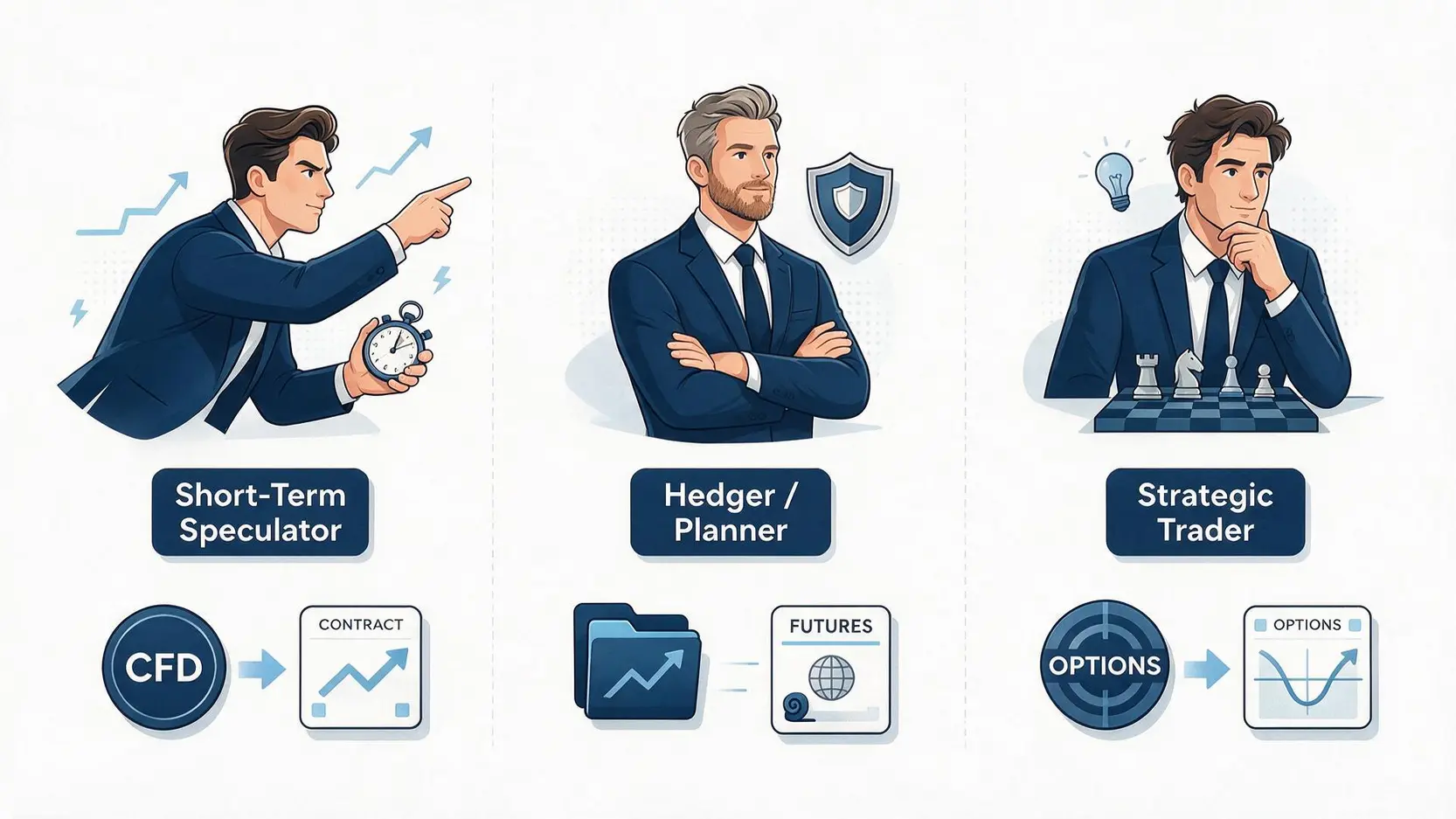
Pro Tip: Match the instrument to your timeframe and objective. Short-term speculation on price direction often points to CFDs. Long-term price-locking for a commodity points to Futures. Strategic, risk-defined bets with flexibility point to Options.
After years in the trenches, I’ve learned that theory is useless without application. Let’s simulate some common trader profiles and see which instrument aligns best.
Best for Short-Term Speculators: CFDs
If your strategy involves intra-day or swing trading over a few days, focusing on popular markets like EUR/USD, Gold, or the S&P 500 index, CFDs are often the most efficient choice.
The low capital entry, flexible position sizing, and the absence of a looming expiry date allow you to focus purely on price action. You can enter and exit the market quickly with minimal friction.
However, this is only true if you are disciplined with your risk management. Using a stop-loss is not negotiable when trading with the high leverage inherent in CFDs.
Best for Hedgers and Long-Term Planners: Futures
Imagine you are a business owner who needs to purchase a large amount of copper in six months. You are worried the price will rise significantly by then.
By buying a copper futures contract today, you can lock in the purchase price. This is hedging. This is the primary, and most noble, purpose of the futures market.
Speculators can also use futures for long-term directional bets (months, not days), especially if they have the capital to handle the large contract sizes and margin requirements.
The transparency and regulation of the futures exchange provide the security needed for such large, long-term commitments.
Best for Strategic Flexibility and Risk Management: Options
If you have a more nuanced view of the market, options are your playground. For example, you might be bullish on a stock but want to protect your downside.
You could buy the stock and simultaneously buy a put option. This acts as an insurance policy. Or perhaps you believe a stock will trade within a specific range for the next month.
You could construct an ‘iron condor’ strategy to profit from this sideways movement and the passage of time.
The ability to define your risk (as an option buyer) and to craft strategies for any market outlook makes options the most versatile derivative. This versatility, however, demands the most homework.
Frequently Asked Questions
1. What is the simplest way to explain the difference between CFDs, futures, and options?
Think of it this way: A CFD is like betting on the score of a football match with a bookie. A Futures contract is like signing a binding agreement now to buy a season ticket for next year at today’s price.
An Option is like paying a small, non-refundable fee to reserve that season ticket, giving you the right—but not the obligation—to buy it at the agreed price later.
2. Are CFDs or Futures better for beginners?
From a risk-management perspective, neither is truly ‘beginner-friendly’. However, CFDs are often more accessible due to lower capital requirements and smaller, more flexible contract sizes. This allows a beginner to start with very small positions.
The danger is the high leverage, which can quickly lead to large losses. Futures require more capital and have a steeper learning curve regarding contract specifications.
My advice is to spend months on a demo account with either instrument before trading live capital, understanding that a demo account cannot replicate the psychological pressure of real trading.
3. Is it possible to lose more than your initial investment with all three?
Yes, but the risk differs. With CFDs and Futures, due to leverage, a rapid market move against your position can result in losses that exceed your initial margin deposit, leading to a negative account balance if your broker doesn’t offer negative balance protection.
For an Option buyer, the maximum loss is capped at the premium paid for the option; you can never lose more than your initial investment.
However, for an Option seller (writer), the risk is potentially unlimited, far exceeding the initial premium received. This is one of the greatest risks in all of derivatives trading.
4. Why are CFDs not allowed in the USA?
CFDs are traded Over-The-Counter (OTC) and are banned for retail traders in the United States by the Securities and Exchange Commission (SEC) and the Commodity Futures Trading Commission (CFTC).
The regulators have cited concerns over a lack of transparency and potential conflicts of interest inherent in the OTC model, preferring that leveraged products for retail traders be traded on regulated exchanges, like futures and options are.
Danny’s Final Thoughts
In my years of trading, the most important lesson has been one of survival. It’s not about the one spectacular win; it’s about managing risk so you can stay in the game long enough for your strategy to play out.
CFDs, futures, and options are all powerful tools, but they are unforgiving of ignorance. Don’t chase the leverage or the promise of quick profits.
Instead, focus on which instrument’s risk profile truly aligns with your trading plan, your capital, and your tolerance for pain.
The market doesn’t care about your hopes; it only responds to your strategy and discipline. Choose your tool wisely, respect the risk, and trade to trade another day.
Sources & Methodology
Danny strictly relies on primary regulatory data and authoritative official information to ensure accuracy. Data cited in this guide is sourced from:
- Investopedia: Understanding Contracts for Difference (CFDs)
- Investopedia: Futures Contracts Definition
- Investopedia: Options Contracts Explained
- Financial Conduct Authority (FCA): UK’s derivatives trading obligation
- Bursa Malaysia: Derivatives Market Products
- CME Group: Understanding the Role of Hedgers in Futures Markets
*Disclaimer: The content of this article represents the personal views of the author (Danny) and is for educational and reference purposes only. It does not constitute professional investment or financial advice. Trading and investing involve significant risk; proceed with caution.*
