

I’ve been trading for over a decade, and I’ve seen countless promising traders crash and burn. The reason is almost always the same: they get a few wins, become overconfident, and then take on a position so large it wipes out their entire account in a single bad trade.
If you want to survive, let alone profit, in this game, the very first thing you must master is not a fancy indicator or a secret strategy, but your risk. This is where a position sizing calculator becomes the most critical tool in your arsenal.
Understanding how to calculate your position size for any trade is the non-negotiable foundation of professional trading risk management. It’s the wall that stands between you and a margin call.
The Position Sizing Formula: A Step-by-Step Calculation Guide
Pro Tip: Before any trade, you must have three numbers: your total account equity, the percentage of that equity you’re willing to risk, and the price where you’ll cut your loss (your stop-loss). The formula combines these to tell you exactly how many units of an asset to buy or sell. Never enter a trade without this calculation.
The calculation itself is straightforward. The discipline required to stick to it is what separates amateurs from professionals. Let’s break it down into three clear, actionable steps.
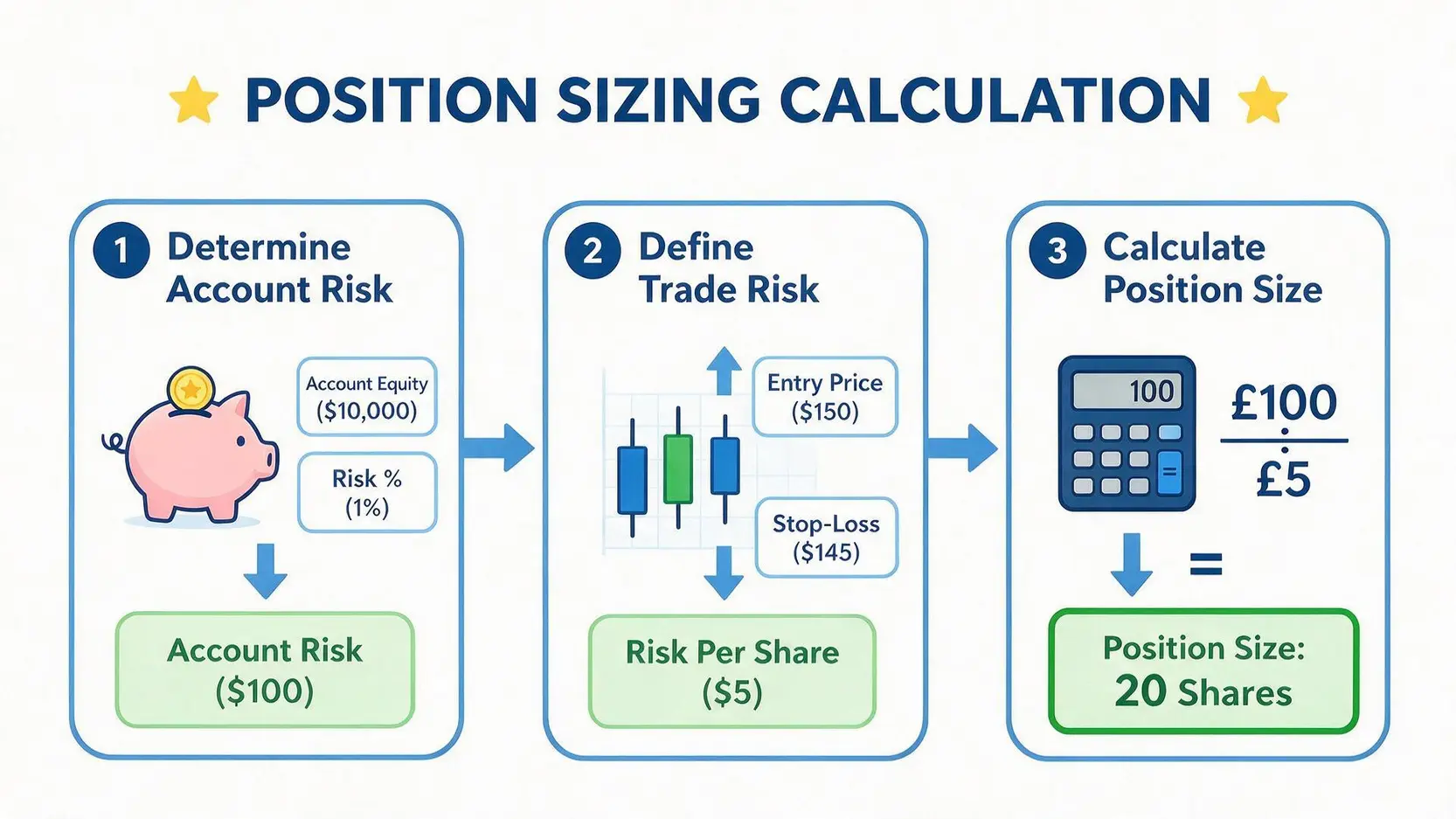
Step 1: Determine Your Account Risk (The 1-2% Rule)
The first variable is the most important: how much of your total trading capital are you willing to lose on this single idea? For a professional, the answer is almost always a small fraction.
The widely accepted standard is the 1% rule, where you risk no more than 1% of your account on any single trade. Some may stretch this to 2%, but I would strongly advise against it, especially if you are not consistently profitable.
Danny’s Insight: Think of this as your survival capital. If you have a £10,000 account and stick to a 1% rule, you would need to be wrong 100 times in a row to wipe out. Even a terrible strategy is unlikely to produce that result. However, risk 10%, and you’re only 10 losses away from zero. I’ve seen it happen faster than you can imagine.
So, for a £10,000 account, your maximum acceptable loss per trade is £100 (1% of £10,000). This figure is your starting point for the entire calculation. It is an absolute ceiling.
This concept is a cornerstone of capital preservation, a topic authoritative sources like Investopedia have covered in depth. You can read more about it in their guide to Risk Management Techniques for Active Traders.
Step 2: Define Your Trade Risk (Entry Price vs. Stop-Loss Price)
Your trade risk is the monetary value of the space between your entry price and your stop-loss price. A stop-loss is a pre-determined order to exit a trade at a specific price to cap your losses.
It is not an arbitrary number; it should be placed at a logical level based on your analysis of the market structure.
For example, if you are buying a stock, you might place your stop-loss just below a recent support level or a key moving average. The distance between your planned entry and this stop-loss level, measured in currency, determines the ‘per-share’ or ‘per-unit’ risk.
- For a stock: If you buy at £150 and set your stop-loss at £145, your trade risk is £5 per share.
- For Forex (e.g., GBP/USD): If you buy at 1.2550 and set your stop-loss at 1.2500, your trade risk is 50 pips.
Step 3: Calculate Position Size (Bringing It All Together)
Now you combine the figures from Step 1 and Step 2. The formula is:
Let’s use our stock example:
- Account Capital: £10,000
- Account Risk: 1% (which is £100)
- Stop-Loss Distance: £5 per share (£150 entry – £145 stop-loss)
Calculation: Position Size = £100 / £5 = 20 shares.
This is your answer. To adhere to your risk plan, you should buy exactly 20 shares. If the trade hits your stop-loss, you will lose £100 (£5 loss per share x 20 shares), which is precisely 1% of your account.
By using this formula, you have quantified your risk *before* entering the trade.
Why Position Sizing is the Cornerstone of Trading Risk Management
Pro Tip: Your entry and exit signals determine if a trade is profitable. Your position sizing determines if you stay in business long enough to find profitable trades. It is the single most critical element of a robust trading plan, transforming trading from a gamble into a calculated business.
Many traders obsess over finding the perfect entry, but they expose themselves to catastrophic risk by neglecting position size. A winning strategy with poor risk management will always fail eventually.
Conversely, a mediocre strategy with excellent risk management can survive and even thrive. The goal is to ensure no single trade can significantly harm your account.
Understanding the Key Variables: Account Capital, Risk Percentage, and Stop-Loss
These three variables work in a dynamic relationship. If you decide to use a wider stop-loss (increasing your trade risk), the position sizing formula will automatically force you to take a smaller position to keep the total risk at your pre-defined 1% level.
This inverse relationship is crucial for maintaining discipline.
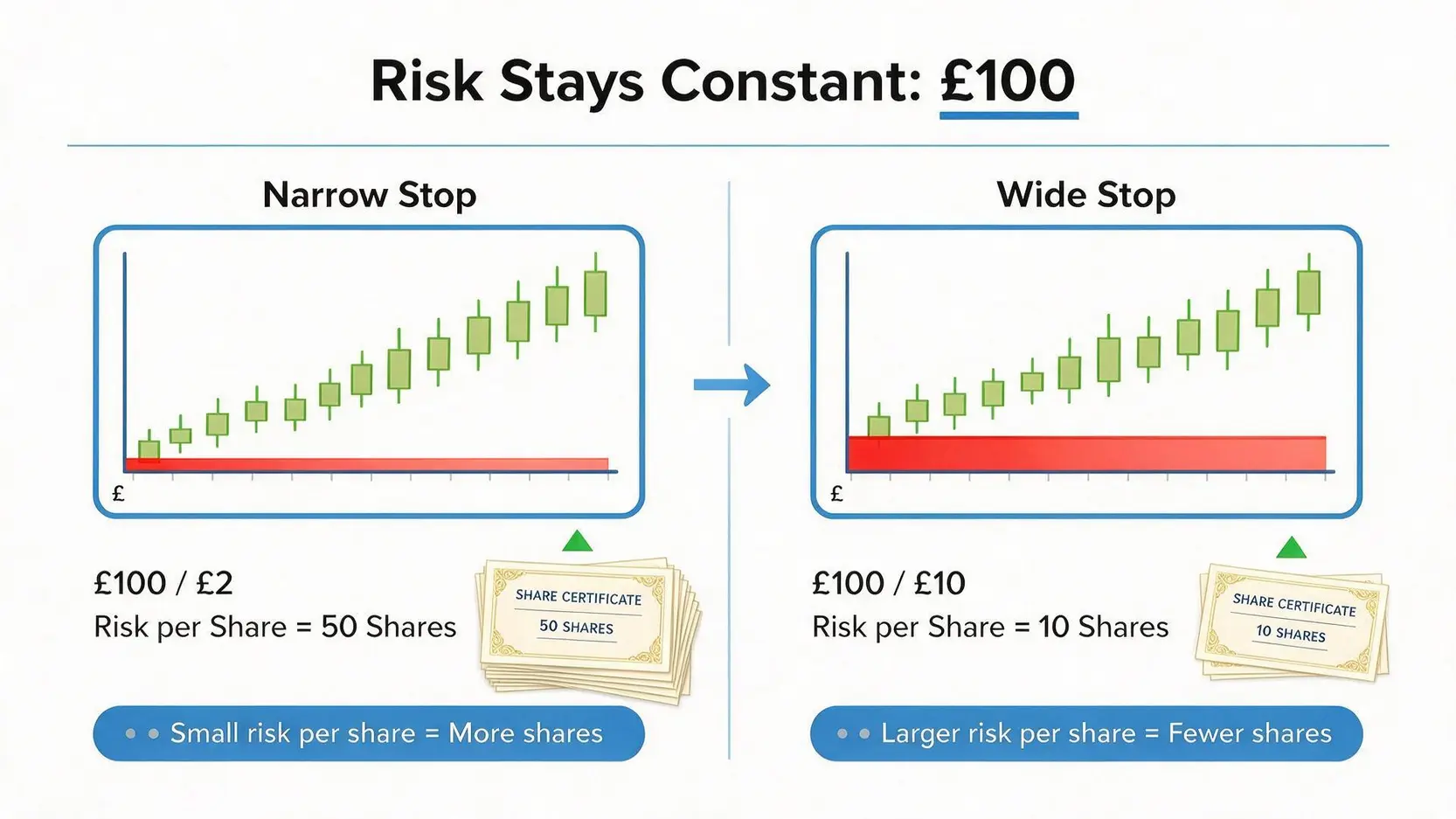
Danny’s Insight: I often see new traders say, “This trade has a lot of potential, so I’ll risk more.” This is emotional thinking. The correct approach is, “This setup requires a wider stop-loss, so my position size must be smaller.” The formula removes emotion and enforces mathematical discipline.
A Worked Example: Applying the Formula to a Real Stock Trade
Let’s apply this to a hypothetical trade on a FTSE 100 company, say Barclays PLC (BARC.L), assuming a trading account of £25,000.
- Entry Price: You decide to buy at £1.55.
- Stop-Loss: Based on a technical support level, you place your stop-loss at £1.48.
- Trade Risk per Share: £1.55 – £1.48 = £0.07.
Now, let’s see how your position size changes based on your chosen account risk.
| Account Risk % | Max Loss (£) | Calculation | Calculated Position Size (Shares) |
|---|---|---|---|
| 0.5% | £125 | £125 / £0.07 | 1,785 |
| 1.0% (Recommended) | £250 | £250 / £0.07 | 3,571 |
| 2.0% (Aggressive) | £500 | £500 / £0.07 | 7,142 |
As you can see, doubling your risk from 1% to 2% doubles your position size. While this doubles your potential profit, it also brings you dangerously closer to a significant drawdown if you hit a string of losses.
Advanced Concepts in Position Sizing: Factoring in Leverage
Pro Tip: Leverage does not alter the fundamental position sizing formula. The calculation is always based on your own account equity at risk. Leverage is a tool that allows you to control a larger position, but the amount of your own capital you stand to lose should remain fixed by the 1% rule.
Leverage is a major source of confusion for traders using a position sizing calculator, especially in markets like Forex. It’s often described as a ‘double-edged sword’ because it magnifies both profits and losses.
Understanding its relationship with position sizing is vital.
Does Leverage Change the Core Position Sizing Formula?
No. The formula `Position Size = (Account Capital x Risk %) / (Stop-Loss Distance)` remains the same. The calculation determines the number of lots or units that ensures a loss at your stop-loss equals your pre-defined risk (£100 in our first example).
Leverage simply determines how much of the position’s *notional value* is covered by your own margin and how much is provided by the broker.
The danger is that high leverage makes it *possible* to take on enormous positions that are completely detached from any sensible risk management plan.
A broker offering 100:1 leverage on a £10,000 account doesn’t mean you *should* be controlling a £1,000,000 position.
Common Mistakes When Calculating Position Size in Forex
The principles are the same in Forex, but the variables are different. Instead of shares and pounds, you deal with lots, pips, and varying pip values. This is where mistakes happen.
| Common Mistake | Incorrect Approach | Correct Approach |
|---|---|---|
| Ignoring Pip Value | Assuming the value of a pip is the same for all pairs. (e.g., using the pip value of EUR/USD for GBP/JPY). | Calculating the exact pip value for the specific pair being traded at the intended volume. A pip on EUR/USD is not worth the same as a pip on USD/JPY. |
| Guessing the Lot Size | Choosing a random lot size like ‘0.1 lots’ because it ‘feels right’. | Calculating the precise lot size based on your account risk and stop-loss distance in pips. |
| Confusing Risk with Margin | Thinking the margin required to open the trade is the amount at risk. | Understanding that margin is a deposit to open a trade, while risk is the calculated potential loss if the trade hits your stop-loss. |
Regulatory Risk Warning: Instruments like CFDs and spread bets are complex and come with a high risk of losing money rapidly due to leverage. As the UK’s Financial Conduct Authority (FCA) often warns, a high percentage of retail investor accounts lose money when trading these products. You should consider whether you understand how these instruments work and whether you can afford to take the high risk of losing your money. Always check the FCA’s guidance on risk warnings before investing.
Frequently Asked Questions
1. What percentage of my account should I risk per trade?
As a veteran trader, my advice is to never exceed 1% of your trading capital on a single trade. For those starting out, even 0.5% is a more prudent choice.
This ensures you can withstand the inevitable losing streaks that every trader faces, allowing you to stay in the game and learn without destroying your capital base.
2. How is position size different from leverage?
Position size is the answer to the question, “How many shares/lots should I trade to risk a specific amount of my own capital?” Leverage is the answer to, “How much am I borrowing from my broker to control a position larger than my own capital would allow?”
Your position sizing calculation must always come first; leverage is merely a facility that may or may not be used.
3. Can I use the same position sizing formula for stocks, forex, and crypto?
Yes, the core principle is universal: `Risked Amount / Per-Unit Risk = Position Size`. However, the ‘Per-Unit Risk’ component must be adapted. For stocks, it’s the stop distance in currency (£, $).
For Forex, it’s the stop distance in pips multiplied by the pip value. For cryptocurrencies, it might be the stop distance in USD per coin. The formula’s logic remains identical, but the inputs must match the asset being traded.
Danny’s Final Thoughts
After more than a decade in the markets, including navigating the 2015 CHF flash crash and the 2020 COVID meltdown, I can tell you with absolute certainty that survival comes down to defence. And your primary defence is disciplined position sizing.
It’s not the most exciting part of trading, but it’s the most important. A position sizing calculator isn’t just a tool; it’s your business manager.
Use it for every single trade, without exception. It’s not about winning one trade; it’s about surviving the whole game.
Sources & Methodology
Danny strictly relies on primary regulatory data and authoritative official information to ensure accuracy. Data and concepts cited in this guide are sourced from:
*Disclaimer: The content of this article represents the personal views of the author (Danny) and is for educational and reference purposes only. It does not constitute professional investment or financial advice. Trading and investing involve significant risk; proceed with caution.*
