

As a market analyst observing the surge in retail participation across global markets, particularly from the UK and Malaysia, a critical question frequently arises: is CFD trading halal?
The allure of derivative instruments like Contracts for Difference (CFDs) is undeniable, offering high leverage and access to a vast range of assets.
However, for the observant Muslim trader, this financial innovation stands at a difficult crossroads with Sharia-compliant trading principles.
This guide provides an uncompromising analysis from a financial markets perspective, dissecting the structure of CFDs against the core tenets of Islamic finance to offer a clear verdict on this complex issue and explore the Islamic perspective on derivatives.
The Verdict: Is CFD Trading Halal or Haram?
Pro Tip: The overwhelming majority of Islamic finance scholars and jurists have concluded that CFD trading, in its standard form, is Haram (forbidden). This is not a light assertion but a conclusion based on a structural analysis of the product, which is found to be in direct violation of several core prohibitions in Islamic commercial law.
The reasoning behind this prohibition is not superficial. It delves into the very essence of what a CFD contract represents—a speculative derivative that does not confer ownership of the underlying asset.
To understand this verdict, one must look beyond the surface-level transaction and analyse its mechanics through the lens of Sharia principles.
The Majority Scholarly Consensus: Why CFDs Are Largely Considered Haram
The consensus is built upon the understanding that CFDs are not a form of investment but a form of speculation that closely mirrors gambling.
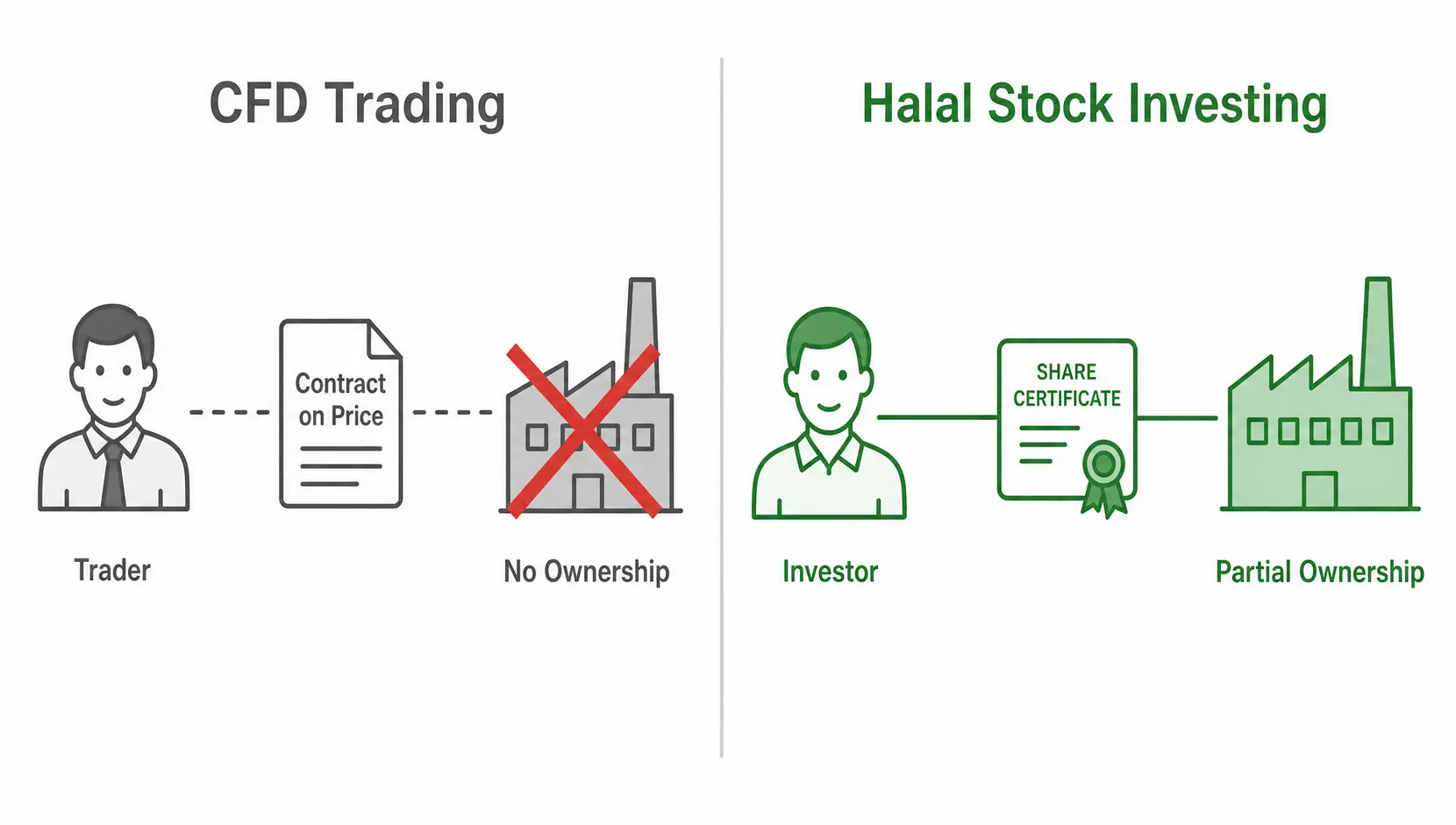
Unlike investing in shares of a company, where one takes an equity stake in a real-world enterprise, a CFD trader is merely placing a wager on the price direction of an asset.
This fundamental distinction is the primary point of failure when assessed for Sharia compliance.
Core Islamic Finance Prohibitions Violated by CFDs
Islamic finance is built on principles that promote fairness, transparency, and risk-sharing.
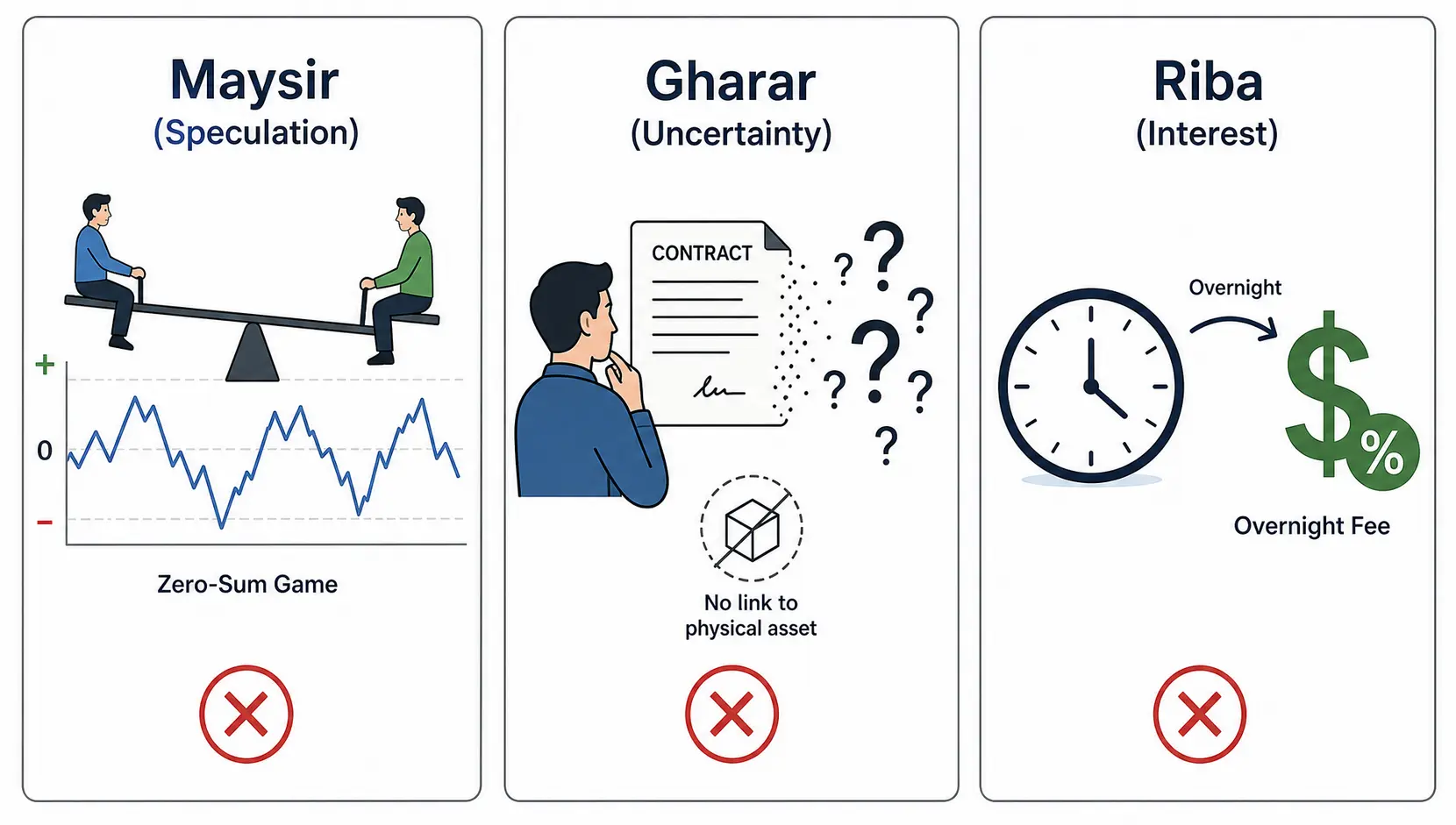
CFDs are found to be problematic in three key areas:
- Maysir (Gambling): Maysir refers to acquiring wealth by chance or speculation, rather than through effort or productive activity. A CFD contract is a zero-sum game where one party’s gain is directly and precisely the other party’s loss (the broker or another trader). The outcome is heavily dependent on chance and short-term price fluctuations, not on the underlying growth or productivity of an asset. This structure is seen as a form of gambling, which is strictly forbidden.
- Gharar (Excessive Uncertainty): Gharar denotes excessive uncertainty, ambiguity, or deception in a contract. The very nature of a CFD is built on the uncertainty of a future price, which is the subject of the contract. Furthermore, the complexity of the pricing, the role of the broker as the counterparty, and the lack of asset ownership create a level of ambiguity that is unacceptable under Sharia law. The contract is not for a tangible asset but for a notional ‘difference’, which is a classic example of Gharar.
- Riba (Interest): This is the most widely known prohibition, referring to any form of interest. In CFD trading, Riba manifests primarily through ‘swap’ or ‘overnight financing’ fees. When a trader holds a position overnight, the broker charges a fee, which is a direct calculation based on interest rate differentials. This is a clear-cut case of Riba.
Deconstructing the ‘Swap-Free’ Islamic CFD Account
Pro Tip: The introduction of ‘swap-free’ or ‘Islamic’ accounts by brokers is a marketing response, not a structural solution. While they remove the explicit interest-based overnight fee (Riba), they fail to resolve the more fundamental issues of Maysir (gambling) and Gharar (uncertainty).
Brokers market these accounts as Sharia-compliant, targeting a growing demographic of Muslim traders. However, a deeper analysis reveals that this is often a superficial fix. The core nature of the transaction remains unchanged.
What Are Swaps and Why Are They Haram (Riba)?
In the context of forex and CFD trading, a swap or rollover fee is the interest paid or earned for holding a position overnight. It arises because when you trade on leverage, you are effectively borrowing capital to control a larger position.
The interest on this borrowed capital is passed on to you. As the charging or receiving of interest is the very definition of Riba, any account that involves swaps is unequivocally Haram.
Do ‘Swap-Free’ Accounts Really Make CFD Trading Halal?
The short answer is no. Removing the swap fee is like treating a single symptom of a multi-faceted disease.
The fundamental problems remain:
- No Asset Ownership: You still do not own the underlying asset. The transaction remains a speculative bet on a price movement, not an investment in a tangible asset.
- Gharar and Maysir Persist: The contract is still based on excessive uncertainty (Gharar) and functions as a zero-sum game of speculation (Maysir).
- Disguised Costs: Many brokers compensate for the lack of swap fees by other means. They may charge a fixed daily ‘administration fee’ on open positions, widen the spread (the difference between the buy and sell price), or charge higher commissions. These can be viewed as a ‘backdoor’ form of Riba, a fixed cost for the service of lending, which simply re-packages the forbidden element under a different name.
| Feature | Standard CFD Account | ‘Swap-Free’ Islamic CFD Account | Sharia Compliance Analysis |
|---|---|---|---|
| Overnight Fees | Charges/earns interest-based swaps (Riba). | No swaps, but may have fixed admin fees. | Admin fees can be a disguised form of Riba. The core issue isn’t resolved. |
| Asset Ownership | None. Purely a contract on price. | None. The fundamental structure is identical. | Fails the test of tangible asset ownership, a key requirement. |
| Speculation | High degree of speculation (Maysir). | High degree of speculation (Maysir). | The element of gambling/pure speculation remains central to the product. |
| Uncertainty | High contractual uncertainty (Gharar). | High contractual uncertainty (Gharar). | The contract is on a notional value, not a deliverable asset, which is a core feature of Gharar. |
CFDs vs. Halal Investing: Understanding the Key Differences
Pro Tip: The fundamental difference lies in ownership and productive intent. Halal investing involves taking an ownership stake in a permissible asset or enterprise, sharing in its risks and rewards. CFD trading is a detached wager on price movements without any ownership. This distinction is critical for Muslim investors.
The Problem of Ownership: Trading Contracts vs. Owning Assets
From a market analyst’s perspective, this is the most crucial distinction. When you buy shares in a Sharia-compliant company (e.g., a tech firm with no debt and permissible business activities), you become a part-owner of that company.
You have a claim on its assets and a share in its profits (and losses). Your success is tied to the company’s real-world performance. This is a productive economic activity.
With a CFD, you own nothing. You have simply entered into a contract with a broker who agrees to pay you the difference in an asset’s price between the opening and closing of the contract.
If the price moves against you, you must pay the broker. It’s a synthetic instrument that creates a speculative environment detached from real economic activity.
| Aspect | CFD Trading | Halal Stock Investing |
|---|---|---|
| Ownership | No ownership of the underlying asset. | Direct partial ownership of the company. |
| Nature of Transaction | A speculative wager (Maysir) on price movement. | An investment in a productive enterprise. |
| Risk Sharing | Zero-sum game; your gain is the broker’s loss. | Shared risk; success is tied to company performance. |
| Islamic Principles | Involves Maysir, Gharar, and potentially Riba. | Compliant if the company’s business is Halal. |
Halal Alternatives to Consider for Muslim Traders
For traders in Malaysia, the UK, and beyond, who wish to engage with financial markets in a Sharia-compliant manner, there are several robust alternatives:
- Direct Equity Investing: Buying shares of companies that have been screened for Sharia compliance (e.g., low debt, permissible business activities). This is the most straightforward form of halal investing.
- Islamic Investment Funds & ETFs: These are professionally managed funds that invest only in a portfolio of Sharia-compliant securities. This offers diversification and is a good option for those who do not wish to pick individual stocks.
- Physical Commodity Trading: While CFD trading on commodities is Haram, owning and trading physical commodities (like gold, silver, or palm oil) with direct ownership and settlement can be permissible under certain conditions (e.g., hand-to-hand exchange or immediate transfer of ownership).
- Sukuk (Islamic Bonds): These are asset-backed securities, not debt instruments. A Sukuk represents ownership in a tangible asset or a project, and the returns are generated from the asset’s profit, not from interest.
Frequently Asked Questions
1. Why is CFD trading considered haram by the majority of scholars?
From my market analysis viewpoint, it boils down to the structure of the instrument.
CFD trading is considered Haram primarily because it violates three core Islamic finance principles: Maysir (gambling), as it’s a speculative bet on price without underlying economic activity; Gharar (excessive uncertainty), due to the ambiguous nature of a contract on a ‘difference’ rather than a tangible asset; and often Riba (interest), through overnight swap fees.
2. Are all financial derivatives haram in Islam?
This is a nuanced area. While speculative derivatives like CFDs are largely deemed impermissible, not all derivatives are automatically Haram.
For instance, some forms of derivatives used for genuine hedging (risk management for an existing asset) rather than pure speculation may be viewed differently by some scholars.
However, the dominant view is highly cautious, and retail-oriented speculative instruments almost always fall into the forbidden category.
3. Is a ‘swap-free’ CFD account automatically halal?
No, it is not. A ‘swap-free’ account only addresses the issue of Riba (interest) on the surface. It does nothing to resolve the more fundamental violations of Maysir (gambling) and Gharar (uncertainty) that are inherent in the CFD contract itself.
The fact that you still don’t own the asset and are engaging in a zero-sum speculative wager means the transaction remains non-compliant from a majority scholarly perspective.
4. I see many Muslim traders using Islamic CFD accounts. Are they all wrong?
The decision to trade is a personal one, and individuals have varying levels of knowledge and interpretation. However, the prevalence of a practice does not make it permissible.
As an analyst, I focus on the facts: the structural mechanics of CFDs are in direct conflict with established Islamic commercial jurisprudence.
The marketing of ‘Islamic’ accounts is a powerful tool, but it often masks these underlying, unresolved prohibitions. Responsible trading requires looking past the label to the substance of the product.
Andrew Wong’s Final Thoughts
Sources & Methodology
Andrew Wong strictly relies on primary regulatory data and authoritative official information to ensure accuracy. Data cited in this guide is sourced from:
*Disclaimer: The content of this article represents the personal views of the author (Andrew Wong) and is for educational and reference purposes only. It does not constitute professional investment or financial advice. Trading and investing involve significant risk; proceed with caution.*
