

As a market analyst, I’m often asked how seemingly distant economic decisions can impact major currencies. A prime example is understanding how Bank of Japan policies indirectly affect US Dollar strength.
While not immediately obvious, the connection is a powerful undercurrent in the foreign exchange markets, driven by mechanisms like US-Japan interest rate differentials and the subtle impact of Japan’s quantitative easing on the dollar.
For any serious trader in 2026, grasping these channels isn’t just academic—it’s a prerequisite for navigating the complexities of global capital flows.
The Primary Driver: Understanding US-Japan Interest Rate Differentials
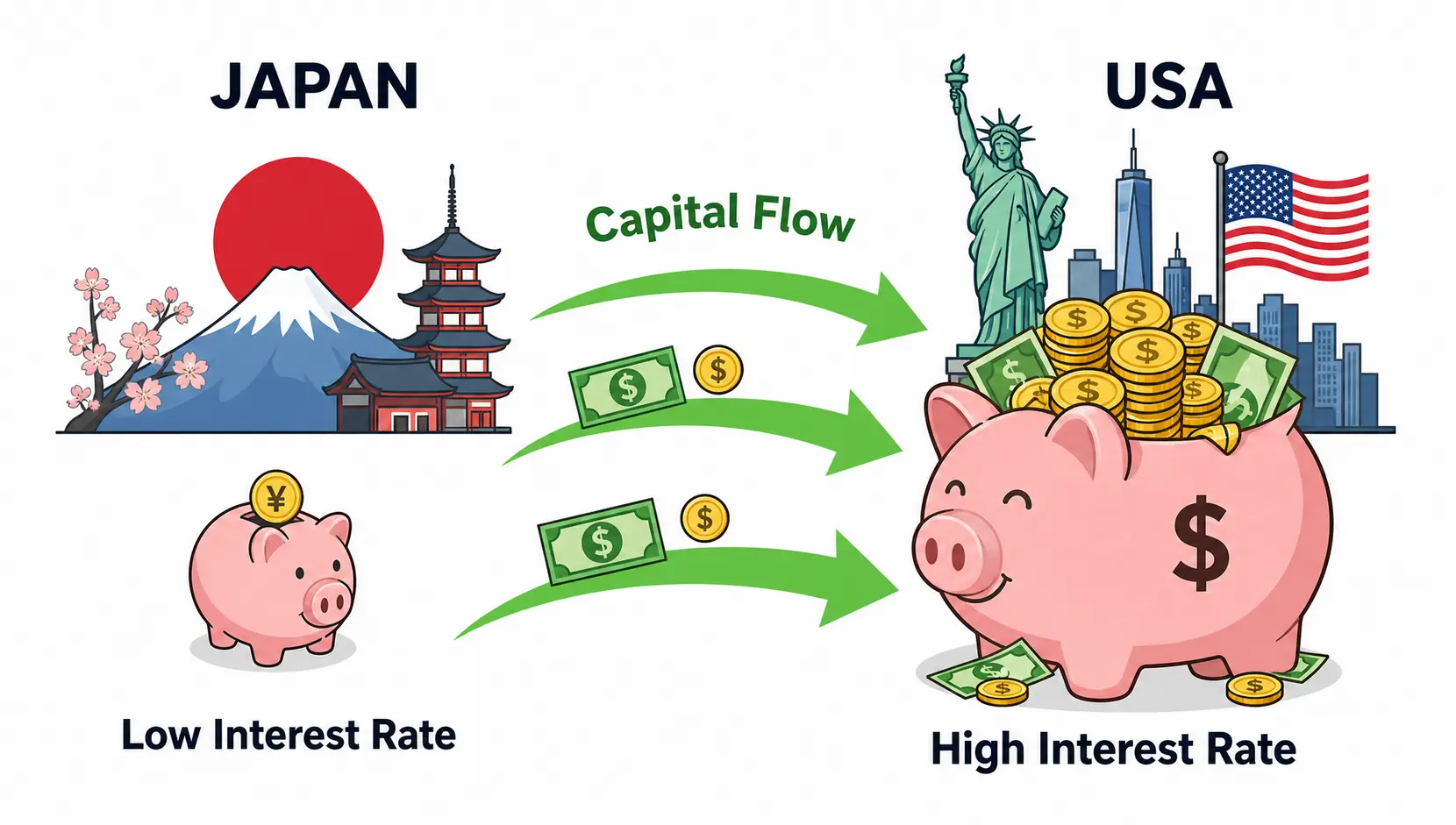
Pro Tip: The core of the BoJ-USD relationship lies in the yield gap. When the U.S. Federal Reserve offers higher interest rates on its bonds compared to the near-zero rates from the Bank of Japan, global capital is incentivised to flow towards the higher-yielding currency (the USD) to maximise returns. This influx directly increases demand for the dollar, causing its value to appreciate against other currencies, including the yen.
Japan’s Ultra-Low Interest Rate Policy vs. The Fed’s Stance
For decades, the Bank of Japan (BoJ) has maintained an ultra-loose monetary policy, characterised by extremely low, and at times negative, interest rates.
The primary goal has been to combat deflation and stimulate Japan’s domestic economy. As of September 2026, this accommodative stance continues, albeit with constant monitoring of global conditions.
Conversely, the U.S. Federal Reserve has been in a tightening cycle to manage its own inflationary pressures, creating one of the most significant policy divergences in modern economics.
This disparity is the engine driving major currency movements.
| Central Bank Policy Comparison (Sept 2026) | Bank of Japan (BoJ) | U.S. Federal Reserve (Fed) |
|---|---|---|
| Benchmark Interest Rate | Near-Zero (Sub-0.1%) | Moderately Hawkish (2.5% – 3.0% range) |
| Monetary Policy Bias | Dovish / Accommodative | Cautiously Hawkish / Data-Dependent |
| Primary Mandate Focus | Achieving 2% inflation target; Economic stimulation | Price stability; Maximum employment |
How Capital Flows to Higher-Yielding US Assets
Institutional investors, pension funds, and hedge funds are constantly searching for yield. When Japan offers a near-zero return on government bonds, holding yen-denominated assets becomes unattractive.
These investors will execute a simple but powerful strategy: sell Japanese yen (JPY) and buy U.S. dollars (USD) to purchase higher-yielding U.S. Treasury bonds.
This large-scale capital migration has a direct and sustained effect: it increases the supply of yen in the market while simultaneously increasing the demand for dollars.
The result is a stronger USD and a weaker JPY, a trend that has defined the USD/JPY pair for much of the last few years.
Andrew Wong’s Insight: Market movements are a combination of macroeconomic gravity and technical psychology. The interest rate differential is the ‘gravity’ pulling capital towards the US. This fundamental force is so strong that it often overrides short-term geopolitical noise. Traders who ignore this fundamental driver do so at their own peril.
Risk Warning: This capital flow is not guaranteed to be perpetual. Any signal from the Bank of Japan that it may normalise its policy or a dovish pivot from the U.S. Fed could cause a rapid and violent reversal of these flows, leading to significant USD weakness against the JPY.
Quantitative Easing and its impact on the Yen Carry Trade
Pro Tip: The Bank of Japan’s Quantitative Easing (QE) programme amplifies the effect of low interest rates by flooding the market with liquidity. This makes the yen the world’s primary funding currency for a strategy known as the ‘yen carry trade,’ which indirectly funnels capital into dollar-denominated assets, boosting the USD.
Explaining the Yen Carry Trade: Borrowing Low, Investing High
The yen carry trade is a strategy where an investor borrows Japanese yen at its low interest rate, converts the borrowed amount into a higher-yielding currency (like the U.S. dollar), and invests in assets denominated in that currency.
The investor profits from the interest rate differential, or ‘carry’. For example, borrowing yen at ~0% and investing in a U.S. bond yielding 3% provides a clear profit margin, assuming the exchange rate remains stable.
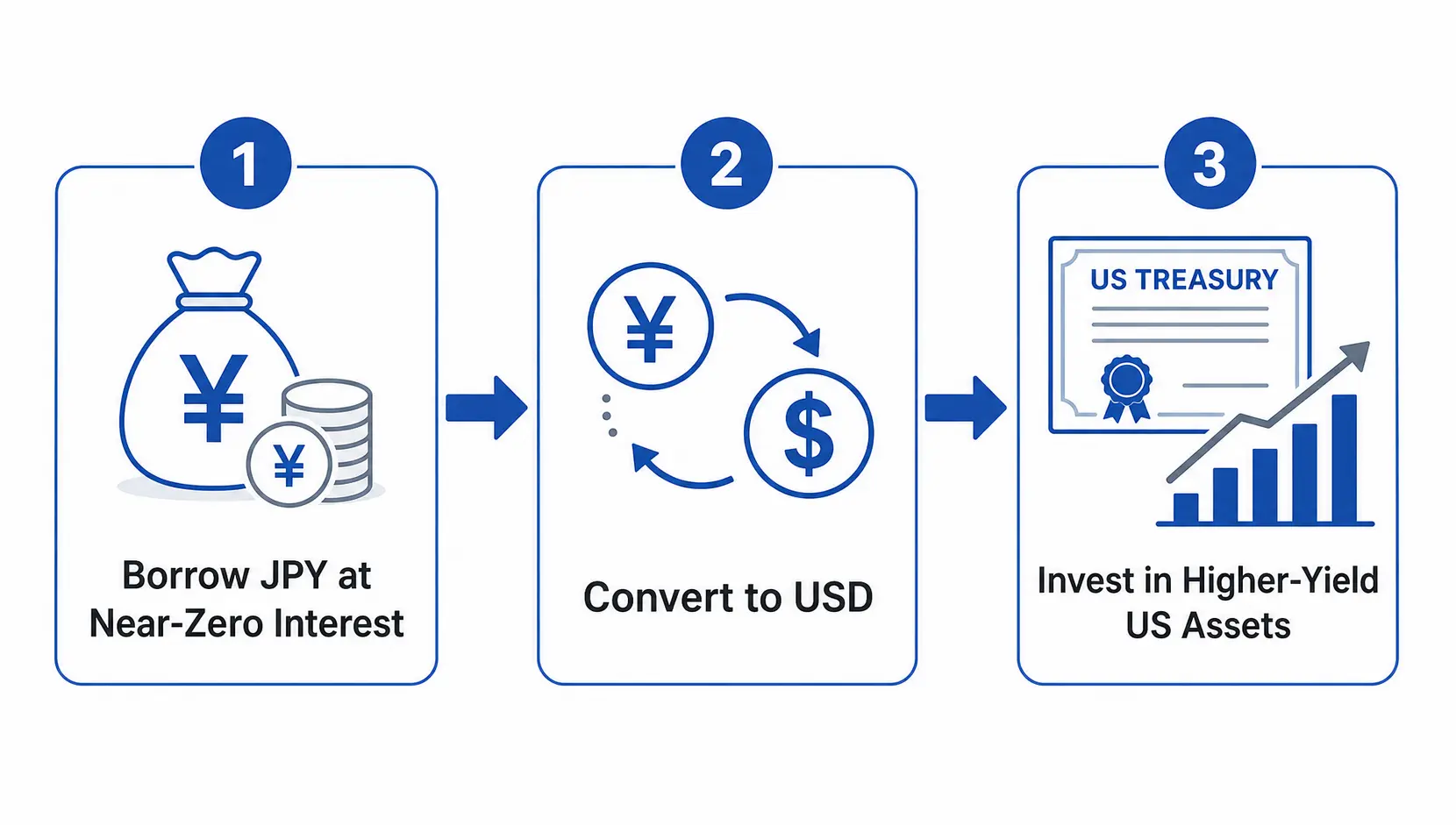
The BoJ’s massive QE operations, which involve buying government bonds and other assets, ensure that the financial system is flush with cheap yen, making it incredibly easy and affordable for investors to initiate these trades.
This constant borrowing pressure on the yen contributes to its weakness, while the subsequent investment in U.S. assets props up the dollar. It’s a self-reinforcing cycle where BoJ policy actively facilitates a stronger USD.
As explained by authoritative sources like Investopedia, this strategy is fundamental to understanding modern currency dynamics.
Risk Warning: The yen carry trade is highly sensitive to market volatility. During periods of risk aversion (a ‘risk-off’ environment), investors rapidly unwind these trades. They sell their high-yield assets and buy back the yen to repay their loans. This sudden surge in demand for yen can cause a dramatic spike in its value and a corresponding drop in the USD, catching many off-guard.
Broader Economic Impacts on Global Trade and Investor Sentiment
Pro Tip: A weak yen and a strong dollar, resulting from BoJ policy, directly impact the terms of trade between the U.S. and Japan. This affects everything from the price of imported goods in the U.S. to the profitability of multinational corporations, reinforcing the dollar’s global dominance.
How a Weak Yen and Strong Dollar Affect U.S. Import Prices
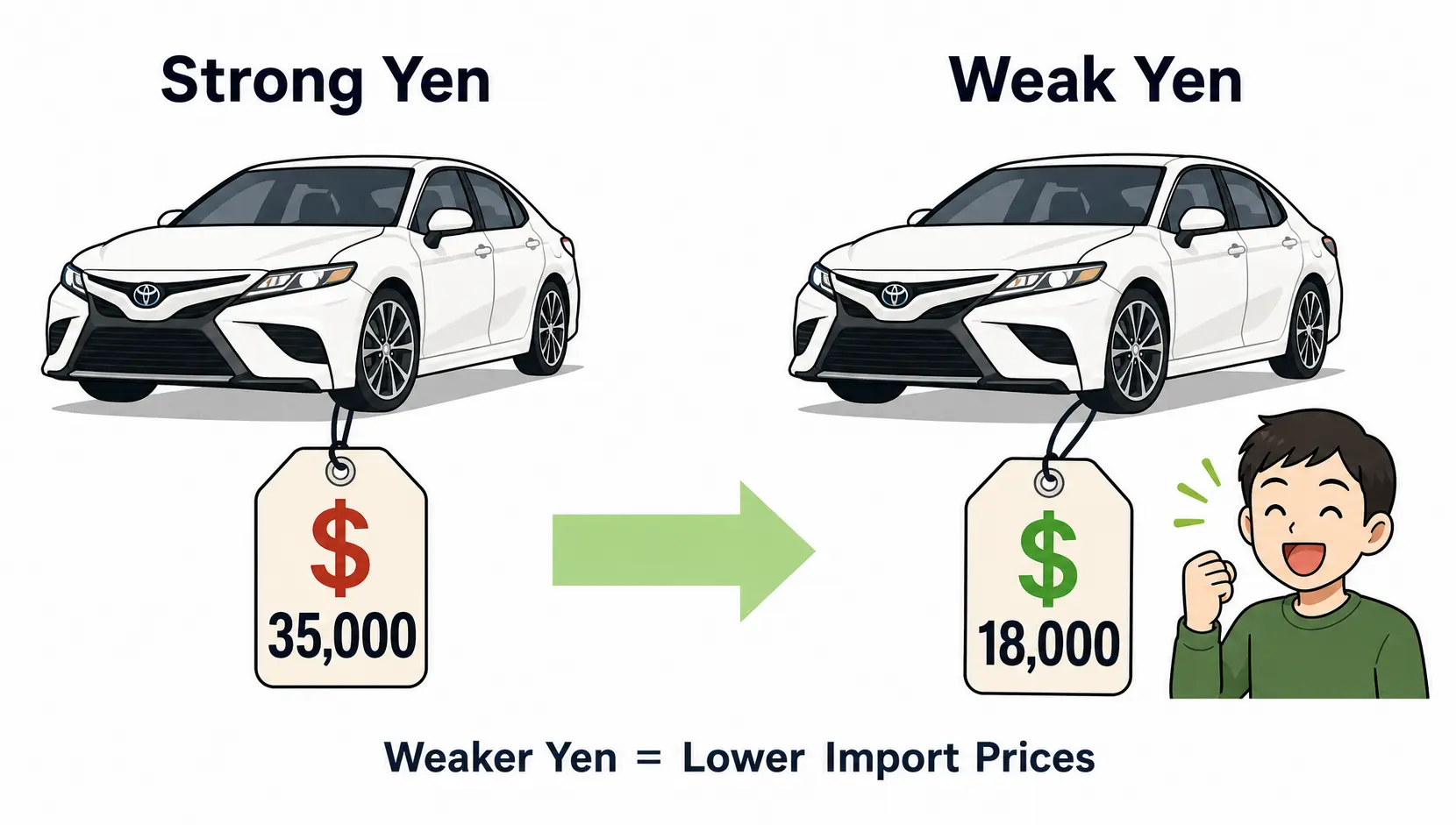
When the yen is weak, Japanese goods (cars, electronics, etc.) become cheaper for American consumers and businesses to purchase. This can help to suppress inflation in the United States by lowering import costs.
While beneficial for consumers, it can put pressure on domestic U.S. manufacturers who have to compete with cheaper foreign goods.
This trade dynamic, influenced by BoJ policy, creates both winners and losers within the U.S. economy and highlights the interconnectedness of global finance.
| Impact of a Weak Yen/Strong Dollar on the US Economy | Positive Effects (Pros) | Negative Effects (Cons) |
|---|---|---|
| For Consumers | Lower prices on imported Japanese goods. | Reduced purchasing power for travel to Japan. |
| For US Importers | Increased profit margins due to lower cost of goods. | Currency hedging costs may rise with volatility. |
| For US Domestic Producers | Incentive to become more efficient to compete. | Increased competition from cheaper imports. |
| For US Exporters to Japan | Limited direct benefits. | US goods become more expensive for Japanese buyers, potentially reducing sales. |
The Role of Investor Sentiment and ‘Safe Haven’ Status
The U.S. dollar is considered the world’s primary ‘safe haven’ currency. During times of global uncertainty, investors flee to the perceived safety of USD-denominated assets.
The BoJ’s persistent easing policy, which weakens the yen and signals an ongoing struggle with domestic growth, can inadvertently reinforce the dollar’s safe-haven appeal.
When one major economic bloc is actively pursuing a weak currency policy, it makes the currency of a more robust, higher-yielding economy—the U.S.—look even more attractive as a store of value.
This psychological factor, driven by divergent central bank policies, adds another layer of indirect support to the U.S. dollar’s strength.
Andrew Wong’s Insight: Sentiment is a powerful catalyst. The narrative in the market is that the BoJ is ‘locked in’ to its easing cycle, while the Fed has more flexibility. This perception alone creates a default bullish bias for the USD/JPY pair, as traders anticipate the policy divergence will continue. The market trades on expectations as much as on reality.
Frequently Asked Questions
1. What is the ‘yen carry trade’?
From my perspective as a market analyst, the yen carry trade is a strategy where investors borrow yen at Japan’s ultra-low interest rates and use the funds to purchase higher-yielding assets in another currency, such as U.S. dollars.
The aim is to profit from the difference in interest rates. This practice increases the selling pressure on the yen and the buying pressure on the other currency, indirectly strengthening it.
2. How does official currency intervention differ from monetary policy?
Monetary policy, set by a central bank like the Bank of Japan, involves tools like interest rates and quantitative easing to manage the overall economy (inflation, growth).
These actions affect currency value indirectly and over the long term.
Official currency intervention is a direct, short-term tactic where a government or central bank buys or sells currencies in the foreign exchange market to influence exchange rates immediately.
For instance, if the yen weakens too fast, the Japanese Ministry of Finance might directly buy yen to support its value, an action separate from the BoJ’s core monetary policy.
3. Does a weaker yen always result in a stronger U.S. dollar?
Not necessarily. While the two are often correlated due to the mechanisms I’ve described, the U.S. dollar’s value is influenced by many other factors.
The strength of the U.S. economy, the policies of the European Central Bank, geopolitical events, and commodity prices all play a significant role.
A weaker yen might coincide with a period where the Euro is strengthening significantly against the dollar, leading to a neutral or even weaker USD on a trade-weighted basis (as measured by an index like the DXY).
The relationship is strong but not absolute.
Andrew Wong’s Final Thoughts
The intricate dance between the Bank of Japan and the U.S. dollar is a textbook case of macroeconomic gravity. Capital, much like water, will always flow down the path of least resistance to the point of highest return. As long as the fundamental chasm between U.S. and Japanese monetary policy persists, the indirect strengthening of the dollar through these channels will remain a dominant theme in the global financial landscape. The key for any investor is to not only understand these forces but to respect their power and the inherent risks of their potential reversal.
Sources & Methodology
Andrew Wong strictly relies on primary regulatory data and authoritative official information to ensure accuracy. Data cited in this guide is sourced from:
*Disclaimer: The content of this article represents the personal views of the author (Andrew Wong) and is for educational and reference purposes only. It does not constitute professional investment or financial advice. Trading and investing involve significant risk; proceed with caution.*
