

There are few feelings in trading as gut-wrenching as watching your account balance collapse. I’ve been there. The 2015 Swiss Franc tsunami and the COVID-19 panic of 2020 taught me lessons that no book ever could.
The first thing you need to understand about how to recover from a blown account trading US30 is that it’s a methodical process. It is not about a frantic dash to win the money back.
This guide is about rebuilding your trading account after a loss, focusing on a robust US30 trading psychology and a strategy that can withstand market turbulence.
Step 1: Acknowledge and Step Away from the Charts
The urge to ‘make it back’ in the next trade is a siren call that leads directly to ruin. This is called revenge trading, and it’s the fastest way to compound your losses.
Your decision-making is compromised, and you’re not trading a strategy; you’re gambling on hope.
Why You Must Stop Trading Immediately
When you blow an account, you experience a significant psychological shock. Your judgment is clouded by a cocktail of emotions: anger, fear, regret, and panic.
Continuing to trade in this state is equivalent to a pilot trying to fly a plane through a hurricane with their eyes closed. You need to create a deliberate ‘cooling-off’ period to allow these emotions to subside and for rational thought to return.
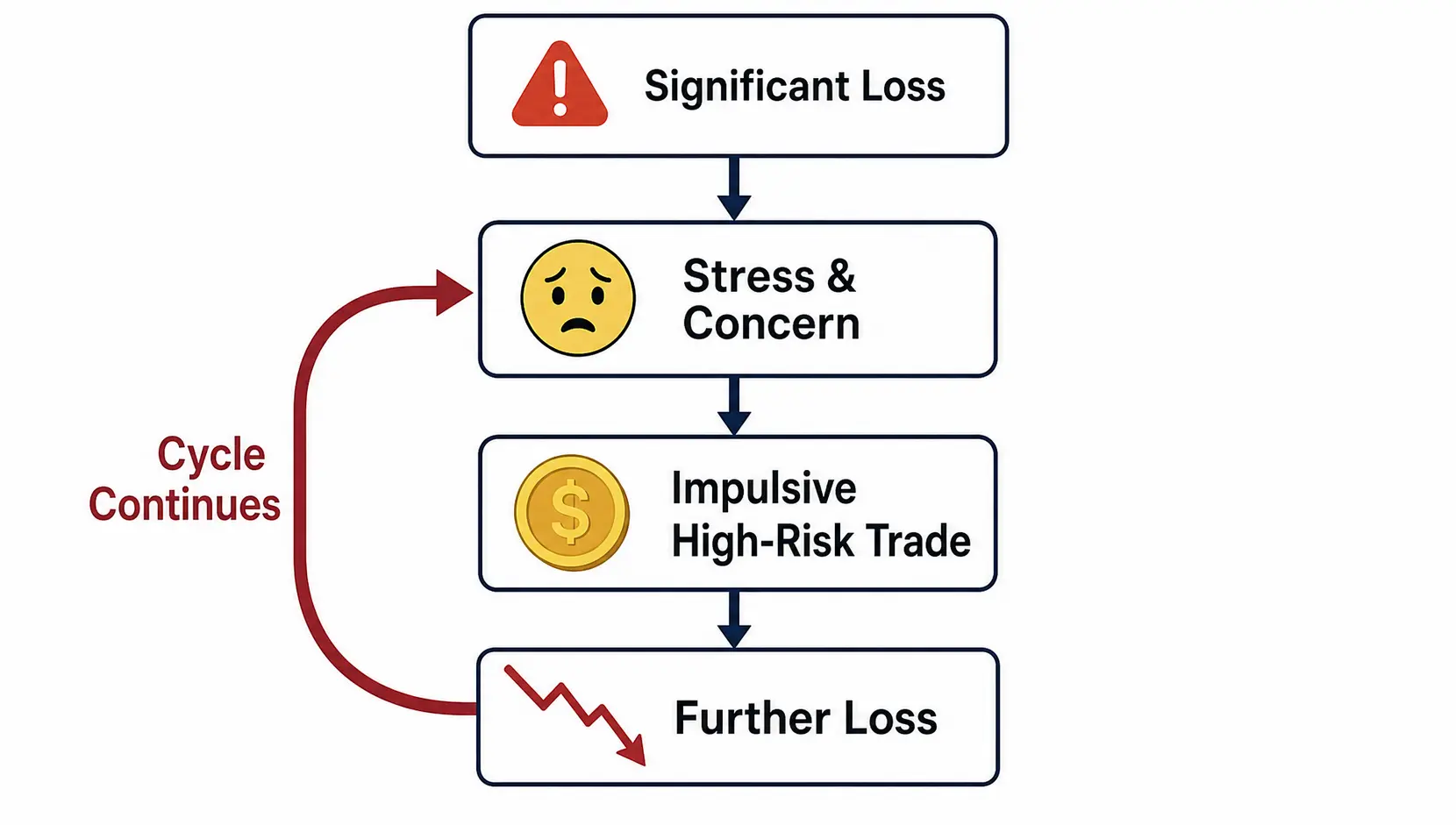
Processing the Loss: Acknowledging Your Emotions Without Judgment
It’s crucial to accept the loss as a sunk cost, a tuition fee paid to the market. Don’t suppress the emotions, but don’t let them control you either.
Acknowledge the anger and frustration. Write it down. Talk to a trusted friend (preferably not a trader who will just tell you their own bad beat stories).
The goal is to move from an emotional reaction to an objective analysis, which is impossible if you’re still in the heat of the moment.
Step 2: Conduct a Trading Post-Mortem
Once you’ve had a break and can look at your trading history without emotion, it’s time to become a detective. You need to identify the precise cause of the account failure. It was not ‘bad luck’. It was a failure in process, strategy, or discipline.
Analysing Your Trades: Identify What Went Wrong
Export your entire trade history from your blown account. Go through it line by line.
Ask yourself critical questions:
- Did I follow my trading plan on every single trade?
- Where did I deviate? Was I chasing price?
- Did I enter trades based on ‘a feeling’ or a confirmed setup?
- Was there one catastrophic trade that wiped me out, or was it a series of a thousand cuts?
- How did I react to losing trades? Did I move my stop-loss further away, hoping for a reversal?
Evaluating Your Risk Management and Position Sizing
This is often the root cause of a blown account. The US30 (Dow Jones Industrial Average) is a volatile index.Without iron-clad risk management, it can drain an account with alarming speed.
Scrutinise your approach:
- Position Sizing: Was I risking a consistent, small percentage (e.g., 1-2%) of my capital per trade? Or were my trade sizes erratic and based on my confidence level?
- Stop-Loss Orders: Did I use a hard stop-loss on every trade? Or did I use mental stops that I failed to honour?
- Leverage: Was I over-leveraged? High leverage magnifies both gains and losses. It’s a tool that must be respected, not abused.
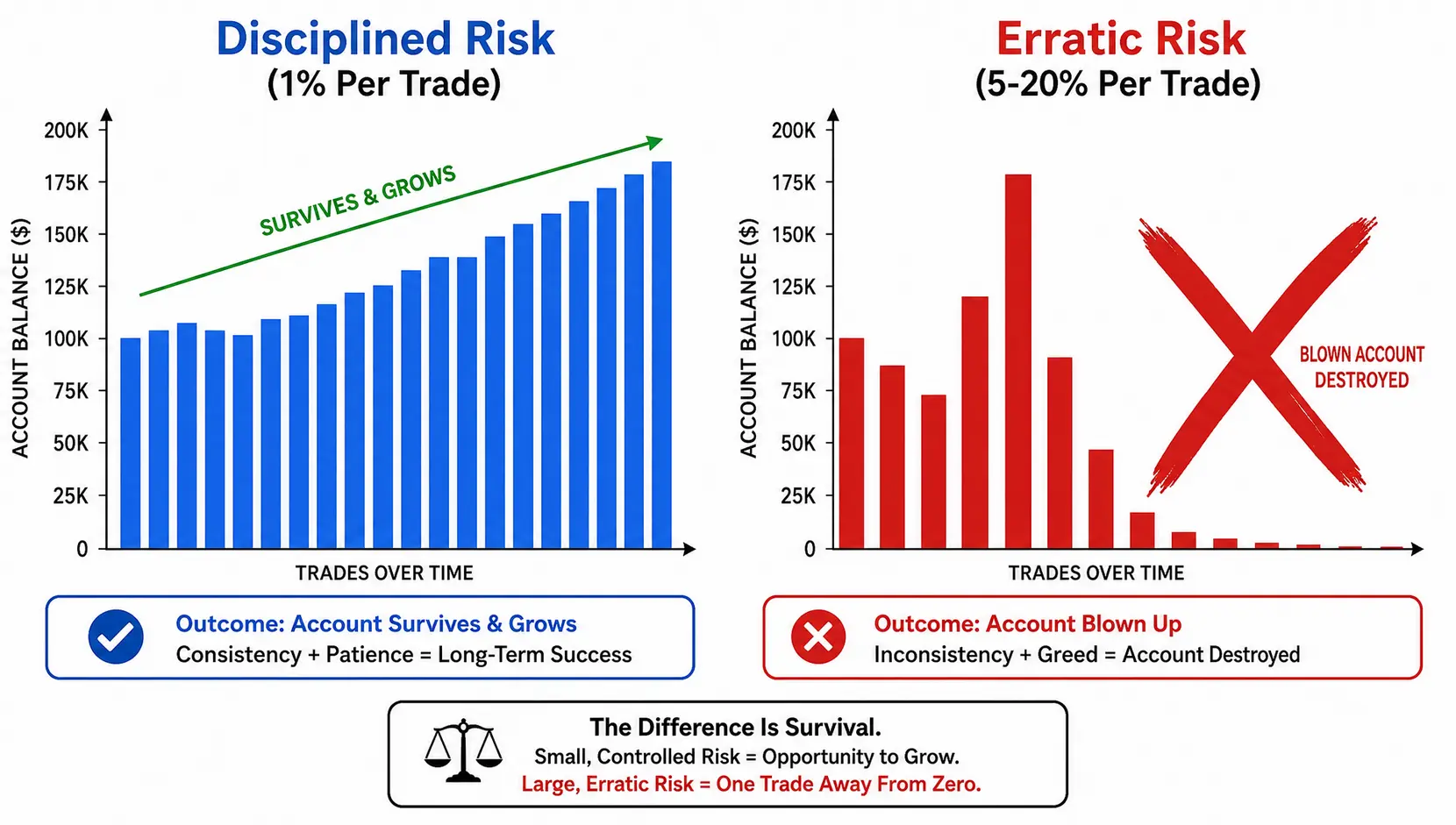
Step 3: Rebuild Your Trading Psychology
Recovering from a blown account is primarily a psychological challenge. The technical side—analysing charts and plans—is the easy part. Taming your own mind is the real work.
As Investopedia highlights, understanding the emotions that drive your decisions is fundamental to success.
Overcoming Fear, Greed, and the Urge for Revenge Trading
After a major loss, two powerful emotions will fight for control: fear and greed.
Fear will make you hesitate on valid trade setups, causing you to miss opportunities (‘hesitation is devastation’). Greed will manifest as the urge for revenge—trying to win back your losses with one huge, high-risk trade.
You must consciously build a mindset based on discipline and patience.
| Mindset Trait | Revenge Trading Mindset (Account Killer) | Disciplined Recovery Mindset (Professional) |
|---|---|---|
| Goal | ‘I must make my money back, now!’ | ‘I must execute my plan flawlessly on every trade.’ |
| Focus | The P&L (Profit and Loss) | The process and the quality of execution |
| Risk | Takes oversized risks to get a big win | Applies strict, consistent risk management |
| Emotion | Trades based on anger, hope, and desperation | Trades based on logic, rules, and patience |
Developing a Disciplined and Patient Mindset for Long-Term Success
Discipline is not a trait you are born with; it’s a muscle you build. Start small. Set a goal to follow your trading plan for five consecutive trades, regardless of the outcome.
Celebrate the discipline, not the profit. Patience is about waiting for the market to present you with a high-probability setup that matches your plan. If there’s no setup, there’s no trade. The market does not owe you opportunities.
Step 4: Forge a New, Bulletproof Trading Plan
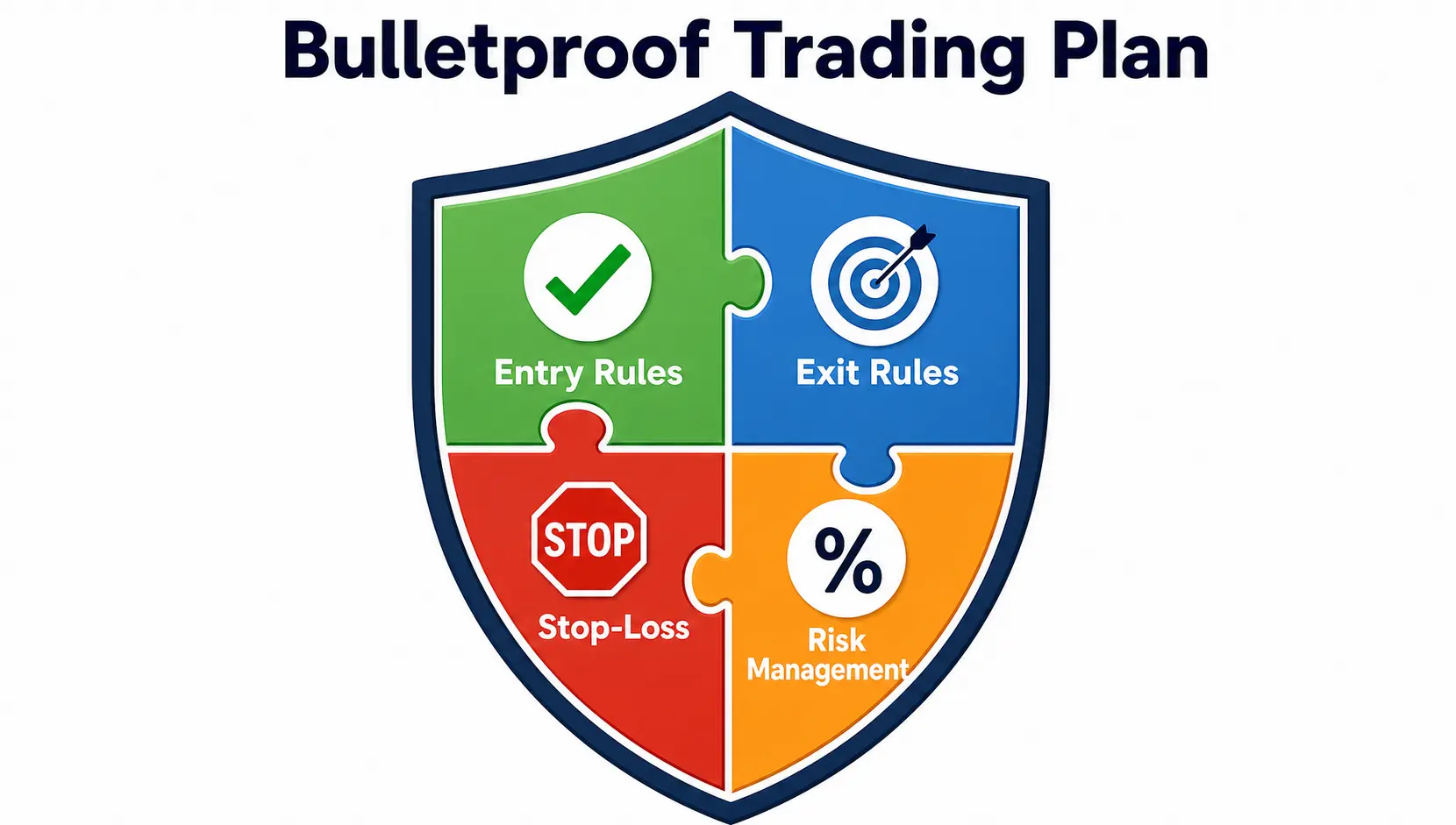
Your post-mortem should have revealed the cracks in your old plan. Now, you will build a new one designed to prevent a repeat failure. This plan must be explicit and detailed, leaving no room for guesswork during live market conditions.
Defining Strict Rules for Trading US30
Your new plan must include, at a minimum:
- Entry Criteria: What specific technical conditions (e.g., indicators, price action, structure) must be met before you enter a trade?
- Exit Criteria (Profit): Where will you take profit? Is it a fixed risk:reward ratio (e.g., 1:2), or do you trail your stop?
- Exit Criteria (Loss): Your stop-loss is not a suggestion. Define exactly where it will be placed for every setup. This is non-negotiable.
- Risk Management: Define your maximum risk per trade (e.g., 1% of account balance) and your maximum daily loss (e.g., 3%). If you hit your max daily loss, you shut down for the day. No exceptions.
- Tradable Hours: The US30 has different volatility profiles. Will you only trade the London or New York session? Avoid trading in low-liquidity periods.
The Importance of Backtesting Your New Strategy
Before you risk a single dollar, you must validate your new plan. Backtesting involves applying your set of rules to historical US30 data to see how it would have performed.
This process builds statistical confidence in your edge. It proves to you that your system has a positive expectancy over a large sample of trades.
This confidence is what will give you the fortitude to execute your plan when you inevitably face a string of losing trades.
Step 5: Easing Back into Live Trading
Returning to the battlefield after a major defeat requires a careful, phased approach. Jumping straight back into a standard-sized account is reckless. You need to rebuild your confidence and prove your new-found discipline under live fire.
Starting with a Demo Account to Regain Confidence
A demo account is your flight simulator. Use it to trade your new plan under live market conditions without financial risk. The goal is to achieve ‘unconscious competence’—where following your plan becomes second nature.
Aim for a specific, process-oriented goal, such as ‘Execute my plan flawlessly for 50 consecutive trades’. Only once you have achieved this should you consider moving to a live account.
How to Manage a New, Smaller Live Account Effectively
After proving your discipline in a demo environment, the next step is a small, live account. This reintroduces the element of real financial risk and its associated emotions, but at a manageable level.
This is the final test of your psychological recovery.
| Feature | Demo Account | Small Live Account |
|---|---|---|
| Primary Goal | Practice execution and build confidence in the plan. | Test psychological discipline with real money on the line. |
| Emotional Impact | Low to none. No real risk involved. | High. Even small losses can trigger fear if discipline is weak. |
| Focus | Process-oriented. Following the rules perfectly. | Process-oriented, while managing real emotional pressure. |
| When to Use | Immediately after creating and backtesting the new plan. | After proving flawless execution on the demo account. |
Frequently Asked Questions
1. How long should I wait before trading again after blowing an account?
There is no fixed timeline, but I would advise a minimum of one full week away from the charts completely.
The real answer is: you should wait as long as it takes to complete the post-mortem, build a new plan, backtest it, and be able to look at the market without any feeling of anger or a need for revenge.
For some, this is two weeks. For others, it could be two months. Do not rush it.
2. Is it possible to make back all the money I lost?
Thinking about ‘making back the money’ is the wrong mindset and will lead to another blown account. You must treat the lost capital as a sunk cost.
Your new goal is not to recover the old loss, but to grow a new account by following a disciplined, risk-managed process.
Over a long period of consistent, disciplined trading, you may eventually earn profits that exceed your previous loss, but that cannot be your primary focus.
3. What are the most common reasons traders blow their US30 accounts?
From my experience, the top three reasons are:
1) Egregious position sizing and over-leveraging, risking far too much on a single trade.
2) The absence of a hard stop-loss or the failure to honour it, turning a small, manageable loss into a catastrophic one.
3) Revenge trading after a loss, which starts a downward spiral of increasingly reckless decisions.
All three are symptoms of a lack of discipline.
Danny’s Final Thoughts
Sources & Methodology
Danny strictly relies on primary regulatory data and authoritative official information to ensure accuracy. Data cited in this guide is sourced from:
*Disclaimer: The content of this article represents the personal views of the author (Danny) and is for educational and reference purposes only. It does not constitute professional investment or financial advice. Trading and investing involve significant risk; proceed with caution.*
