

In my first couple of years trading, I was fixated on strategy. Spreads, leverage, indicators… that’s all that mattered. I nearly learned a very expensive lesson when a ‘broker’ I was considering turned out to be a complete phantom, a ghost in the machine.
That close call taught me the most critical rule of this game: your broker is your single most important partner. This guide on how to check if a trading broker is regulated is the first, most crucial piece of due diligence you will ever perform.
Before you even think about placing a trade, understanding the importance of using a regulated broker and mastering the step-by-step process of checking a broker’s status isn’t just a recommendation; it’s your primary defence against catastrophic loss.
Why You Absolutely Must Trade With a Regulated Broker
Pro Tip: Choosing a regulated broker is the only way to secure fundamental protections, such as segregated client funds and access to compensation schemes. It is a non-negotiable aspect of risk management. An unregulated entity operates outside the law, offering you zero recourse if things go wrong.
When you trade, you’re placing immense trust in a company to hold your capital and execute your orders fairly. Regulation is the framework that justifies this trust.
It’s a legal and operational mandate that forces brokers to adhere to strict standards, designed entirely to protect you, the investor.
Understanding Investor Protection and Fund Segregation
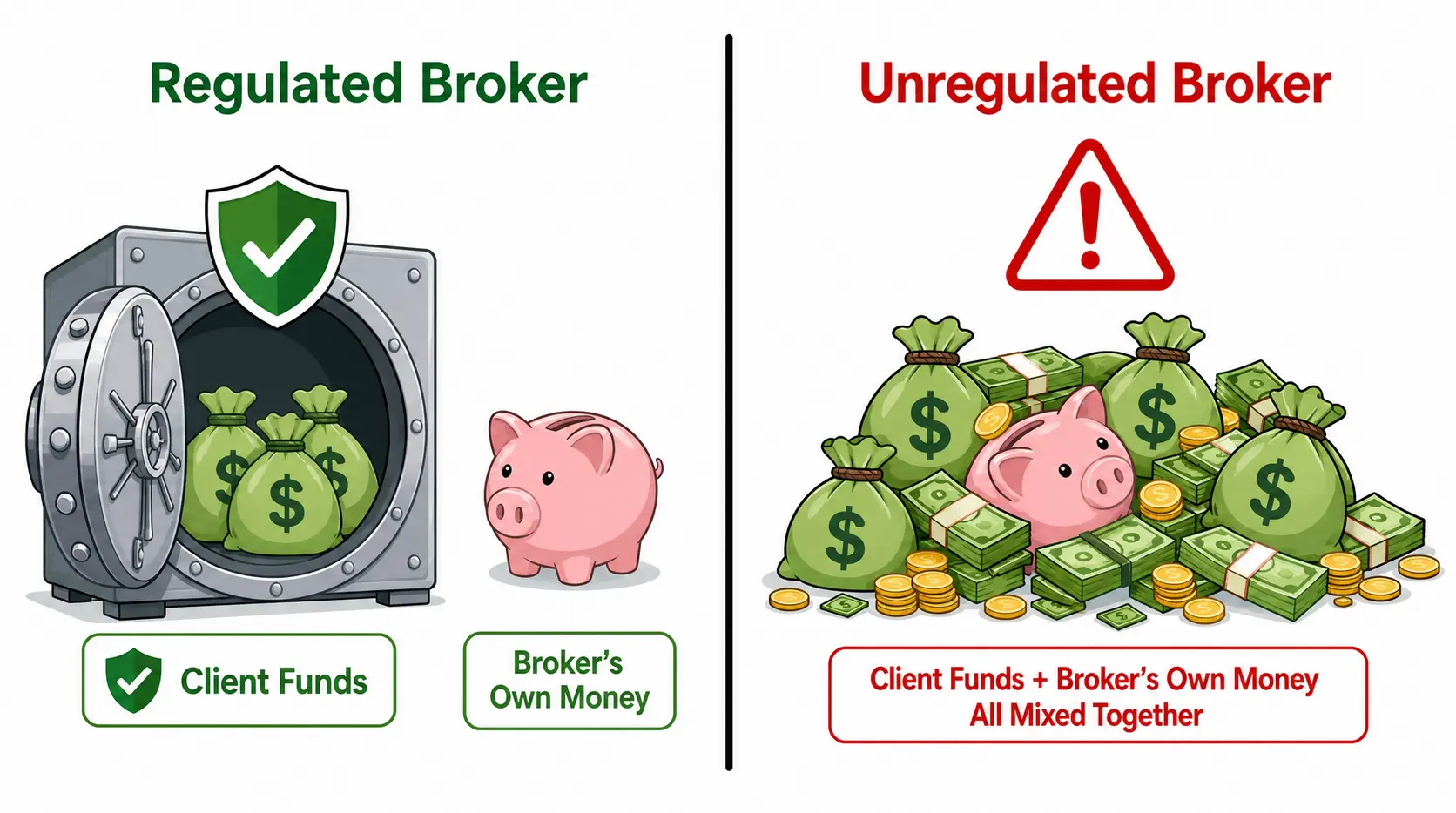
This is the big one. A core tenet of financial regulation is the mandatory segregation of client funds. This means your capital must be held in accounts completely separate from the broker’s own operational funds.
Why does this matter? If the broker goes insolvent, your money isn’t part of the assets that can be claimed by their creditors. It remains your property.
Furthermore, many top-tier regulatory jurisdictions have investor compensation schemes. For instance, brokers regulated by the UK’s Financial Conduct Authority (FCA) are part of the Financial Services Compensation Scheme (FSCS).
If your broker fails, the FSCS can compensate you up to £85,000 (as of 2026). This is a safety net you simply do not have with brokers operating from unregulated or loosely-regulated offshore havens.
Ensuring Fair Market Practices and Price Transparency
How do you know the price you’re quoted is fair? How can you be sure the broker isn’t manipulating the spread against you? Regulation. Tier-1 regulators enforce strict rules on fair pricing, order execution, and transparency.
They conduct surveillance to prevent market abuse and ensure that the broker acts as a fair intermediary, not a counterparty betting against you without disclosure.
Regulated brokers are required to provide clear information on their execution policies, including how they handle slippage and the nature of their pricing, whether it’s from a market maker model or direct market access (DMA).
This transparency is enforced through regular audits and reporting to the regulator. An unregulated broker has no such obligation.
They can widen spreads arbitrarily, trigger stop losses with manufactured price spikes, and deny withdrawals without justification. You have no one to appeal to.
| Feature | Regulated Broker (Tier-1 Jurisdiction) | Unregulated Broker |
|---|---|---|
| Client Fund Security | Held in segregated accounts, protected from broker insolvency. | Co-mingled with company funds. High risk of total loss. |
| Investor Compensation | Eligible for schemes like FSCS (UK) or SIPC (US Stocks). | None. Zero compensation if the broker vanishes. |
| Fair Practice & Pricing | Monitored for fair execution, transparent spreads, and anti-manipulation. | No oversight. Prone to spread manipulation, requotes, and withdrawal issues. |
| Dispute Resolution | Access to official ombudsman services for independent dispute resolution. | No legal recourse. You are at their mercy. |
| Legal Recourse | Operates under the legal framework of a major financial centre. | Often registered in offshore jurisdictions with weak or non-existent financial laws. |
A Step-by-Step Guide to Verifying Broker Regulation
Pro Tip: This is a two-step process. First, find the broker’s claimed license number on their site. Second, and most importantly, verify that number *independently* on the official regulator’s website. Never, ever trust a screenshot or a link provided by the broker.
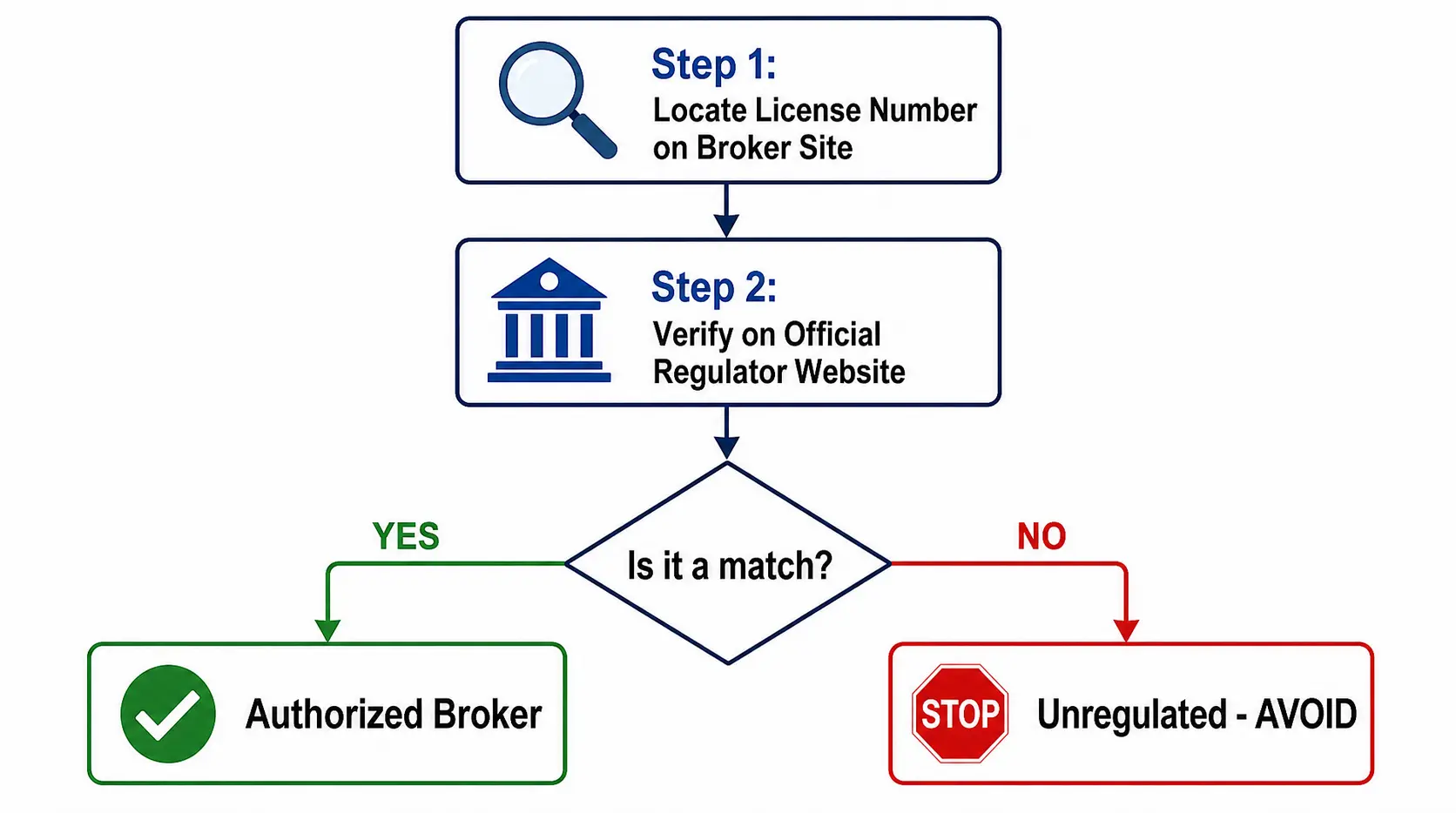
This process takes less than ten minutes, but it’s the most valuable time you’ll spend. Do not skip it.
Step 1: Locate the Broker’s Stated Regulation and Licence Number
Any legitimately regulated broker is proud of its status and displays it prominently. Scour their website’s footer (the very bottom of the page). This is the most common place to find this information.
Look for text like:
- ‘XYZ Broker is authorised and regulated by the Financial Conduct Authority (FCA), Firm Reference Number (FRN) 123456.’
- ‘ABC Trading is a member of the Financial Industry Regulatory Authority (FINRA), CRD# 789101.’
If you cannot find it in the footer, check their ‘About Us’ or a dedicated ‘Regulation’ page. If a broker makes it difficult to find their regulatory details, consider this a major red flag.
Transparency is key. Be wary of vague language like ‘registered in’ or ‘supervised by’—you’re looking for the specific phrase ‘regulated by’ and a concrete licence number.
Step 2: Use Official Regulatory Websites to Confirm the Details
This is the critical step. Take the name of the firm and the licence number you found and go directly to the regulator’s public database. Do not use a link from the broker’s site. Use a search engine to find the official register.
When you look up the firm, check the following details meticulously:
- Firm Name: Does the name on the register exactly match the name on the website? Scammers often create clone firms with very similar names to legitimate ones.
- Licence Number: Does the number match perfectly?
- Approved Activities: Does the regulator permit the firm to offer the services you intend to use (e.g., ‘dealing in investments as principal’, ‘arranging deals in investments’)? A firm might be licensed for advisory services but not for holding client money.
- Website Domain: Most regulatory registers will list the approved website domain(s) for the firm. Ensure the website you are on is the one listed. This is the single best way to defeat clone websites.
- Status: The register should say ‘Authorised’ or ‘Regulated’. If it says ‘No longer authorised’, ‘Lapsed’, or has any other warnings, walk away.
Key Regulatory Bodies and Their Verification Tools
Different countries have different regulators, but a handful are considered ‘Tier-1’ due to their stringent requirements and enforcement. If your broker isn’t regulated by one of these or an equivalent body, you should ask yourself why.
For US Traders: FINRA’s BrokerCheck and the CFTC’s BASIC
In the United States, the regulatory landscape is split. For stocks, bonds, and securities, the primary regulator is the Financial Industry Regulatory Authority (FINRA).
- Tool: FINRA BrokerCheck
- What to check: You can search for both firms and individual brokers. It provides a history of their employment, licences, and any disciplinary actions or disputes. It is an incredibly comprehensive resource.
For futures and forex trading, the regulator is the Commodity Futures Trading Commission (CFTC).
- Tool: The CFTC maintains a database called the Background Affiliation Status Information Center (BASIC).
- What to check: You can search for firms and individuals to see their registration status and any regulatory actions filed by the CFTC. You can find this tool on the official CFTC website.
For UK Traders: The FCA Financial Services Register
The Financial Conduct Authority (FCA) is the UK’s watchdog and one of the most respected regulators globally. Their standards are exceptionally high.
- Tool: FCA Financial Services Register
- What to check: This register is the definitive source for firms authorised to offer financial services in the UK. As mentioned, pay close attention to the ‘permissions’ the firm holds and the approved website domain. The FCA also maintains a public warning list of unauthorised firms to avoid.
For Malaysian Traders: SC and BNM Oversight
In Malaysia, the primary regulator for capital markets, including stocks and derivatives, is the Securities Commission Malaysia (SC).
- Tool: The SC maintains a Public Register of Licence Holders on its official website.
- What to check: Verify that the broker holds a Capital Markets Services Licence (CMSL). The SC also publishes an extensive Investor Alert List of unauthorised entities, which is essential reading.
For forex and financial services offered by banks, oversight is provided by Bank Negara Malaysia (BNM).
- Tool: BNM lists all licensed and approved financial institutions on its website. It also publishes a Financial Consumer Alert list, similar to the SC’s list, flagging illegal or unapproved schemes.
| Regulator | Country/Region | Primary Focus | Key Protection Feature |
|---|---|---|---|
| FCA (Financial Conduct Authority) | United Kingdom | CFDs, Forex, Equities | FSCS Compensation (£85,000) |
| FINRA / CFTC | United States | Securities (FINRA), Derivatives (CFTC) | SIPC Protection (Securities), Strict Segregated Funds |
| ASIC (Australian Securities & Investments Commission) | Australia | CFDs, Forex, Equities | Strict Client Money Rules |
| SC (Securities Commission) | Malaysia | Equities, Derivatives | Capital Market Compensation Fund |
| CySEC (Cyprus Securities and Exchange Commission) | Cyprus (EU) | Retail Forex, CFDs | Investor Compensation Fund (ICF), MiFID II Passporting |
Frequently Asked Questions
1. What do I do if a broker is not on a regulatory list?
You close the browser tab and never look back. It’s that simple. There are hundreds of well-regulated brokers to choose from.
The potential return from using an unknown, unregulated entity is never worth the risk of losing 100% of your capital. Do not engage, do not deposit funds, and do not provide them with your personal information.
2. Can a broker be regulated in one country but not another?
Yes, and this is a critical point. A large global broker will often have multiple entities regulated in different jurisdictions to serve clients in different regions.
For example, a broker might be regulated by the FCA in the UK and by ASIC in Australia. When you sign up, you must be clear which entity you are contracting with. If you are a UK resident, you should be onboarded through the FCA-regulated entity to receive protections like FSCS.
Some brokers may try to onboard international clients to an offshore entity (e.g., regulated in the Bahamas or St. Vincent & the Grenadines) which has much weaker rules. Always verify which regulation applies to *your* account.
3. What are the main red flags of an unregulated broker?
Beyond not appearing on a regulator’s register, watch for these signs:
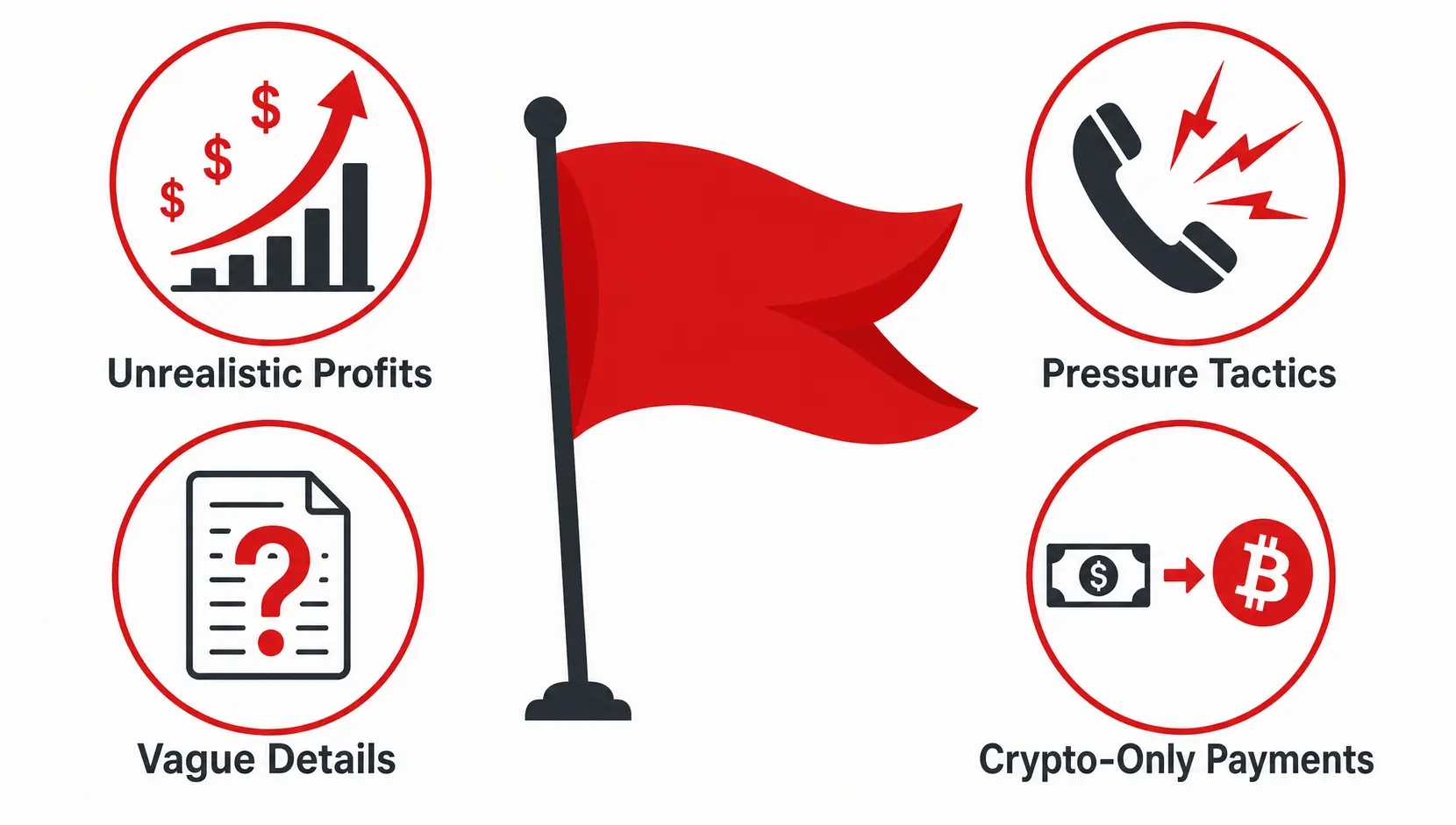
Guaranteed or unrealistic profit promises (‘Double your money in a month!’). High-pressure sales tactics. Vague or missing physical addresses and contact information. An insistence on cryptocurrency-only deposits and withdrawals.
A lack of transparency about fees, spreads, and company history. If it feels too good to be true, it is.
4. Is a broker being ‘registered’ the same as being ‘regulated’?
Absolutely not. This is a deceptive tactic used by many offshore entities. A company can be ‘registered’ as a business in a country (like St. Vincent and the Grenadines) without having any financial supervision whatsoever. Registration is just a business license.
‘Regulated’ means the company is actively supervised by a financial authority that enforces rules on client protection, capital adequacy, and fair conduct. Always look for the word ‘regulated’ by a specific, credible financial authority.
Danny’s Final Thoughts
Sources & Methodology
Danny strictly relies on primary regulatory data and authoritative official information to ensure accuracy. Data cited in this guide is sourced from:
*Disclaimer: The content of this article represents the personal views of the author (Danny) and is for educational and reference purposes only. It does not constitute professional investment or financial advice. Trading and investing involve significant risk; proceed with caution.*
