
As a financial planner, I’ve spent years helping families in Malaysia build sustainable wealth. The most heartbreaking moments in my career are when I meet individuals who have seen their life savings vanish overnight.
Recently, a client, a thoughtful retiree named Mr. Chen, came to me, visibly distressed. He was on the verge of transferring a significant portion of his retirement fund to a so-called ‘account manager’ he met online who promised him ‘guaranteed high returns’.
This incident was a stark reminder of the pervasive threat of fake account manager scams. This online trading scam alert is designed to arm you with the knowledge to protect your hard-earned money.
My goal is to walk you through the scammer’s playbook, expose their tactics, and provide a clear, actionable plan to keep your finances safe.
How the Fake Account Manager Scam Unfolds: A Step-by-Step Breakdown
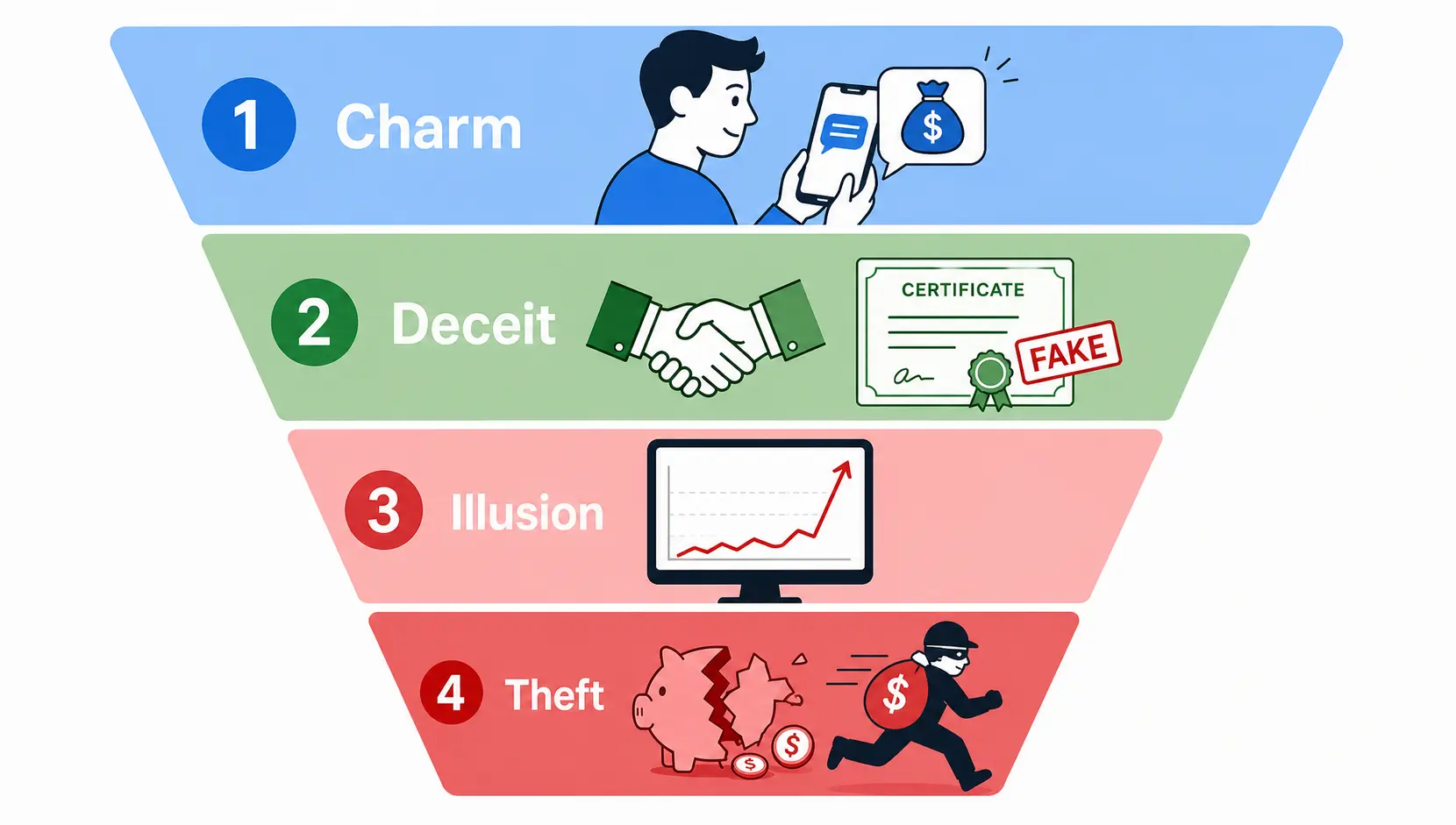
Pro Tip: These scams almost always follow a predictable four-stage script: Charm, Deceit, Illusion, and Theft. Understanding this pattern is your first and strongest line of defence. They prey on hope but thrive on a lack of due diligence.
From my experience in financial planning, I can tell you that scammers are masters of psychological manipulation. They don’t just steal money; they exploit trust and dreams. Let’s dissect their process, so you can recognise it from a mile away.
Stage 1: The Initial Contact and Unrealistic Promises
The journey into financial loss often begins with an unsolicited message. It might be a direct message on Instagram, a ‘friend request’ on Facebook from a stranger with a lavish profile, or a message in a WhatsApp or Telegram group.
The profile of this ‘manager’ is often carefully curated – showing a life of luxury, complete with expensive cars, exotic holidays, and what look like trading profit screenshots.
They will approach you with a friendly, disarming tone, claiming they have a foolproof trading strategy or access to an exclusive investment vehicle.
The core of their bait is the unrealistic promise: ‘Guaranteed 20% returns monthly,’ ‘zero-risk trading,’ or ‘double your money in 90 days.’ This is the first and most critical red flag of a potential scam involving a fake account manager.
David Lim’s Insight: I always tell my clients a fundamental truth of finance: returns are intrinsically linked to risk. Extraordinarily high returns always, without exception, come with extraordinarily high risk. Anyone who guarantees high returns with low or no risk is not offering an investment; they are selling a fantasy. Authoritative sources like Investopedia consistently explain this core risk-return tradeoff, a principle every investor must understand.
Stage 2: Building False Trust and Requesting Funds
Once you engage, the scammer’s next objective is to groom you and build a foundation of false trust. They will spend time getting to know you, asking about your financial goals and family.
This is a tactic to make the interaction feel personal and professional. They might send you fake credentials, links to a slick but fraudulent website, or even doctored testimonials from other ‘satisfied clients’. They position themselves as your financial saviour, someone who can guide you to prosperity.
Once this rapport is established, they will instruct you to fund a trading account. Often, this will be with a little-known, unregulated offshore ‘broker’. They will guide you through the process, making it seem legitimate.
The request for funds is often coupled with high-pressure tactics, suggesting that a ‘golden opportunity’ is about to close.
Risk Warning: Never entrust your funds to a broker or platform recommended by an online stranger without conducting your own independent, thorough verification. A legitimate financial advisor will work with well-known, regulated institutions. Pressure to deposit funds quickly is a classic sign of a scam.
Stage 3: The Fake Dashboard and Fabricated Profits
This is where the illusion becomes most potent. After you deposit your initial funds, the ‘account manager’ will either ask for your login credentials to ‘trade on your behalf’ or give you access to a trading dashboard.
You will be amazed as you watch your investment grow at an incredible rate. Every day, you see new profits adding up. You might see a series of successful trades, with your account balance swelling. The scammer might even allow you to make a small, successful withdrawal initially.
This is a calculated move to solidify your trust and encourage you to invest a much larger sum. The reality is that this dashboard is a complete fabrication. It’s a simulated environment, a piece of software designed to show you whatever the scammer wants you to see.
The ‘trades’ are not real, and the ‘profits’ are just numbers on a screen controlled by the fraudster.
Stage 4: The Inevitable Loss and Disappearing Act
The scam culminates when you decide to withdraw your ‘profits’. This is the moment the fantasy shatters. Suddenly, your previously helpful and responsive account manager becomes evasive. A series of problems will arise.
They might tell you that you need to pay a ‘tax’ or a ‘withdrawal fee’ – always with a new bank account. If you pay, another, larger fee will appear. This can go on for several rounds, with the scammer milking you for as much as possible.
This tactic is known as ‘fee-extraction’. Eventually, when they have either extracted all they can or you refuse to pay more, the account manager will simply disappear.
Their social media profiles will be deleted, their phone numbers will be disconnected, and the fake trading website may go offline. Your entire investment, along with any ‘fees’ you paid, is gone.
Top 5 Red Flags of a Fake Account Manager and How to Respond
Pro Tip: Your best defence is a healthy dose of scepticism. Scammers rely on emotional manipulation—greed and fear of missing out. By staying objective and looking for these clear warning signs, you can protect your financial future from these online trading scams.
Recognising the warning signs is crucial. Here are the top five red flags that should immediately make you question the legitimacy of any online ‘account manager’.
Red Flag 1: Guarantees of Profit or Zero Risk
As I’ve mentioned, this is the most glaring red flag. In the world of legitimate finance, there is no such thing as a guaranteed profit. All investments carry a degree of risk. Licensed financial professionals are ethically and legally bound to explain these risks to you, not hide them.
When someone promises returns that are significantly higher than market averages (e.g., the historical returns of major stock indices) with little to no risk, they are not being honest. Their promises are the bait in the trap.
David Lim’s Action Plan: If you encounter such claims, your immediate response should be to disengage. Do not argue or try to reason with them. Simply block them and report the profile. A practical step for any aspiring investor is to familiarise themselves with the concept of the risk-reward spectrum. Understand that a safe government bond will have low returns, while a speculative tech stock could have high returns but also carries a high risk of loss. This foundational knowledge is your shield against unrealistic promises.
Red Flag 2: High-Pressure Tactics to Deposit More Money
Scammers create a false sense of urgency. They use phrases like ‘This is a limited-time opportunity,’ ‘The market is moving right now, you need to invest more to maximise gains,’ or ‘We have a bonus deposit match that expires today.’
A legitimate financial planner wants you to make considered, informed decisions that align with your long-term goals. They will never pressure you into making a hasty investment.
High-pressure sales tactics are a hallmark of a scam, designed to make you act on emotion (fear of missing out) rather than logic.
Red Flag 3: Requesting Your Trading Account Login Credentials
This is a non-negotiable boundary. You should never, under any circumstances, share your trading account username and password with anyone. A fake account manager will claim they need it to execute trades for you.
This is a lie. Giving them access is like giving them the keys to your bank vault. They can manipulate the account, lock you out, and it creates a direct path for them to steal your funds or personal information.
Legitimate investment managers operate through specific legal structures like a ‘Limited Power of Attorney’ (LPOA) that grants them the ability to trade on your behalf without having full access to your account or the ability to withdraw funds to their own accounts.
Risk Warning: Your login credentials are the keys to your financial assets. Treat them with the same security as your bank PIN. Any ‘advisor’ or ‘manager’ who asks for them is not legitimate and likely has malicious intent.
Red Flag 4: Use of Unregulated Brokers and Vague Company Details
This is a critical checkpoint. Legitimate financial entities are regulated by governmental bodies. In the UK, this is the Financial Conduct Authority (FCA).
In Malaysia, it’s the Securities Commission Malaysia (SC) and Bank Negara Malaysia (BNM). These regulators maintain public registers of authorised firms and individuals.
A scammer will almost always use an unregulated broker, often a company with a professional-looking website but no physical address and registered in a jurisdiction known for lax financial oversight (like St. Vincent and the Grenadines, which has publicly stated it does not regulate forex trading).
Always ask for the company’s name and registration number, and then verify it independently on the regulator’s official website.
You can check the official registers here:
- United Kingdom: FCA Financial Services Register
- Malaysia: Securities Commission Malaysia’s Investor Alert List
Red Flag 5: Communication Exclusively Through Informal Channels
Think about it: would a professional managing thousands or even millions of dollars conduct all their business via WhatsApp, Telegram, or Instagram DMs?
While these platforms might be used for initial contact, a legitimate financial relationship involves formal documentation, official email addresses (using a company domain, not Gmail or Yahoo), and clear terms of service.
Scammers prefer informal channels because they are difficult to trace, allow for anonymity, and messages can be easily deleted. If your ‘manager’ refuses to provide a registered office address, a landline phone number, or formal documents, you are likely dealing with a fraudster.
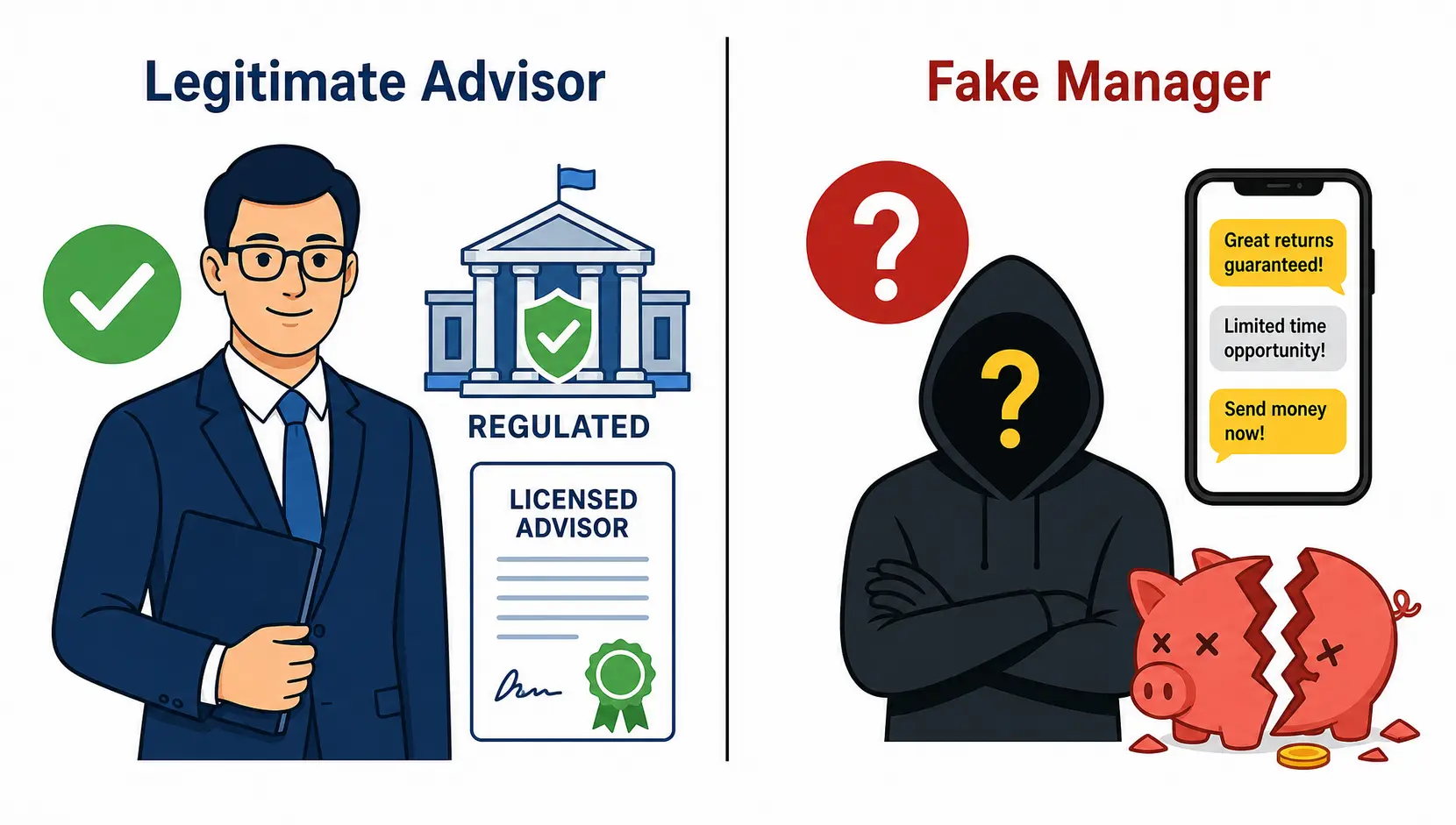
| Feature | Legitimate Financial Advisor | Fake Account Manager |
|---|---|---|
| Regulation | Licensed and registered with a national authority (e.g., FCA, SC). Verifiable on a public register. | Unregulated or claims regulation from a questionable offshore authority. Not on major regulatory registers. |
| Promises & Guarantees | Emphasises risk, provides realistic potential returns, and never guarantees profit. | Guarantees high, consistent profits with little or no risk. |
| Communication | Uses official company email, provides formal documents, has a physical office and public records. | Relies on informal apps (WhatsApp, Telegram), avoids formal documentation, and has no verifiable physical presence. |
| Access to Funds | Your funds are held with a regulated custodian. Withdrawals are clear and direct to your bank account. | Demands funds be sent to unregulated brokers or personal accounts. Creates obstacles (fees, taxes) for withdrawals. |
| Credentials | Will ask for your login credentials. | Will never ask for your account login details. May use a formal LPOA if managing your portfolio. |
What to Do if You’ve Been Targeted by a Fake Account Manager Scam
Pro Tip: If you suspect a scam, acting quickly and decisively is paramount. Your goals are to prevent further financial loss and to report the crime to the proper authorities to help protect others.
It’s a deeply distressing situation, but falling into a state of panic is what the scammers hope for. Here is a structured approach to take control of the situation.
Immediate Steps to Protect Yourself
- Cease All Contact and Payments: The moment you suspect a scam, stop all communication. Do not respond to their messages or calls. Block them on all platforms. Crucially, do not send any more money, no matter what threats or promises they make about recovering your initial investment. Any request for a ‘fee’ or ‘tax’ is just part of the scam.
- Document Everything: Your records are vital evidence. Take screenshots of all conversations, the scammer’s profile, the fake trading platform showing your ‘balance,’ and any transaction receipts. Save all emails and note down phone numbers and website addresses.
- Contact Your Bank: If you made payments via bank transfer or credit/debit card, contact your bank immediately. Explain that you believe you have been the victim of a scam. They can advise you on whether any transactions can be reversed (though this is often difficult) and will take steps to secure your accounts.
- Secure Your Information: If you shared any personal information or passwords, assume they are compromised. Change the passwords on all your important accounts immediately, especially email and online banking. Enable two-factor authentication (2FA) wherever possible.
| Scammer’s Excuse for Withdrawing | The Reality |
|---|---|
| “You must pay a 20% tax on your profits before we can release the funds.” | This is an extraction tactic. Legitimate brokers do not collect taxes on behalf of governments. Taxes are your personal responsibility to declare and pay to your local tax authority (e.g., LHDN in Malaysia, HMRC in the UK). |
| “A withdrawal fee/blockchain gas fee is required to process your transaction.” | While some platforms have small transaction fees, they are typically deducted from the withdrawal amount, not required as a separate, upfront payment. This is another attempt to get more money from you. |
| “Your account is frozen for a ‘security review’. You need to deposit more funds to verify your identity.” | A legitimate security review would never require a fresh deposit. This is a nonsensical excuse designed to exploit your panic and desperation. |
| “You need to upgrade to a VIP account to enable large withdrawals. This requires a fee.” | This is a classic upsell scam. Your ability to withdraw your own money should never be contingent on paying for a higher account tier. |
Reporting the Scam to Authorities and Trading Platforms
Reporting is a crucial step. While it may not always lead to the recovery of your funds, it helps authorities track these criminal networks and can prevent others from falling victim.
- In Malaysia:
- File a report with the Royal Malaysia Police (PDRM) at your nearest station.
- Contact the National Scam Response Centre (NSRC) by dialling 997. This is the primary national hotline for reporting financial scams.
- Report the matter to Bank Negara Malaysia (BNM) and the Securities Commission Malaysia (SC) through their official complaint channels.
- In the United Kingdom:
- Report the incident to Action Fraud, which is the UK’s national reporting centre for fraud and cybercrime. You can do this on their website.
- If the scam involved a firm pretending to be authorised, report it to the Financial Conduct Authority (FCA).
- Report on Social Media: Report the scammer’s profile on the social media platform (Facebook, Instagram, etc.) where they contacted you. This can help get their account shut down.
Frequently Asked Questions
1. What’s the difference between a real and a fake account manager?
As a financial planner, I can tell you the core difference lies in three areas: Regulation, Transparency, and Professionalism.
A real manager is licensed by a government body like the SC or FCA and their registration is publicly verifiable. They are transparent about risks and their fees are clearly stated in formal documents.
A fake manager is unregulated, promises unrealistic guaranteed profits, and operates through informal channels, often pressuring you for quick decisions.
2. Are celebrity endorsements for trading platforms always fake?
While not all are fake, many scam operations misuse images and create fake endorsements of celebrities and public figures (like Martin Lewis in the UK or local personalities in Malaysia) without their knowledge.
You should always be extremely sceptical of any investment opportunity you see advertised with a celebrity endorsement on social media. Treat it as a red flag and do your own research on the product or platform itself, completely ignoring the endorsement.
3. Can I get my money back after being scammed by a fake account manager?
I have to be honest with you; recovering funds from these scams is very difficult and, in many cases, impossible.
Scammers use complex methods, including unregulated brokers and cryptocurrencies, to move money across borders, making it almost untraceable. Your best chance, though slim, is to act immediately by contacting your bank to see if a transaction can be stopped or disputed.
Reporting to the police is essential for the official investigation, but you should be wary of anyone who contacts you afterwards promising to recover your money for a fee – this is often a secondary scam, known as a recovery scam.
4. Why did they let me withdraw a small amount of money at first?
This is a deliberate and very effective psychological tactic. By allowing you to make a small, easy withdrawal, they ‘prove’ the system works.
This builds your confidence and extinguishes any doubt you might have. It’s designed to make you feel safe enough to invest a much larger sum of money, which they never intend to let you withdraw. It is a classic confidence trick updated for the digital age.
David Lim’s Final Thoughts
In my years of practice, I’ve built my philosophy on a simple principle: financial plans must be simple, practical, and sustainable. This is the very antithesis of what fake account manager scams promise.
They offer complexity disguised as sophistication, impractical ‘get-rich-quick’ schemes, and a completely unsustainable path that always leads to ruin.
Building wealth is a marathon, not a sprint. It is achieved through discipline, patience, and sound, regulated investment strategies—not through a ‘secret algorithm’ peddled by a stranger on social media. Your financial security is one of your most valuable assets.
Protect it with vigilance, educate yourself on the risks, and always remember the old wisdom: if it sounds too good to be true, it is.
Sources & Methodology
David Lim strictly relies on primary regulatory data and authoritative official information to ensure accuracy. Data cited in this guide is sourced from:
*Disclaimer: The content of this article represents the personal views of the author (David Lim) and is for educational and reference purposes only. It does not constitute professional investment or financial advice. Trading and investing involve significant risk; proceed with caution.*
