

As a trader who has navigated the markets for over a decade, I’ve seen my share of chaos. I remember the pit in my stomach during the 2015 Swiss Franc flash crash, a stark reminder of how quickly volatility can erase a poorly defended account. This experience taught me a crucial lesson: managing risk isn’t just a part of the game; it is the game. That’s why today, I want to talk about a tool I consider essential for survival: the guaranteed stop-loss order (GSLO). In this guide, we’ll explore in-depth how guaranteed stop loss orders work in volatile markets, a concept that is more than just theory—it’s a practical shield. Understanding the difference between a guaranteed stop loss vs. regular stop and how it can help prevent slippage in volatile markets is not optional; it’s fundamental to long-term survival.
What is a Guaranteed Stop Loss Order (GSLO)?
Pro Tip: A Guaranteed Stop Loss Order (GSLO) is your ‘trade insurance policy’. For a small premium, it provides absolute certainty that your position will be closed at the exact price you specified, no matter how volatile the market becomes or how far it gaps. It completely eliminates the risk of slippage.
Many new traders learn about stop-loss orders as their first line of defence. While a standard stop-loss is a vital tool, it has a critical weakness in turbulent conditions. A GSLO is an advanced order type that addresses this very weakness, offering a level of protection that a standard order cannot match.
The Core Mechanism: How a GSLO Works
Think of a GSLO not just as an instruction, but as a contract between you and your broker. When you place a GSLO, you are paying a small, upfront fee known as a premium. In exchange for this premium, the broker guarantees to close your trade at your chosen price level, irrespective of underlying market conditions. If the market suddenly gaps past your stop level—a common occurrence during major news events—your broker absorbs the risk of the price difference. This mechanism ensures your maximum loss is precisely defined and capped, providing what I call ‘sleep-at-night’ certainty. This is a non-negotiable for me when I anticipate high volatility.
GSLO vs. Standard Stop Loss: Understanding the Key Differences
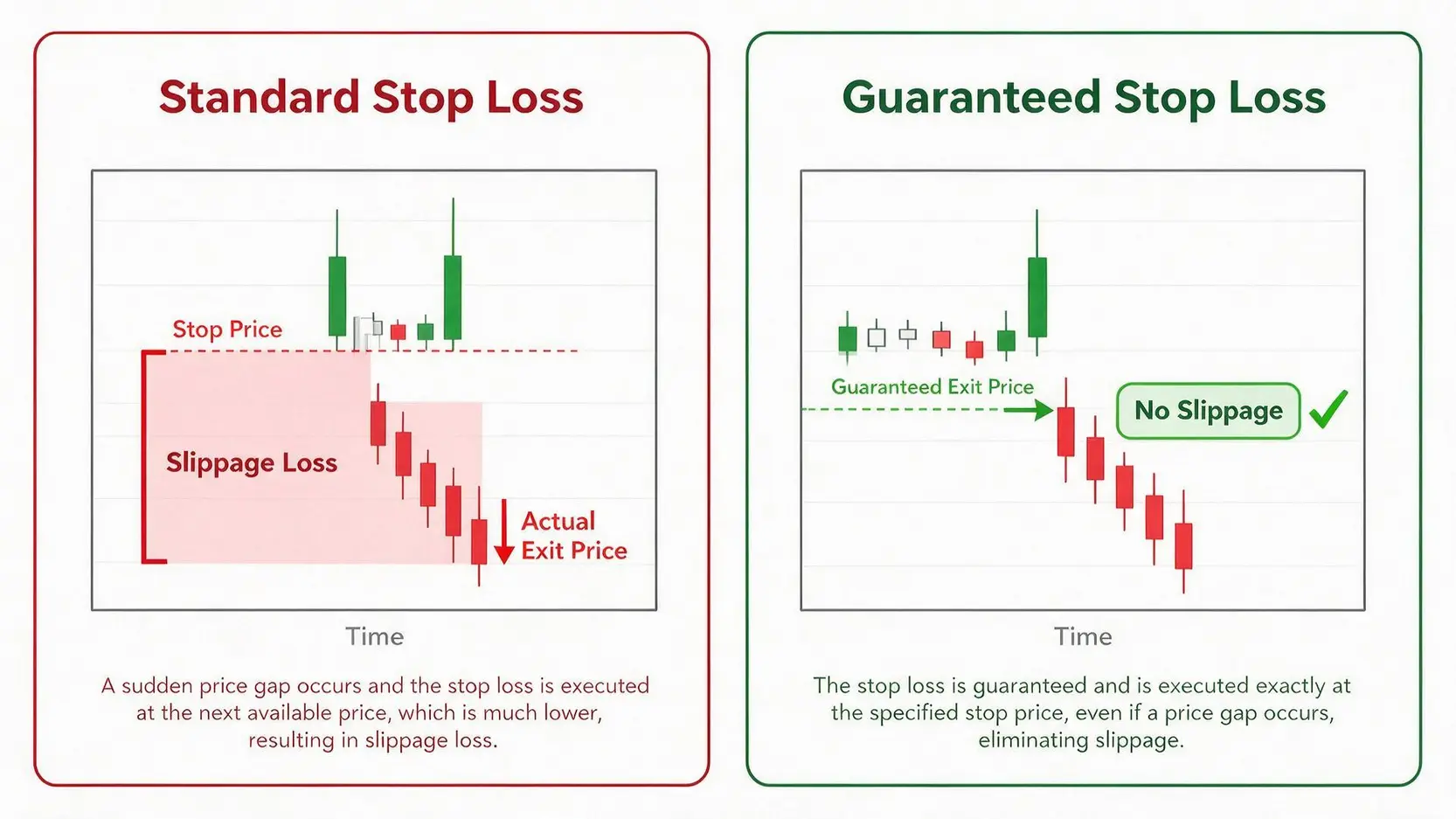
The distinction between a standard stop-loss and a GSLO is one of the most critical concepts a trader must grasp. One is a request; the other is a guarantee. This difference becomes magnified in volatile markets where liquidity thins and price gaps are common. While a standard stop is better than no stop at all, understanding its limitations is key to true risk management.
| Feature | Standard Stop Loss | Guaranteed Stop Loss Order (GSLO) |
|---|---|---|
| Execution | Triggers a market order when your price is hit. Executes at the next available price. | Executes at your exact specified price, guaranteed. |
| Slippage Risk | High risk of slippage in volatile markets. Your exit price could be far worse than your stop price. | Zero slippage risk. The broker assumes the risk of price gaps. |
| Cost | No additional cost to place the order. | Requires a premium, which is a small fee or a wider spread. Often refundable if the GSLO is not triggered. |
| Best For | Normal, stable market conditions. | High-volatility events, overnight positions, weekend holds, and trading volatile assets. |
The Unmatched Role of GSLOs in Volatile Markets
Pro Tip: Use GSLOs as a strategic weapon, not a default setting. Deploy them when you know liquidity will be thin and volatility will be high, such as during NFP (Non-Farm Payroll) releases, interest rate decisions, or on exotic currency pairs known for sharp movements. This is how you turn a defensive tool into a professional edge.
In a calm market, a standard stop-loss works just fine. But we don’t make our living in calm markets, do we? We seek volatility for opportunity, but with that comes heightened risk. It is precisely in these volatile conditions—the very environment traders are drawn to—that the GSLO proves its worth by providing an anchor of certainty in a sea of chaos.
How GSLOs Prevent Slippage and Execution Gaps
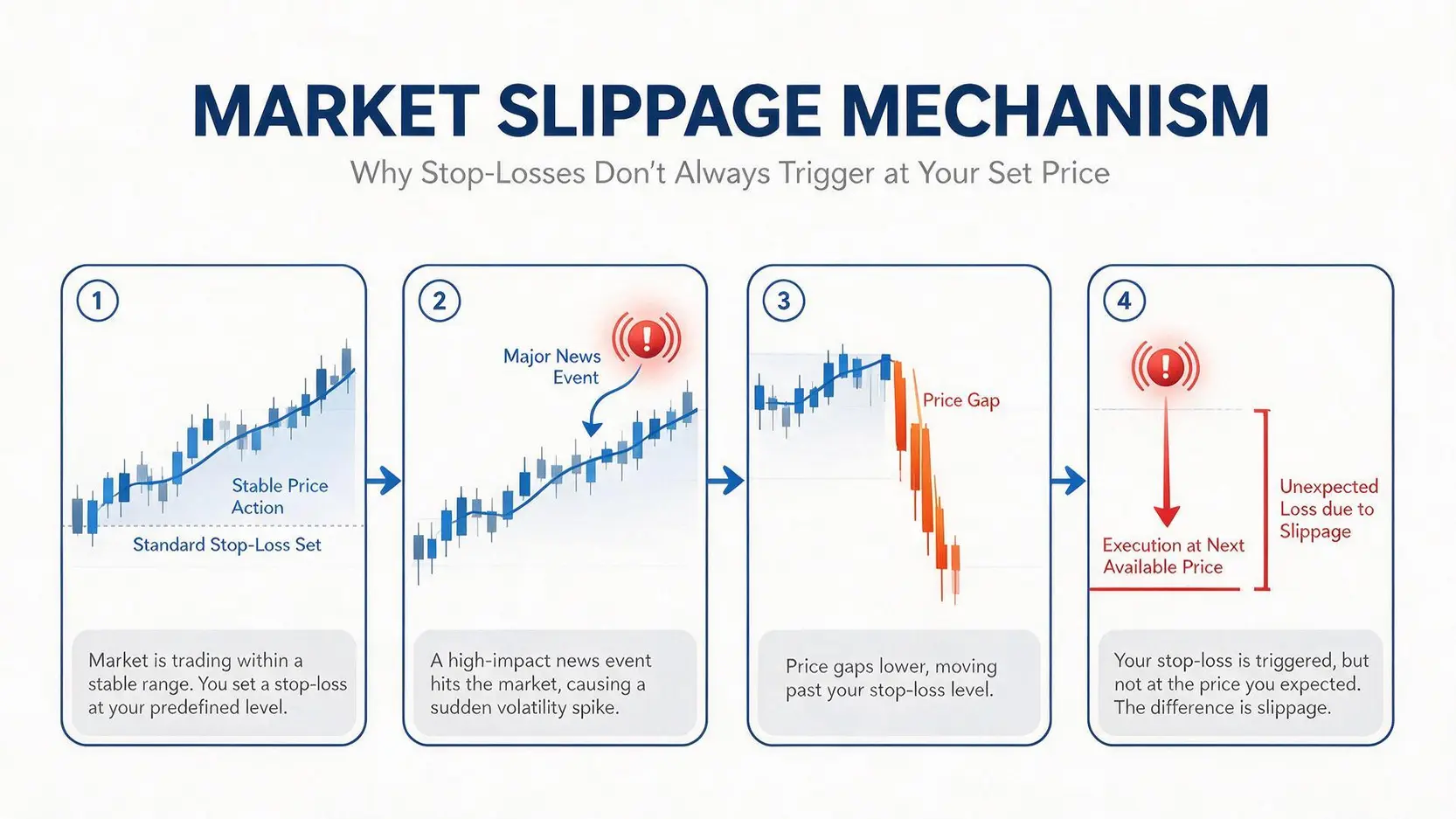
Slippage occurs when there is a difference between the expected price of a trade and the price at which the trade is actually executed. This happens for two main reasons: high market volatility and/or low liquidity. During a major news event, for instance, the market can move hundreds of pips in milliseconds. Buyers and sellers adjust their prices so rapidly that by the time your standard stop-loss order reaches the exchange, the price you wanted is gone. Your order gets filled at the next ‘best’ available price, which can be significantly worse. A GSLO completely bypasses this problem. Since the broker has guaranteed your exit price in a contract, they are obligated to honour it, even if they have to fill the order at a loss to themselves.
Case Study: A Trade Saved by a GSLO During a High-Volatility Event
The quintessential example is the ‘Black Swan’ event of January 15, 2015. The Swiss National Bank (SNB) suddenly announced it was abandoning its currency peg of 1.20 EUR per CHF. The market went into meltdown. The EUR/CHF pair plummeted by over 30% in minutes. Liquidity vanished. Traders who were long on EUR/CHF with standard stop-losses set at, say, 1.1950, found their orders being filled at 1.0500, 0.9000, or even lower. The slippage was unprecedented, leading to losses far exceeding their account balances and bankrupting several brokers.
Now, imagine a trader in that exact scenario but with a GSLO at 1.1950. While the market was in freefall, their broker would have been contractually obligated to close their position at 1.1950 on the dot. Their loss would have been exactly what they had planned for. The GSLO premium would have been the best money they ever spent, saving them from financial ruin. This isn’t a theoretical exercise; it’s the harsh reality of what it means to be protected versus being exposed.
Practical Application and Trading Strategy
Pro Tip: Before entering a trade, ask yourself: ‘Could a sudden news event or weekend gap cause a move that bypasses my standard stop?’ If the answer is yes, the cost of a GSLO premium is a justifiable business expense. Don’t be penny-wise and pound-foolish.
Knowing a tool exists is one thing; knowing when and how to deploy it is another. A GSLO is not meant to be used on every single trade. Its value is situational, and using it strategically is the hallmark of a professional trader who thinks about risk before reward.
The Cost of Certainty: Understanding GSLO Premiums
There is no free lunch in the markets. The certainty provided by a GSLO comes at a cost, typically in the form of a ‘premium’. This premium can be structured in a few ways by brokers:
- A one-time fee: A small, fixed charge paid when you place the GSLO.
- A wider spread: The broker might increase the spread on your trade by a few pips.
- A points-based charge: The cost is a certain number of points based on the trade size.
Crucially, many reputable brokers, regulated by authorities like the Financial Conduct Authority (FCA), will only charge the premium if your GSLO is actually triggered. If you close the trade manually or your take-profit is hit, the premium is often refunded. You only pay for the insurance when you use it. Always check the specific terms with your broker.
| Scenario | Risk with Standard Stop | Outcome with GSLO | Is the Premium Justified? |
|---|---|---|---|
| Trading during an FOMC announcement | High. Potential for 50-100+ pip slippage. | Loss is capped precisely at your stop level. | Absolutely. The cost of the premium is insignificant compared to the potential slippage. |
| Holding a GBP/JPY position over the weekend | Moderate to High. Risk of a weekend gap due to unforeseen geopolitical news. | Protection against any opening gap on Monday morning. | Highly Recommended. It provides peace of mind. |
| Scalping EUR/USD during a quiet Asian session | Low. Markets are stable, liquidity is deep. | Provides the same protection, but the risk of slippage is minimal. | Likely not necessary. The premium might eat into the small profits typical of scalping. |
When to Use a Guaranteed Stop Loss Order in Your Trading Strategy
I build my trading plans around specific scenarios. Here are the situations where I will always consider using a GSLO:
- Major Economic Data Releases: Non-Farm Payrolls (NFP), central bank interest rate decisions, inflation reports (CPI). These are scheduled moments of extreme volatility.
- Holding Positions Over Weekends/Holidays: Markets are closed, but the world isn’t. Geopolitical events can create massive gaps when the market re-opens. A GSLO protects you from this unseen risk.
- Trading Illiquid or Exotic Pairs: Some currency pairs or CFD instruments are inherently less liquid, making them prone to sharp, sudden moves even without a specific news catalyst.
- Protecting a High-Value Account: When your position size is large, even a few pips of slippage can translate into a significant monetary loss. The certainty of a GSLO is paramount.
Frequently Asked Questions
1. How effective are stop loss orders in volatile market conditions?
From my experience, a standard stop-loss order’s effectiveness diminishes significantly in high volatility. It becomes a ‘request’ to exit, not a command. It is highly susceptible to slippage, meaning you can lose far more than you intended. A Guaranteed Stop Loss Order (GSLO), on the other hand, remains 100% effective as it contractually guarantees your exit price, making it the superior tool for volatile conditions.
2. What is the main advantage of a guaranteed stop loss over a regular one?
The single most important advantage is the complete elimination of slippage risk. A regular stop can be executed at a price far from your intended level during market gaps, but a GSLO ensures your position is closed at the exact price you set. This provides absolute certainty over your maximum potential loss on a trade, which is the holy grail of risk management.
3. Do you pay for a guaranteed stop loss if it’s not triggered?
This depends on the broker’s policy, but with most regulated brokers, the answer is no. You typically pay a premium to attach the GSLO to your trade, but this premium is often refunded to your account if the stop is not hit (i.e., you close the trade manually or your take-profit target is reached). You’re only paying for the ‘insurance’ if you actually end up using it, which I find to be a very fair system.
Danny’s Final Thoughts
Sources & Methodology
Danny strictly relies on primary regulatory data and authoritative official information to ensure accuracy. Data cited in this guide is sourced from:
*Disclaimer: The content of this article represents the personal views of the author (Danny) and is for educational and reference purposes only. It does not constitute professional investment or financial advice. Trading and investing involve significant risk; proceed with caution.*
