

As a financial planner, I often sit down with families in Malaysia who are looking to grow their wealth beyond our local shores.
The allure of international markets is strong, offering diversification and growth opportunities not always available on the Bursa Malaysia. However, I’ve also seen the costly consequences of venturing abroad without a proper map.
Many well-intentioned investors make critical financial planning mistakes when investing in foreign markets, turning a promising venture into a source of stress.
This guide is designed to help you navigate this complex landscape, focusing on avoiding costly errors in international investments and building a clear, long-term investment strategy that stands the test of time.
A successful global investment journey begins not with a ‘hot tip’, but with a solid, well-thought-out plan.
The Most Common Financial Planning Errors in Foreign Investing
Embarking on an international investment journey is like planning a long-haul trip. You wouldn’t just show up at the airport without a destination, budget, or itinerary. Yet, many approach foreign markets with exactly that lack of preparation. Let’s break down the most frequent blunders I help my clients correct.
Mistake 1: Letting Emotions Drive Investment Decisions
The 24/7 news cycle, filled with dramatic headlines about market swings in other time zones, can be a powerful emotional trigger. When the Dow Jones Industrial Average has a bad day, it’s easy to feel the tremor here in Kuala Lumpur and consider selling everything.
This is known as ‘panic selling’. Conversely, hearing about a tech boom in Silicon Valley can induce a ‘Fear Of Missing Out’ (FOMO), leading to impulsive buying at inflated prices. Both reactions are driven by emotion, not strategy.
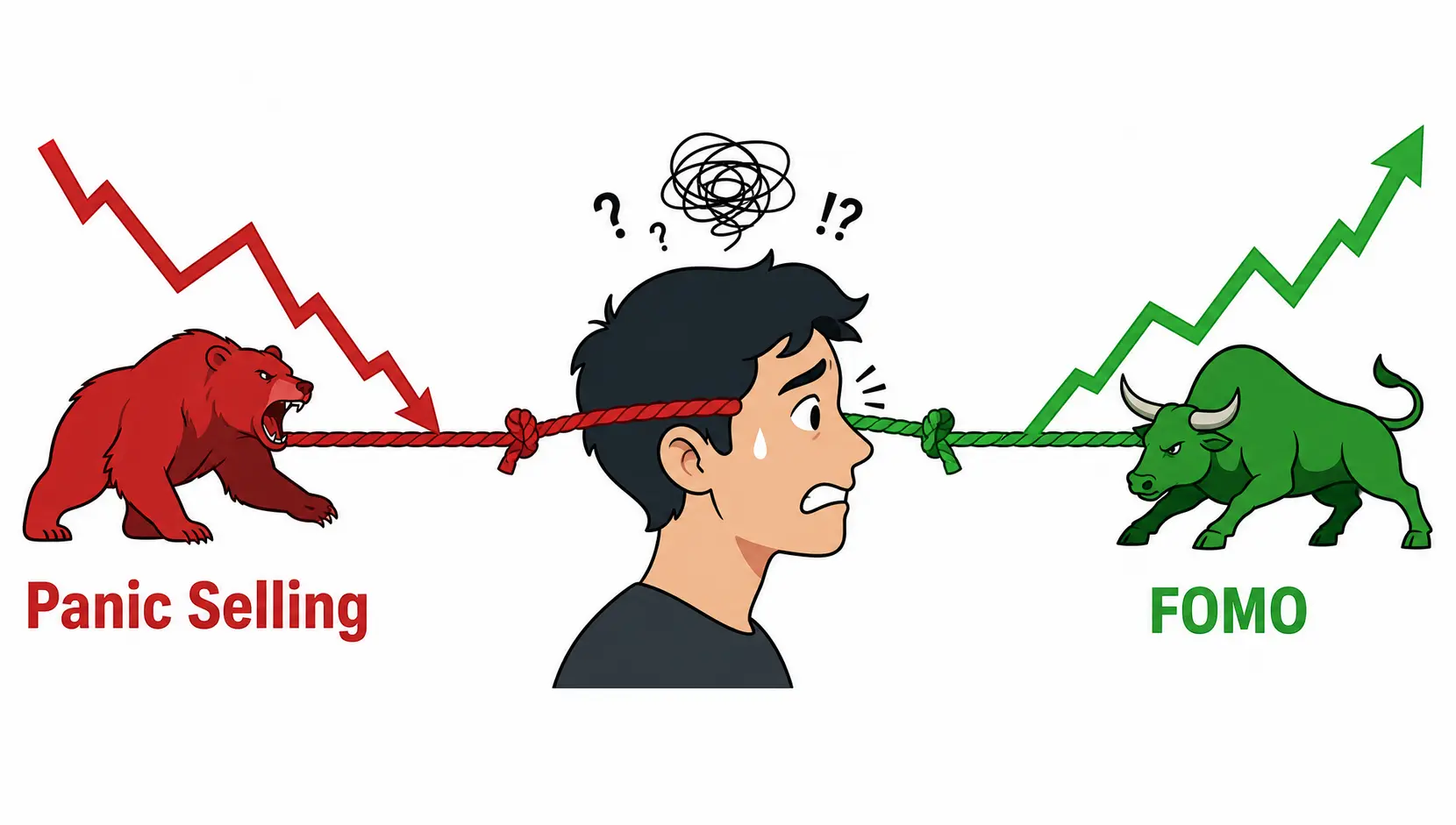
This behavioural challenge is one of the biggest destroyers of wealth. A sound investment plan is created during moments of calm and clarity.
It outlines your goals, your time horizon, and your risk tolerance. Deviating from it because of a scary news report is like throwing your map overboard during that storm.
The key is to have a plan so robust that it accounts for market downturns, allowing you to either stay the course or even rebalance strategically by buying assets at a lower price.
Mistake 2: Insufficient Diversification and Strong Home Bias
As Malaysians, we are naturally comfortable with what we know: local banks, familiar property developments, and companies listed on the Bursa Malaysia. This tendency, known as ‘home bias’, feels safe but is a significant strategic error.
By concentrating all your investments in one country, you are tying your entire financial future to the economic and political fortunes of a single, relatively small market. It’s the classic mistake of putting all your eggs in one basket.
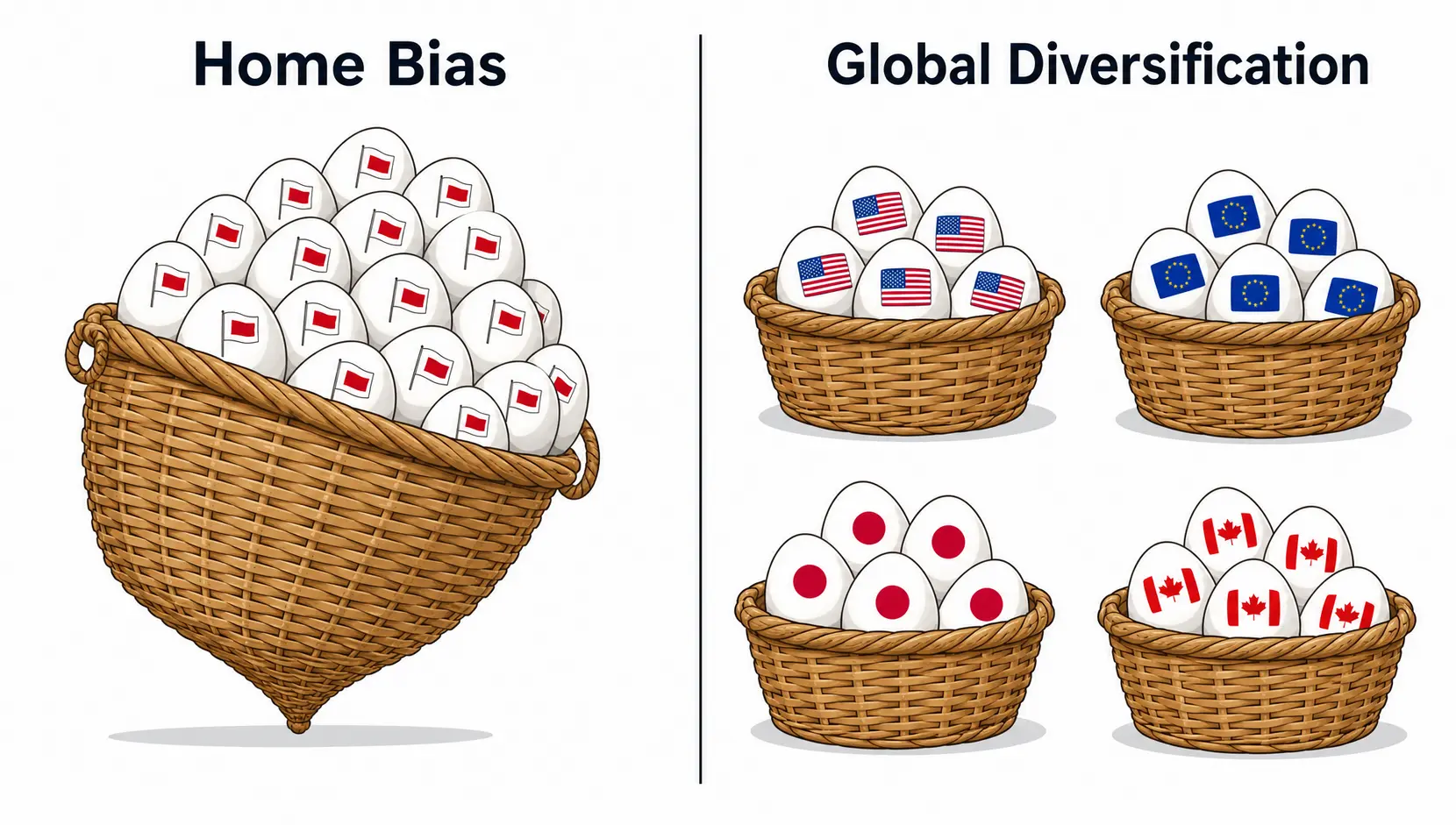
True diversification means spreading your investments across different countries, currencies, industries, and asset classes.
If the Malaysian market is facing headwinds, a well-diversified portfolio with exposure to the US healthcare sector, European consumer staples, or Australian resources can provide stability and growth.
This approach mitigates country-specific risks and provides a much smoother investment journey. Avoiding this common financial planning mistake is fundamental to robust portfolio construction.
| Feature | Domestic-Only Portfolio (High Home Bias) | Globally Diversified Portfolio |
|---|---|---|
| Risk Concentration | High. Entire portfolio is subject to Malaysian economic cycles, political shifts, and Ringgit fluctuations. | Low. Risk is spread across multiple economies, currencies, and political systems. |
| Growth Opportunity | Limited to the growth prospects of the Malaysian economy. Misses out on global innovators like Apple, Amazon, or LVMH. | Vast. Access to the world’s leading companies and fastest-growing sectors, from AI to biotechnology. |
| Portfolio Volatility | Potentially higher, as a downturn in the local market affects all holdings simultaneously. | Generally lower, as losses in one region can be offset by gains in another, leading to a smoother return profile. |
Strategic Pillars for Successful International Investing to Avoid Costly Errors
Now that we’ve identified the pitfalls, let’s focus on building the pillars that will support your journey into foreign markets. A proactive and structured approach is the best defence against the common financial planning mistakes many investors make.
Building a Robust Strategy That Accounts for Global Risks
Your investment strategy must be more than just a list of stocks. It should be a comprehensive ‘Investment Policy Statement’ (IPS) that acts as your constitution.
This document should clearly define:
- Your Financial Goals: Are you investing for retirement in 20 years, your child’s university education in 10, or a down payment on a property in 5? The goal dictates the strategy.
- Your Time Horizon: Longer time horizons allow you to take on more risk for potentially higher returns, as you have more time to recover from downturns.
- Your Risk Tolerance: How would you react to a 20% drop in your portfolio’s value? Be honest with yourself. This will determine your allocation between equities (stocks) and fixed income (bonds).
- Asset Allocation: Define the percentage of your portfolio you will allocate to different regions (e.g., 40% North America, 30% Europe, 20% Asia ex-Malaysia, 10% Malaysia) and asset types.
This strategy must also acknowledge global risks, such as geopolitical tensions, changes in international trade policies, or shifts in monetary policy by central banks like the US Federal Reserve.
While you cannot predict these events, a diversified strategy ensures no single event can derail your entire plan.
The Importance of Due Diligence and Understanding Local Markets
Investing in a foreign country is not the same as investing in a foreign company. You are also investing in that country’s legal system, its political stability, its consumer culture, and its corporate governance standards.
A great company in a poorly-regulated market with an unstable government is a high-risk investment.
Due diligence means going beyond the company’s annual report. It involves understanding the macro-environment.
For retail investors, this can be challenging. This is why many choose to invest through global unit trusts or Exchange-Traded Funds (ETFs). These funds have professional managers and analysts who perform this deep-dive research on your behalf.
They provide instant diversification across hundreds or even thousands of companies in various countries, making it a practical and cost-effective way to get foreign market exposure.
Advanced Topics in Foreign Investment Planning
Once your core strategy is in place, you can consider some of the more technical aspects of international investing. These are the details that can help optimise your returns and prevent unpleasant surprises.
Navigating Currency Risk and Hedging Strategies
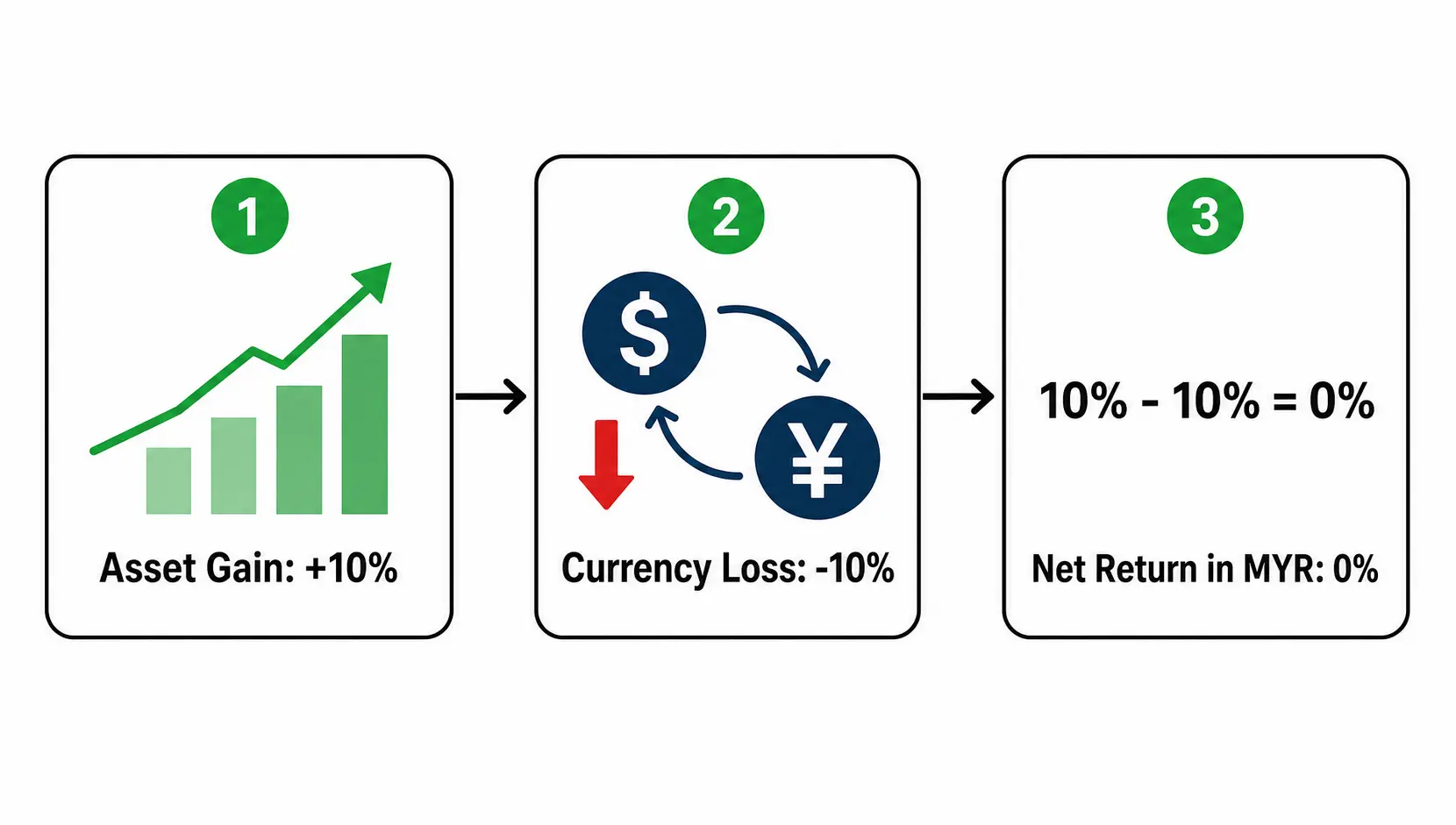
When you invest in a US stock, you are making two bets: one on the company’s performance and another on the USD/MYR exchange rate. If your US stock goes up 10%, but the US dollar weakens by 10% against the Ringgit, your net return in MYR is zero.
This is currency risk, and it’s a critical factor often overlooked.
What can you do? For most retail investors, the simplest approach is to invest via currency-hedged unit trusts or ETFs. These funds use financial instruments to minimise the impact of exchange rate fluctuations on your returns.
While this service comes at a small cost (usually a slightly higher management fee), it provides peace of mind by isolating your investment return from currency volatility.
For a full breakdown of hedging, this guide on forex hedging from Investopedia is an excellent resource.
| Scenario | Unhedged Investment | Hedged Investment |
|---|---|---|
| Initial Investment | RM47,000 to buy $10,000 USD of assets (Rate: 4.70) | RM47,000 to buy $10,000 USD of assets (Rate: 4.70) |
| Asset Performance | Assets grow by 10% to $11,000 USD | Assets grow by 10% to $11,000 USD |
| New Exchange Rate | USD weakens, Ringgit strengthens. Rate is now 4.40. | Hedge locks in a rate close to the original 4.70. |
| Value in Ringgit | $11,000 * 4.40 = RM48,400 (A mere 3% gain) | $11,000 * ~4.70 = ~RM51,700 (Close to the full 10% gain) |
Understanding Tax Implications and Regulatory Hurdles
Tax is one of life’s certainties, but it becomes much more complex when you cross borders. You must be aware of two main areas: taxes in the country you’re investing in (withholding taxes on dividends) and taxes in Malaysia on your returns.
As of 2026, the rules around Foreign Sourced Income (FSI) for Malaysian residents have been evolving. While there was a transition period, it is vital to understand the current policy.
The official source for this is always the Lembaga Hasil Dalam Negeri Malaysia (LHDN). Generally, income earned and received from abroad may be subject to tax, but specific exemptions can apply.
Furthermore, Malaysia has Double Taxation Agreements (DTAs) with many countries, which prevent you from being taxed twice on the same income. Understanding these nuances is crucial for accurate financial planning.
Beyond taxes, there are also regulatory considerations. Bank Negara Malaysia (BNM) sets out the Foreign Exchange Policy (FEP) which governs how much money residents can invest abroad.
For retail investors, the limits are quite generous, but it’s important to be aware of the rules to ensure you remain compliant.
Frequently Asked Questions
1. What is the most common mistake investors make during market uncertainty?
From my experience, the most frequent and damaging mistake is abandoning a well-thought-out long-term strategy in response to short-term market noise.
This often involves selling quality assets at a loss out of fear, only to miss the eventual recovery. A good financial plan is designed to withstand this kind of uncertainty.
2. How can I start investing in foreign markets safely from Malaysia?
The safest way for a beginner is to use licensed and regulated platforms. Start with globally diversified unit trusts or ETFs offered by reputable fund management companies in Malaysia. These products are regulated by the Securities Commission Malaysia.
Start small, be consistent with your investments (a practice known as Ringgit Cost Averaging), and focus on understanding what you’re investing in before making large commitments.
3. What is ‘home bias’ and why is it a mistake?
‘Home bias’ is the natural tendency to invest most of your money in your home country because it feels familiar and safe. It’s a mistake because it leads to a poorly diversified portfolio.
It ties your entire financial well-being to the economic fate of just one country, exposing you to concentrated risks like a local recession, political instability, or currency devaluation.
4. Do I need a lot of money to invest overseas from Malaysia?
Absolutely not. This is a common misconception. Thanks to unit trusts and digital investment platforms, you can start investing in global markets with as little as RM100.
The key is not the amount you start with, but the consistency of your investment habit over the long term. Regular, small contributions can grow into a substantial sum over time due to the power of compounding.
David Lim’s Final Thoughts
Sources & Methodology
David Lim strictly relies on primary regulatory data and authoritative official information to ensure accuracy. Data cited in this guide is sourced from:
*Disclaimer: The content of this article represents the personal views of the author (David Lim) and is for educational and reference purposes only. It does not constitute professional investment or financial advice. Trading and investing involve significant risk; proceed with caution.*
