
Anyone who has spent enough time in the markets understands that survival is the name of the game. When trading volatile instruments like US indices, the decision between a standard lot vs micro lot is one of the most fundamental risk management choices you will make.
It dictates not just potential profit, but the speed at which your capital can be eroded. Understanding how to calculate your position size and select the appropriate contract is paramount before you even think about direction.
This guide is built from years of experience, designed to give you a practical framework for making that choice.
What Are Lot Sizes in Index Trading?
Pro Tip: Think of a ‘lot’ as the standardised quantity of the financial instrument you are trading. In futures, this is called a contract. Its size directly determines the monetary value of each price movement (tick) and, consequently, your total exposure and risk per trade. A larger lot size means each price move has a bigger impact on your account balance.
Before placing any trade, you must understand the language of position sizing. A ‘lot’ is a unit of measurement. The terminology can vary slightly between Forex and Futures markets, but the principle is identical.
It standardises trade sizes, allowing for uniform risk and liquidity across the market. In the context of US index futures, we talk about ‘contracts’—specifically standard (or E-mini) and micro contracts.
Defining Standard, Mini, and Micro Lots
While the term ‘standard lot’ is most common in Forex (representing 100,000 units of the base currency), in the world of index futures, the equivalent is the benchmark contract for that index.
For the S&P 500, this is the E-mini S&P 500 futures contract. The smaller variations are what allow for more granular risk control.
| Lot Type | Typical Representation (Futures) | Primary Characteristic |
|---|---|---|
| Standard (E-mini) | The benchmark futures contract (e.g., E-mini S&P 500 – ES) | High notional value, large tick value. Suited for institutional or well-capitalised traders. |
| Mini | Historically, 1/10th the size of a true standard contract. The ‘E-mini’ itself is a ‘mini’ version of an older, larger contract. | A mid-tier option, largely superseded by the flexibility of E-minis and Micros. |
| Micro | A fraction of the standard/E-mini contract (e.g., Micro E-mini S&P 500 – MES) | Low notional value, small tick value. Ideal for precise risk management, small accounts, and strategy testing. |
How Lot Size Determines Contract Value and Potential P/L
The profit or loss (P/L) of a futures trade is a direct function of the contract’s multiplier and the number of points the index moves. The multiplier is the fixed dollar amount assigned to each point of movement in the underlying index.
Formula: P/L = (Exit Price – Entry Price) x Multiplier x Number of Contracts
A contract with a $50 multiplier (like the E-mini S&P 500) will generate a $50 profit or loss for every 1.0 point move in the index. A contract with a $5 multiplier (the Micro E-mini) will generate a $5 P/L for the same move. This tenfold difference is the core of our discussion.
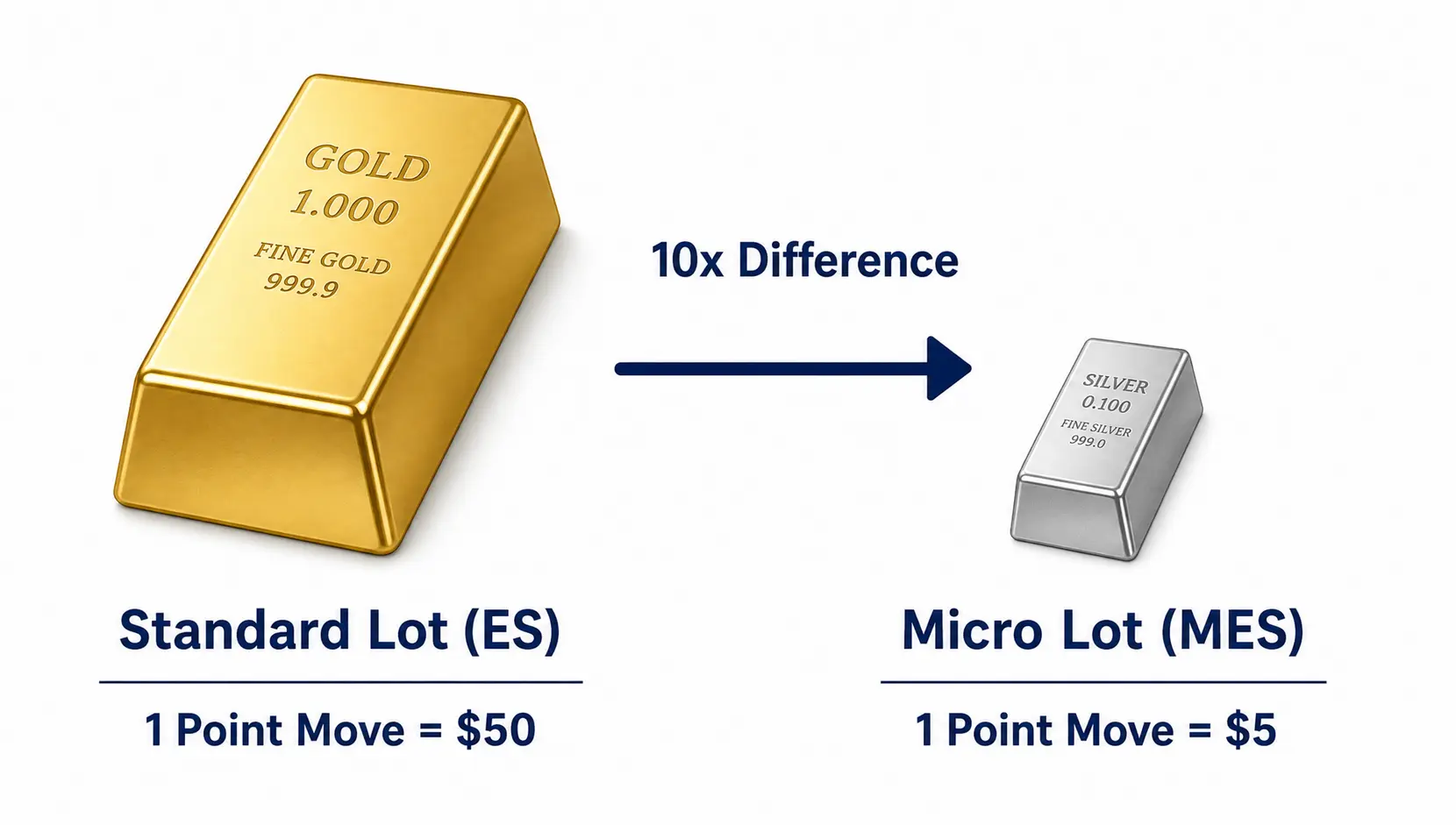
Core Risk Comparison: A Look at Standard Lot vs Micro Lot in Futures Trading
Choosing between a standard (E-mini) and micro contract is a strategic decision that must align with your capital base, risk tolerance, and trading objectives. This is not about being ‘brave’ or ‘timid’; it’s about being a professional who selects the right tool for the job.
The High-Stakes Game: Advantages and Risks of Standard Lots
The E-mini S&P 500 (ES) is a powerful instrument. Its primary advantage is capital efficiency for large-scale traders. If your strategy calls for significant market exposure, trading one ES contract is cheaper in commissions and simpler to manage than trading ten MES contracts.
Advantages:
- Capital Efficiency: Lower commissions for equivalent large-size exposure compared to multiple micro contracts.
- Substantial Returns: The larger multiplier means that a successful trade delivers significant profits in absolute dollar terms. A 10-point move on one ES contract is $500.
However, the risks are symmetric. The leverage that amplifies gains will magnify losses just as viciously.
The Flexible Approach: Advantages and Risks of Micro Lots
Micro E-mini contracts were a revolutionary product. They democratised access to index futures trading by reducing the capital required and allowing for surgical precision in risk management. Their primary advantage is flexibility.
Advantages:
- Granular Risk Management: You can scale your position size with incredible precision. You can trade 1, 2, or 3 micro contracts to fine-tune your exposure, which is impossible with standard contracts.
- Lower Capital Requirement: The margin required to hold a micro contract is 1/10th that of an E-mini, making it accessible to traders with smaller accounts.
- Psychological Benefit: Trading with smaller size reduces the emotional stress of large P/L swings, allowing a trader to focus on executing their strategy correctly. This is invaluable when learning.
The main ‘risk’ or drawback of micro lots is the inverse of the standard lot’s advantage: for a very large position, commissions can be higher than taking a single standard lot. However, for the vast majority of retail traders, this is a non-issue.
Applying Lot Size to US Index Futures
Summary: The choice between the E-mini S&P 500 (ES) and the Micro E-mini S&P 500 (MES) comes down to a single factor: the multiplier. The ES contract has a multiplier of $50 per point, while the MES has a multiplier of $5 per point. This tenfold difference is the key to managing your risk when trading US indices.
Let’s make this concrete. We’ll compare the two flagship S&P 500 futures products from the CME Group, the world’s leading derivatives marketplace.
Case Study: S&P 500 E-mini (ES) vs. Micro E-mini (MES)
Imagine the S&P 500 index is trading at 5,300 points. Let’s break down the two contracts.
| Specification | E-mini S&P 500 (ES) | Micro E-mini S&P 500 (MES) |
|---|---|---|
| Underlying Index | S&P 500 | S&P 500 |
| Contract Multiplier | $50 | $5 |
| Minimum Tick Size | 0.25 index points | 0.25 index points |
| Tick Value | $12.50 ($50 x 0.25) | $1.25 ($5 x 0.25) |
| Notional Value (at 5300) | $265,000 (5300 x $50) | $26,500 (5300 x $5) |
As you can see, the notional value (the total value of the position you are controlling) of one E-mini contract is a quarter of a million dollars. The Micro E-mini is a much more manageable $26,500. This directly impacts your risk calculations.
How to Calculate Your Position Size for Index Trading
This is where everything comes together. A professional trader doesn’t guess; they calculate.
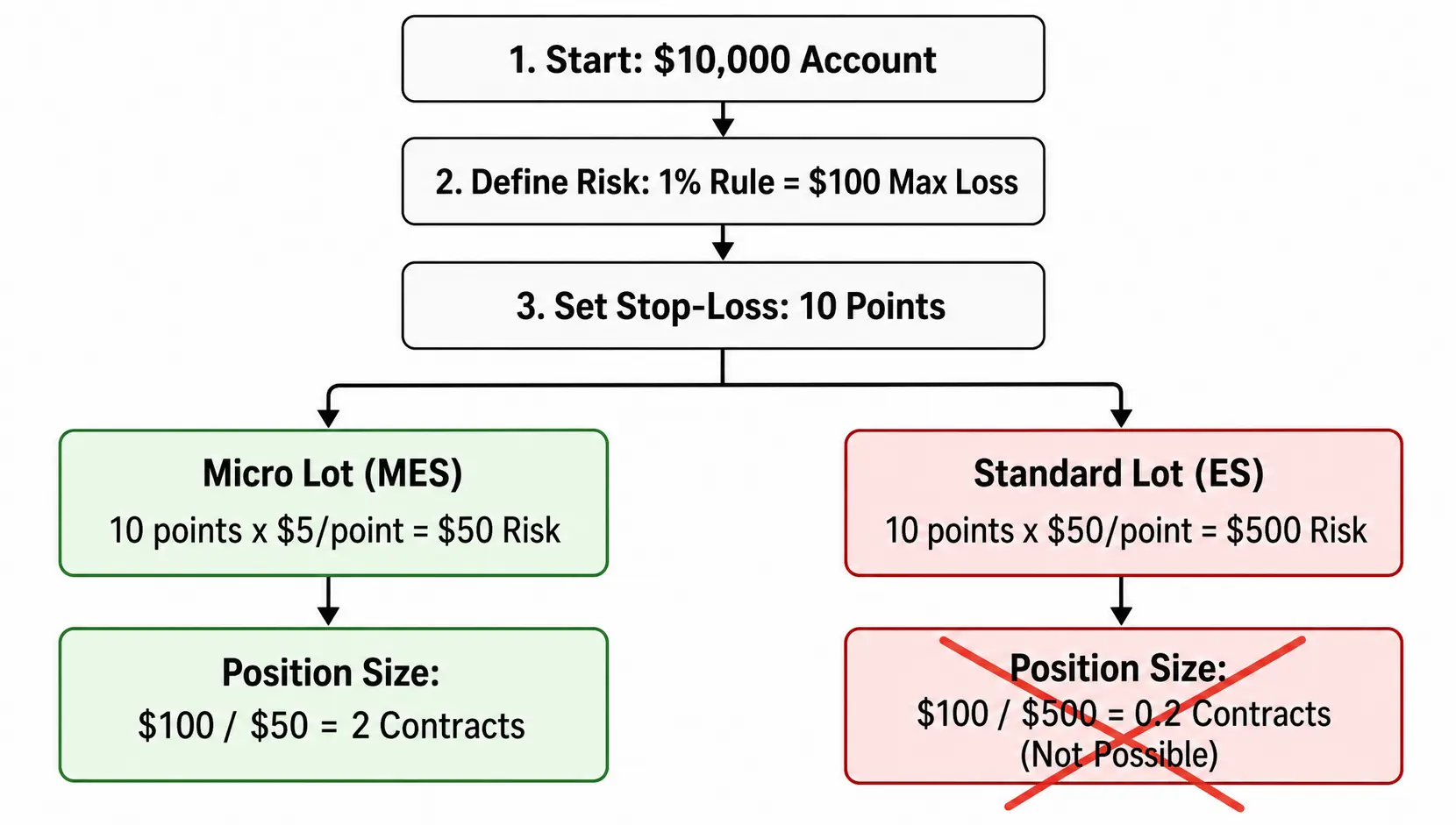
- Determine Your Account Risk Limit: This is the maximum percentage of your trading capital you are willing to lose on a single trade. A conservative and highly recommended starting point is 1%. For a $10,000 account, this is $100.
- Define Your Trade’s Invalidation Point (Stop-Loss): Where will you exit the trade if you are wrong? This should be based on technical analysis, not a random number. Let’s say your analysis indicates a stop-loss 10 points away from your entry.
- Calculate Risk per Contract: For an MES contract, a 10-point stop-loss represents a risk of $50 (10 points x $5 multiplier). For an ES contract, it’s a risk of $500 (10 points x $50 multiplier).
- Calculate Your Position Size: Divide your Account Risk Limit by your Risk per Contract.
- Using MES: $100 (Account Risk) / $50 (Trade Risk) = 2 contracts.
- Using ES: $100 (Account Risk) / $500 (Trade Risk) = 0.2 contracts. Since you cannot trade a fraction of an ES contract, you are immediately faced with a choice: either don’t take the trade, or take on five times your intended risk ($500).
Frequently Asked Questions
1. What is the dollar value of a micro lot in index futures?
The dollar value, or ‘tick value’, of a Micro E-mini S&P 500 (MES) contract is $1.25 for every 0.25 point move. The value per full index point is $5. This is precisely one-tenth the value of the standard E-mini contract.
2. Can beginners trade US indices with a small account using micro lots?
Yes. Micro lots were specifically designed for this purpose. They allow a trader with a smaller capital base (e.g., under $25,000) to trade highly liquid products like the S&P 500 or NASDAQ-100 with appropriate risk management.
It’s the ideal entry point, in my opinion, after one has spent sufficient time on a simulator.
3. How does leverage impact the risk associated with standard and micro lots?
Leverage is a double-edged sword that magnifies both gains and losses. Both standard and micro lots are leveraged instruments. However, the total notional value of a standard lot is ten times larger, meaning the leverage is applied to a much larger base.
A 1% move in the underlying index will have a tenfold greater dollar impact on your P/L with a standard lot compared to a micro lot, making its effective risk exposure significantly higher.
4. Which is better for day trading, a standard or micro lot?
For over 95% of retail day traders, the micro lot is unequivocally the superior tool. It provides the flexibility to manage risk on tight timeframes, scale in and out of positions, and operate with a capital base that isn’t exposed to catastrophic loss from a single adverse move.
Standard lots should only be considered by highly experienced, well-capitalised traders who require that level of exposure.
Danny’s Final Thoughts
In my years of trading, I’ve learned that longevity is the ultimate skill. The debate between a standard lot and a micro lot isn’t about maximising profit on one trade; it’s about structuring your risk so you can survive to trade for the next decade.
The micro lot is the most significant risk management innovation for retail futures traders in the last 20 years. It provides the granularity needed to execute a professional trading plan without exposing your account to unacceptable levels of volatility.
Start small, master your strategy, and respect the risk. The profits will follow from a foundation of discipline, not from oversized bets.
Sources & Methodology
Danny strictly relies on primary regulatory data and authoritative official information to ensure accuracy. Data cited in this guide is sourced from:
*Disclaimer: The content of this article represents the personal views of the author (Danny) and is for educational and reference purposes only. It does not constitute professional investment or financial advice. Trading and investing involve significant risk; proceed with caution.
