

As a trader who has navigated through the shocks of the 2015 Swiss Franc event and the 2020 pandemic meltdown, I’ve learned that market turbulence isn’t a matter of ‘if’, but ‘when’. The key to longevity in this game is not avoiding downturns, but preparing for them. This is where learning how to hedge market downturn using index CFDs becomes an essential skill. It’s a professional strategy to protect your investment portfolio against a market decline, and when executed with discipline, it acts as a crucial buffer. This guide will offer a practical, no-nonsense look into using this derivative tool for effective hedging strategies for market downturns, grounded in hard-won experience rather than textbook theory.
What is Hedging in a Market Downturn?
Pro Tip: Think of hedging as buying insurance for your investment portfolio. You accept a small, defined cost (the cost of the hedge) to protect yourself against a much larger, catastrophic loss during a market crash. The goal is not to make a profit from the hedge itself, but to preserve capital in your primary holdings.
Understanding the Core Concept of Hedging
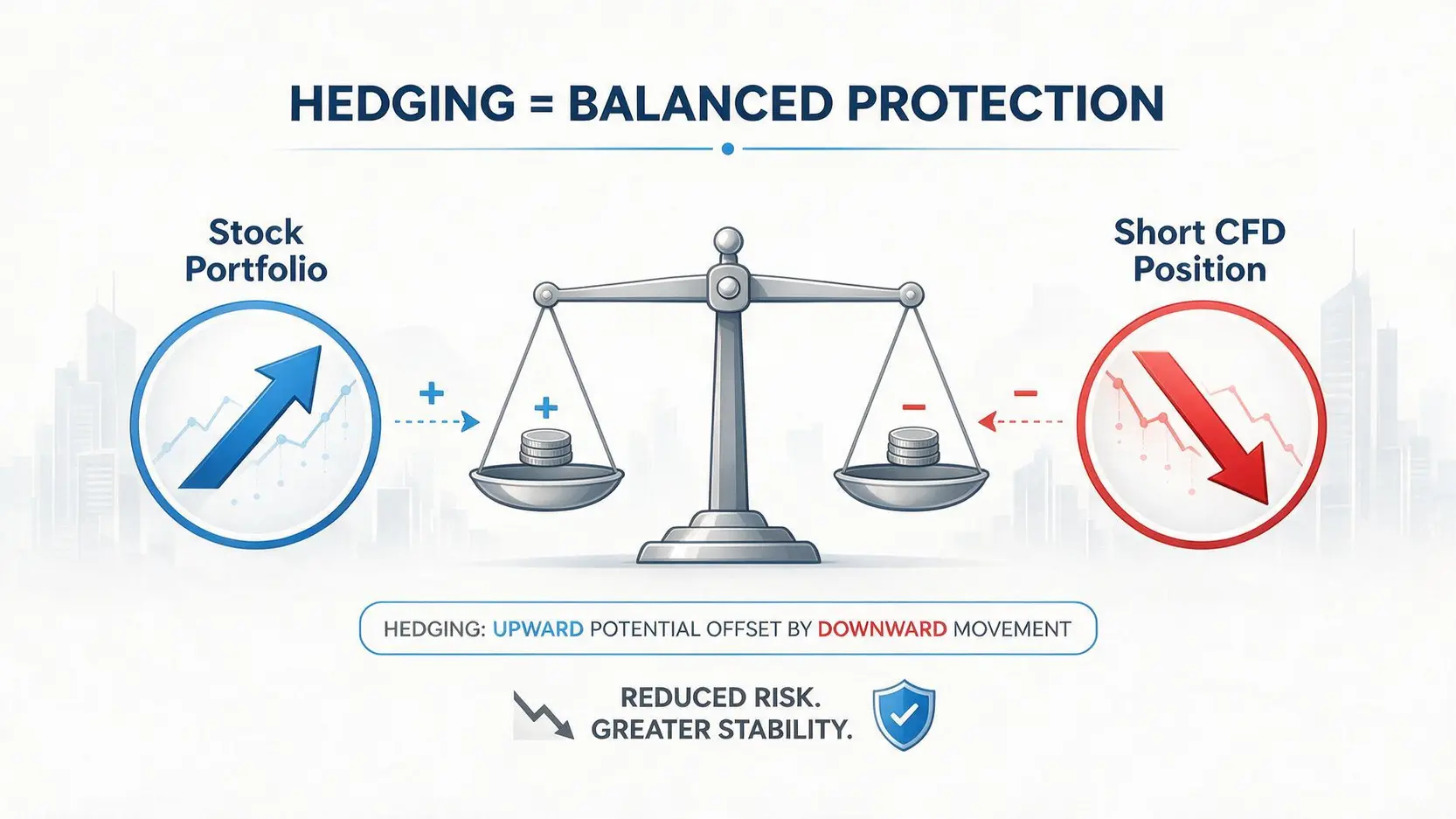
In financial markets, hedging is the strategic practice of taking an offsetting position in a related security. The intention is to mitigate the risk of adverse price movements in an asset. When you own a portfolio of stocks, you are ‘long’ the market – you profit when prices go up. A market downturn, therefore, represents a significant risk. A hedge involves establishing a ‘short’ position that will increase in value as the market falls, thereby offsetting the losses incurred by your long portfolio. For a comprehensive definition, authoritative sources like Investopedia provide a solid foundation. However, I view it more practically: it’s a calculated move to reduce your net exposure when uncertainty is high.
Why Choose Index CFDs for Your Hedging Strategy?
While various instruments like put options and futures can be used for hedging, Contracts for Difference (CFDs) on indices offer a unique combination of flexibility, accessibility, and precision that I find particularly effective for retail traders. An index CFD is a derivative product that allows you to speculate on the price movement of a market index (like the S&P 500 or FTSE 100) without owning the underlying asset.
The primary advantage is the ability to take a short position easily. If you anticipate a market decline, you can sell an index CFD. If the index falls as you predicted, your short position becomes profitable, offsetting the drop in your physical stock portfolio. They are also capital-efficient due to leverage, meaning you only need to put down a fraction of the total trade value as margin. This, however, brings us to the other side of the coin – the risks.
| Feature | Index CFDs | Put Options |
|---|---|---|
| Cost Structure | Spread + Overnight Financing Fees (Swaps) | Premium (Upfront Cost) |
| Complexity | Relatively straightforward (price movement). | More complex (includes strike price, time decay/theta, implied volatility). |
| Capital Outlay | Low initial margin required due to leverage. | Full premium must be paid upfront. |
| Expiry Date | No expiry date (can be held as long as fees are paid). | Fixed expiry date, after which the option becomes worthless. |
| Risk | Losses can exceed initial margin (leverage risk). | Loss is limited to the premium paid. |
A Step-by-Step Guide to Hedging with Index CFDs
Pro Tip: The foundation of a successful hedge is precise calculation, not gut feeling. Follow these steps methodically. Measure twice, cut once. Rushing into a hedge without proper assessment is just another form of gambling.
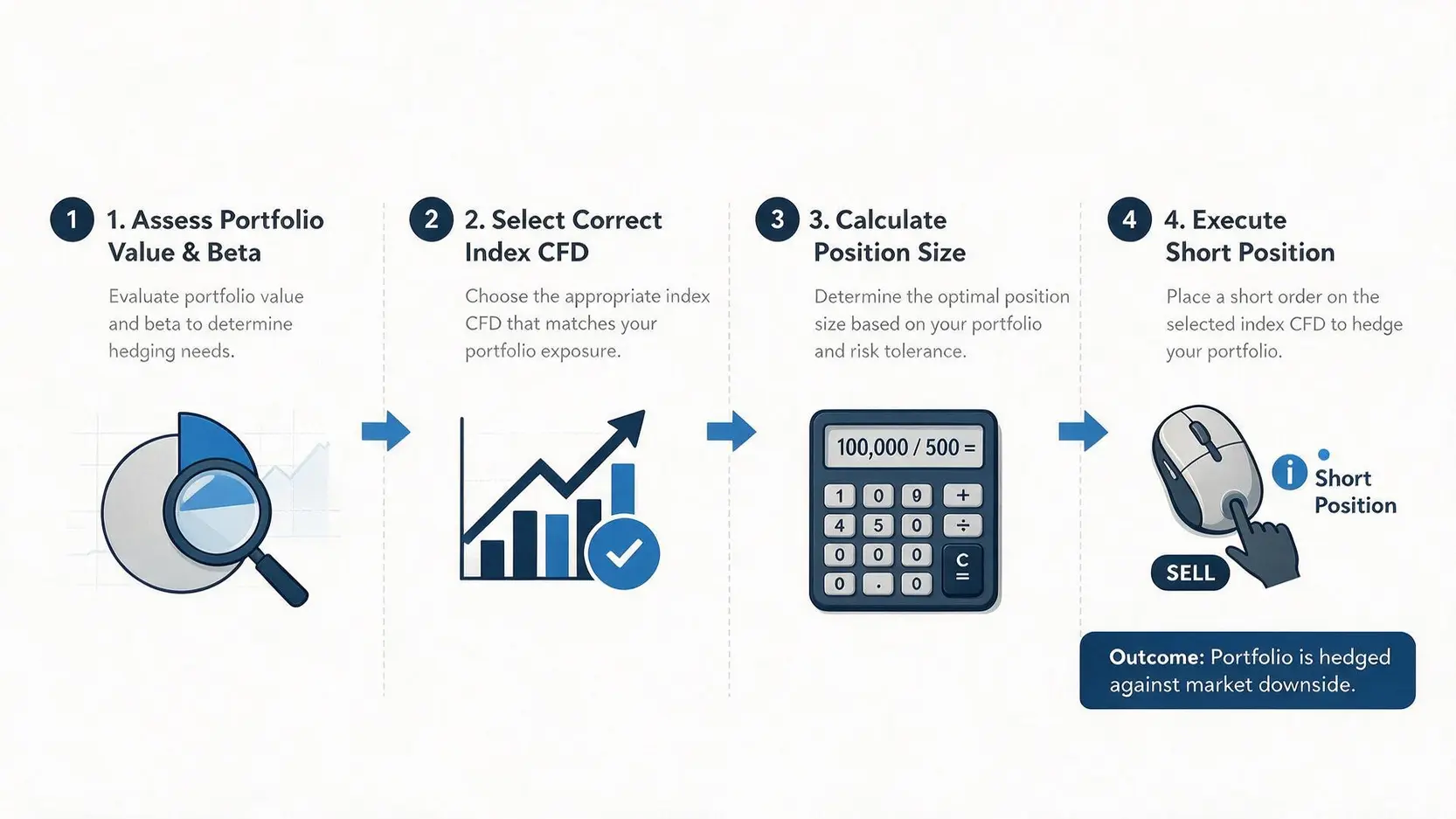
Step 1: Assess Your Portfolio’s Exposure and Value
Before you can hedge, you must know exactly what you are protecting. Start by calculating the current market value of the equity portion of your portfolio that is vulnerable to a market downturn. For instance, if you have a £200,000 portfolio with £150,000 in stocks and £50,000 in bonds/cash, your hedge only needs to cover the £150,000 equity exposure.
You also need to assess its ‘beta’ – a measure of its volatility in relation to the overall market. A beta of 1.0 means your portfolio moves in line with the market. A beta of 1.2 means it’s 20% more volatile. You can calculate this using financial software or by finding the beta of your individual holdings and calculating a weighted average. For simplicity, if your portfolio is diversified across major stocks, you can start by assuming a beta of 1.0.
Step 2: Select the Appropriate Index CFD
The effectiveness of your hedge depends on a high correlation between your portfolio and the index you use to hedge it. There is no point hedging a portfolio of Malaysian banking stocks with a US technology index. The mismatch, known as ‘basis risk’, could lead to your hedge failing to perform as expected.
| Portfolio Composition | Appropriate Index CFD | Rationale |
|---|---|---|
| Diversified portfolio of large-cap UK stocks (e.g., HSBC, Shell, AstraZeneca) | UK 100 (FTSE 100) | The index directly tracks the largest UK-listed companies, providing a high correlation. |
| Portfolio concentrated in US technology and growth stocks (e.g., Apple, Microsoft, Nvidia) | US-TECH 100 (Nasdaq 100) | This index is tech-focused and will mirror the specific risks of such a portfolio more accurately than a broader index. |
| Broad portfolio of large-cap US stocks across various sectors | US 500 (S&P 500) | The S&P 500 is the benchmark for the US economy and offers the best hedge for a diversified US portfolio. |
Step 3: Calculate the Correct Position Size (Hedge Ratio)
This step is where precision becomes paramount. To calculate the value of the index CFD position you need to short, you use the following logic: The value of your short CFD position should equal the value of the portfolio you are hedging. The formula is:
CFD Position Value = Portfolio Value x Beta
Let’s walk through a scenario:
- Portfolio Value: £100,000
- Assumed Beta: 1.1 (meaning it’s slightly more volatile than the market)
- Chosen Index CFD: UK 100, currently trading at 8,250.
- Broker Contract Size: £10 per point. This means for every one-point move in the UK 100 index, the CFD value changes by £10.
1. Calculate the required hedge value: £100,000 x 1.1 = £110,000.
2. Calculate the nominal value of one CFD contract: 8,250 (index level) x £10 (per point) = £82,500.
3. Calculate the number of contracts to short: £110,000 / £82,500 = 1.33 contracts.
Since you can’t trade a fraction of a contract with most brokers, you would round to the nearest whole number (1 contract) for a partial hedge or explore brokers that offer smaller contract sizes (e.g., £1 per point) for more accuracy.
Step 4: Execute a Short Position on the Index CFD
Once your calculations are complete, you log in to your trading platform and execute a ‘SELL’ order for 1.33 (or the closest available amount) contracts of the UK 100 index CFD. Now your hedge is active. If the UK market falls by 10%, your £100,000 portfolio might lose £11,000 (given its 1.1 beta). However, your short CFD position will have gained a corresponding amount, cushioning the loss and preserving your capital.
Key Strategies and Risk Management
Pro Tip: Never seek a ‘perfect’ hedge. A full 100% hedge is often costly and impractical. Aim for a partial hedge (e.g., 50-70%) to soften the blow of a downturn without incurring excessive costs. It’s about risk reduction, not risk elimination.
Full Portfolio Hedge vs. Partial Hedge
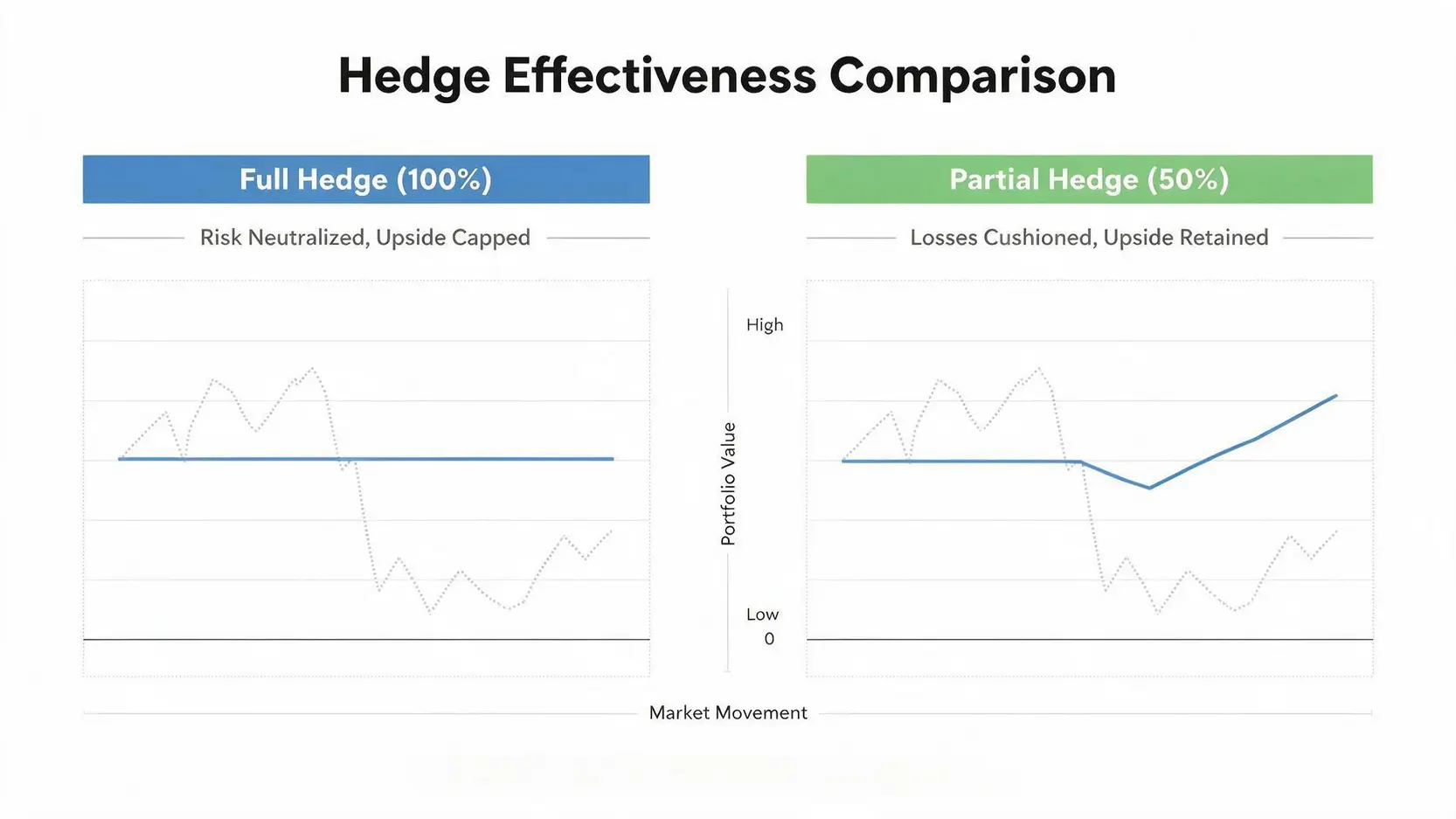
A full hedge (as calculated in our example) aims to completely neutralise the risk of a market fall. While appealing in theory, it can be expensive due to transaction costs and overnight fees. It also caps any potential upside; if the market unexpectedly rallies, your portfolio gains will be wiped out by losses on your hedge.
A partial hedge is my preferred approach. This involves hedging only a fraction of your portfolio, say 50%. In our example, you would only short half the calculated CFD contracts. This approach provides a significant cushion during a downturn but allows you to still participate in some of the gains if the market recovers. It strikes a more practical balance between risk and cost.
Understanding the Costs: Spreads and Overnight Fees
Hedging is not free. There are two main costs to consider:
- The Spread: This is the small difference between the buy and sell price of the CFD. It’s a one-off transaction cost you pay when you open and close the position.
- Overnight Financing (Swap Fees): This is the most significant ongoing cost. When you hold a short CFD position overnight, you are effectively borrowing to do so. Your broker will charge you an interest fee, which can be a credit or debit depending on the instrument and interest rate differentials. For short index positions, this is almost always a cost. These fees are charged daily, and over weeks or months, they can substantially erode the effectiveness of your hedge. A hedge is a temporary shield, not a permanent state of being.
Risks to Consider: Leverage and Market Gaps
While CFDs are powerful tools, they carry significant risks that must be understood and respected. Regulatory bodies like the UK’s Financial Conduct Authority (FCA) consistently publish warnings for a reason.
- Leverage Risk: Leverage magnifies both profits and losses. If you place a hedge and the market unexpectedly rallies strongly, the losses on your CFD position can be substantial and may even trigger a margin call, forcing you to deposit more funds or close the position at a loss.
- Market Gaps: Indices can ‘gap’ up or down at the market open, often due to overnight news or events. This means the opening price can be significantly different from the previous closing price. A large gap against your position can lead to a much larger loss than anticipated, as your stop-loss order may be executed at a worse price.
- Basis Risk: As mentioned, this is the risk that your portfolio does not move in perfect correlation with the index you have shorted. A ‘good’ hedge can still lose money on both sides if the correlation breaks down.
Frequently Asked Questions
1. How is hedging with index CFDs different from buying put options?
While both can be used to protect against a downturn, they function very differently. A put option gives you the right, but not the obligation, to sell at a specific price. Its cost is an upfront premium, and your maximum loss is limited to this premium. CFDs involve no upfront premium (besides the spread) but require margin and can lead to losses exceeding your initial deposit. CFDs are generally more flexible as they don’t have expiry dates, but the ongoing overnight fees are a key consideration. The comparison table earlier in this article provides a direct contrast.
2. Can I hedge a single stock with an index CFD?
I would strongly advise against this. It is a very imprecise and often ineffective strategy. A single stock has ‘idiosyncratic risk’ – risks specific to that company (e.g., poor earnings, a product failure) that have little to do with the broader market. Shorting a whole index to hedge one stock is like using a fishing net to catch a single butterfly. You’ll likely fail, and the cost will be frustrating. For single stocks, a single stock CFD is the more appropriate (though still risky) hedging tool.
3. What happens if the market goes up after I place my hedge?
This is a common and important question. If the market rallies, your short index CFD position will show a loss. However, your primary investment portfolio of stocks will increase in value. In an ideal scenario, the gain in your portfolio would be larger than the loss on your hedge (especially if you used a partial hedge). You must view the loss on the hedge as the ‘cost of insurance’. You paid a small price to protect against a large potential disaster, and the disaster didn’t happen. You simply close the hedge, accept the small loss, and enjoy the gains on your main portfolio. Trying to ‘win’ on both sides is not the point of hedging.
4. How long should I keep a hedge active?
A hedge should not be a ‘set and forget’ position. It should be actively managed based on your market outlook. I typically establish a hedge when I see clear technical or macroeconomic signs of a potential correction. I keep it active as long as that thesis holds. If the market stabilises and shows signs of building a base for a new move up, I will close the hedge to avoid incurring further overnight costs and to allow my portfolio to participate in the upside. The duration is dictated by market conditions, not by a calendar.
Danny’s Final Thoughts
I’ve seen too many traders wiped out by a single market storm they failed to prepare for. Learning to hedge with tools like index CFDs is a mark of maturity. It’s a shift from a purely offensive mindset of chasing gains to a balanced, strategic approach that incorporates defence. It’s not about being bearish; it’s about being a professional who respects risk. Remember, the goal isn’t to time the market perfectly, but to ensure you are still in the game after the storm has passed. Use these tools wisely, manage your risk with discipline, and always, always know your numbers before you place a trade. Start with a demo account until the process is second nature.
Sources & Methodology
Danny strictly relies on primary regulatory data and authoritative official information to ensure accuracy. Data cited in this guide is sourced from:
*Disclaimer: The content of this article represents the personal views of the author (Danny) and is for educational and reference purposes only. It does not constitute professional investment or financial advice. Trading and investing involve significant risk; proceed with caution.*
