

I’ve seen a lot of market chaos over the last decade. One question that keeps coming up, especially from retail investors trying to find their footing, is the choice between an index CFD vs index ETF. They seem similar on the surface—both let you get exposure to indices like the FTSE 100 or S&P 500. But that’s where the similarity ends. Understanding what are the key differences between index CFDs and ETFs is not just academic; it’s fundamental to your survival and success. One is a tool for long-term wealth building, the other is a high-stakes instrument best suited for index cfd for short-term trading. This guide will cut through the noise and give you my unvarnished, first-hand perspective on which to choose, when, and why.
Fundamentals: What Are Index ETFs and Index CFDs?
Pro Tip: Think of it like this: an Index ETF is like buying a small piece of every company in the index, which you own. An Index CFD is a private bet with your broker on the index’s price direction, using borrowed money. You own nothing but the contract.
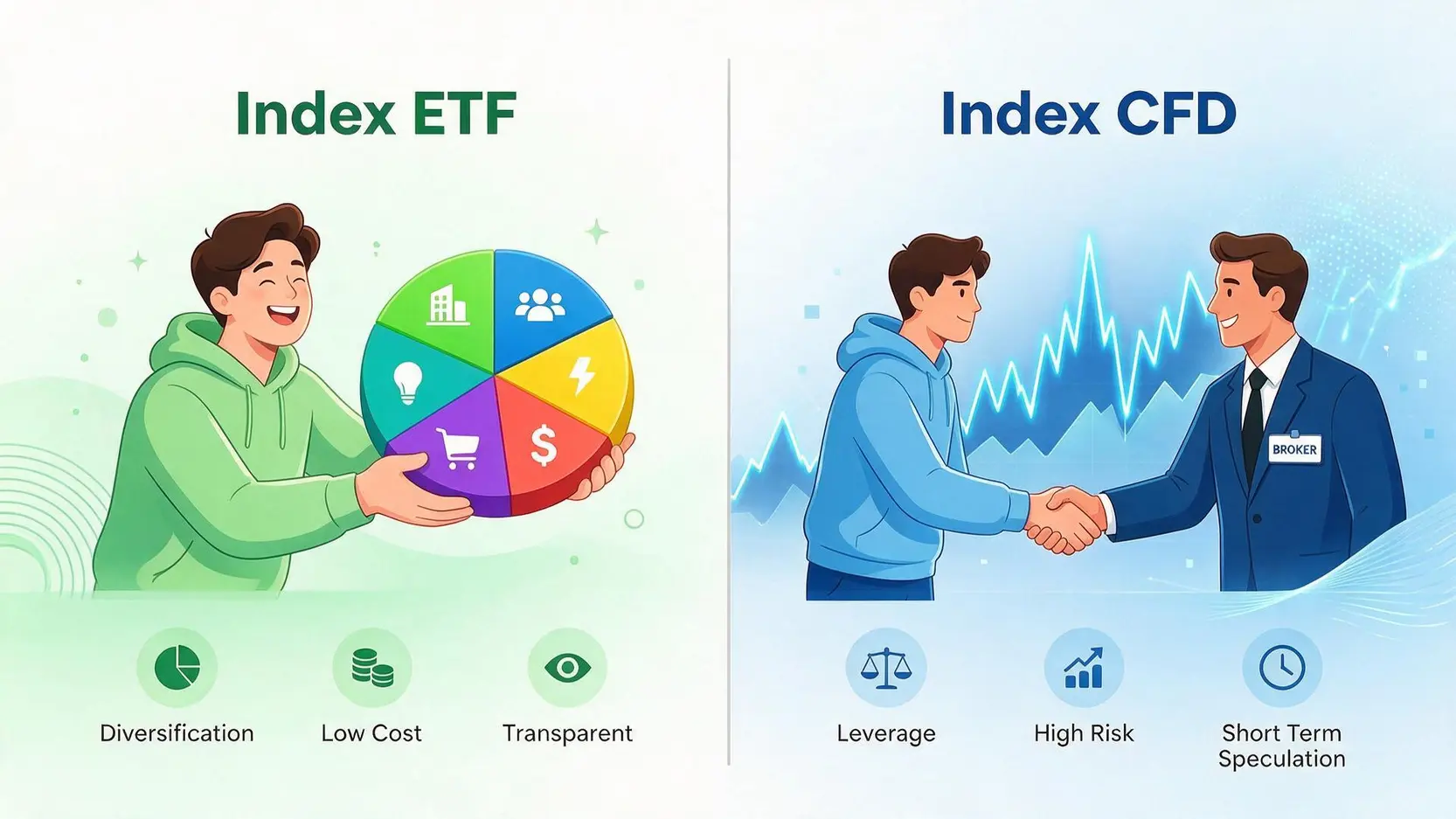
Before we can compare them, you need to understand the mechanics of each instrument. They operate on fundamentally different principles, and confusing them can lead to costly errors. I’ve seen traders wipe out their accounts by using a short-term tool for a long-term strategy, or vice-versa.
Index ETFs: True Ownership for Long-Term Investment
An Exchange-Traded Fund (ETF) is a collective investment vehicle. It pools money from many investors to buy a basket of assets—in this case, all the shares that make up a particular index, like the NASDAQ 100. When you buy a share of an index ETF, you gain fractional ownership of the actual underlying stocks. You can buy and sell these ETF shares on a stock exchange throughout the day, just like an individual stock.
The structure is designed for accessibility and diversification. Instead of buying hundreds of individual company shares, you buy one product. This makes them a cornerstone for passive investing and long-term wealth accumulation. Because they are designed to track an index, their performance mirrors the market, minus a small management fee.
Index CFDs: Leveraged Contracts for Short-Term Trading
A Contract for Difference (CFD) is a completely different beast. It is a derivative product. When you trade an index CFD, you are not buying any underlying assets. Instead, you are entering into a contract with a broker to exchange the difference in the value of an index from the time the contract is opened to when it is closed. If you bet the index will go up (go long) and it does, your broker pays you the difference. If it goes down, you pay the broker.
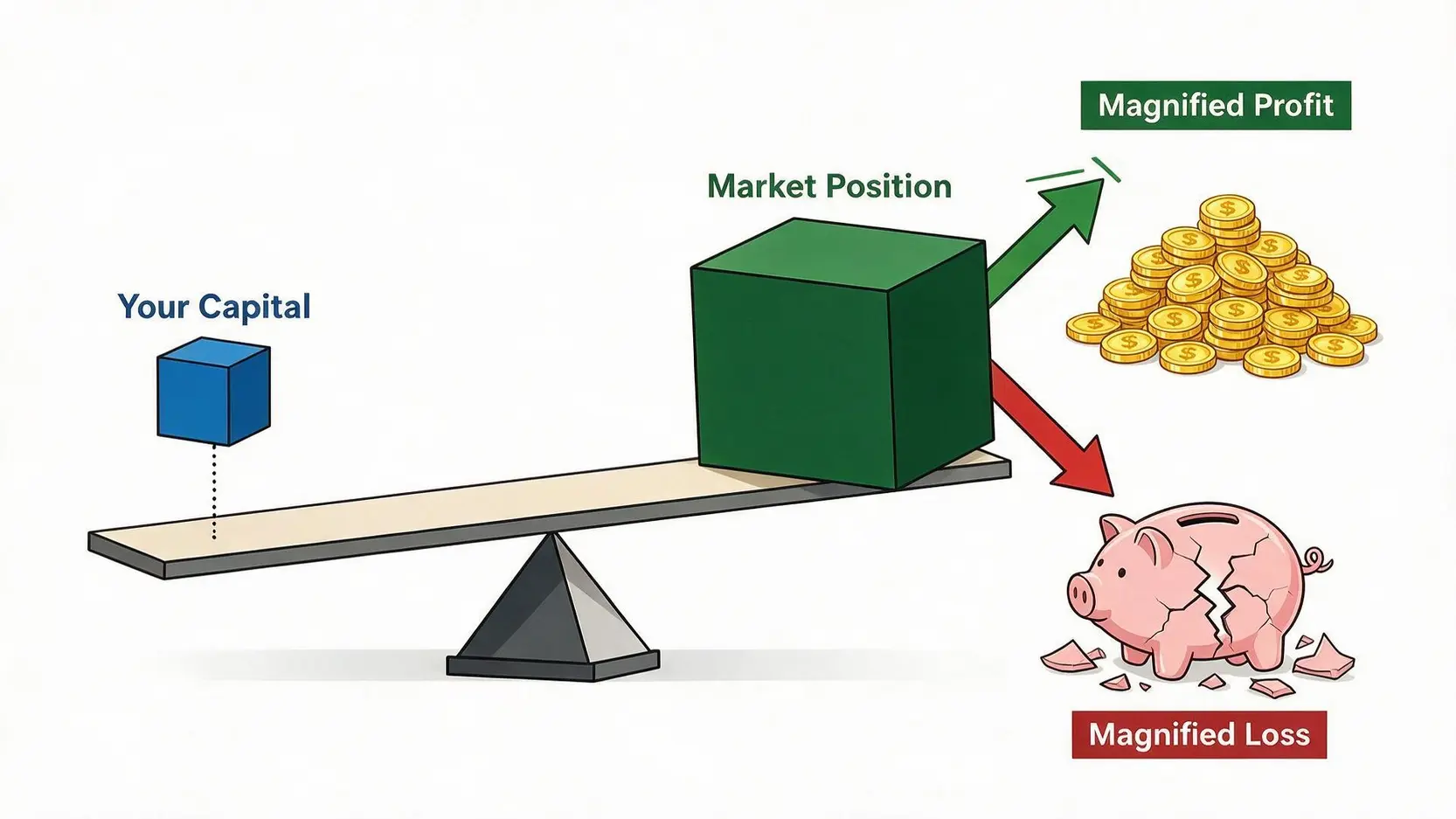
The defining feature of CFDs is leverage. This allows you to control a large position with a small amount of capital (the margin). For instance, with 20:1 leverage, a £1,000 deposit can control a £20,000 position. This magnifies potential profits, but it also magnifies potential losses to the same degree. This is why CFDs are primarily tools for active, short-term trading and hedging.
Pros and Cons: A Head-to-Head Comparison
Summary Paragraph: The core trade-off is simple. Index ETFs offer lower costs and lower risk through asset ownership, making them ideal for investing. Index CFDs offer high leverage and the ability to go short, but at a much higher cost and risk profile, making them suitable only for experienced, short-term traders.
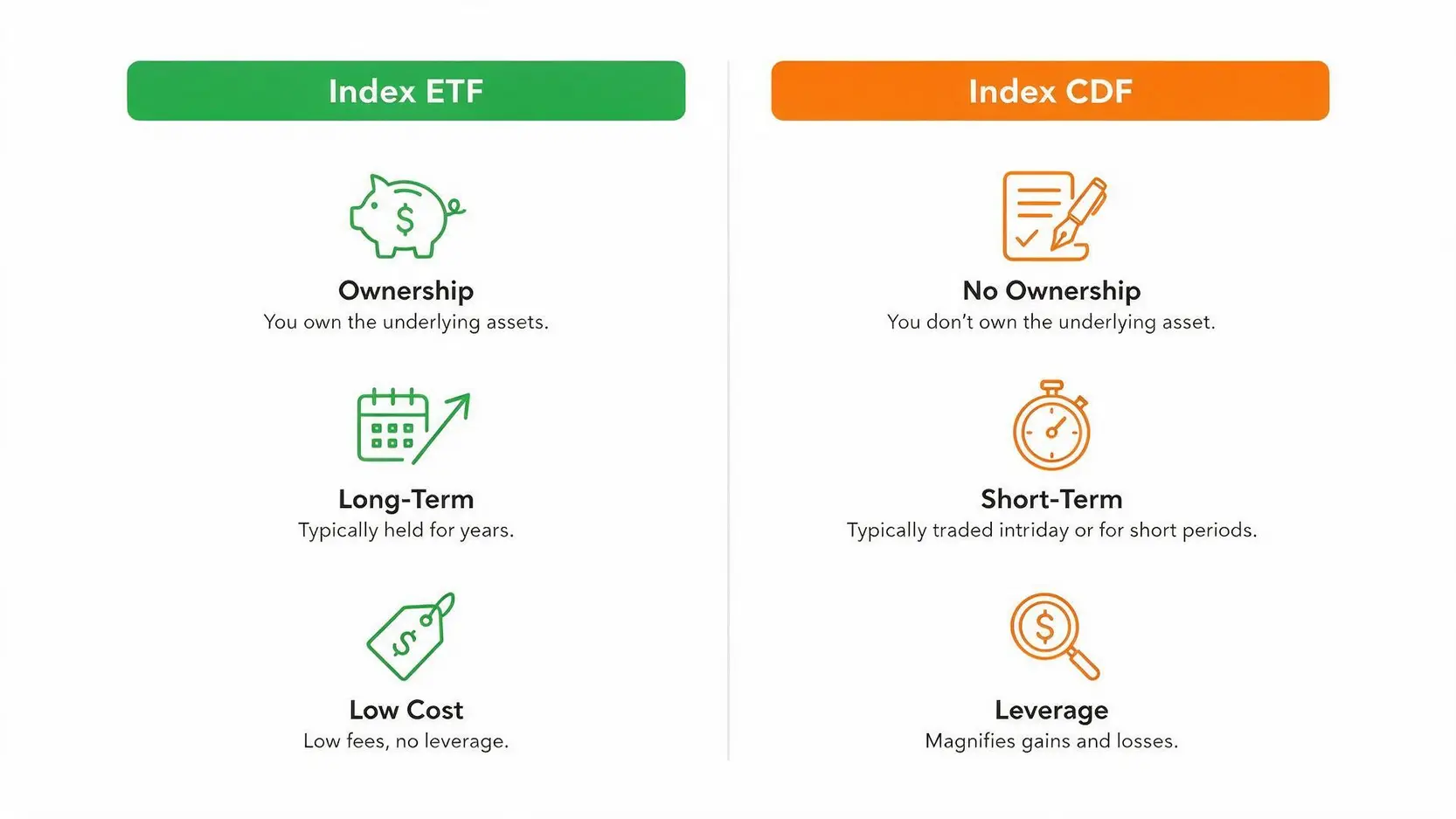
The right choice depends entirely on your objectives, time horizon, and risk tolerance. Let’s break down the critical differences in a structured way. I find tables are the clearest way to see the battlefield.
Comparing Costs: Expense Ratios vs. Spreads & Overnight Fees
Costs are the one thing you can control in trading. They act as a constant drag on your performance, so understanding them is non-negotiable.
| Feature | Index ETF | Index CFD |
|---|---|---|
| Primary Cost | Total Expense Ratio (TER) – a small annual fee (e.g., 0.05% – 0.25%). | The Spread – the difference between the buy and sell price. |
| Holding Costs | None, beyond the TER. You may incur broker commissions on the trade itself. | Overnight Financing (Swap Fees) – charged daily for holding positions past the market close. This makes long-term holding very expensive. |
| Tax Efficiency (UK Example) | Subject to Capital Gains Tax (CGT) upon selling for a profit. Can be held in tax-sheltered accounts like ISAs or SIPPs. | Generally exempt from Stamp Duty and CGT, but profits are subject to income tax if it constitutes your primary income. Always consult a tax advisor. |
| Cost Suitability | Extremely cost-effective for long-term holding (months to years). | Cost-prohibitive for long-term holding due to swap fees. Designed for intraday or short-term trades (hours to days). |
Comparing Risk: The Impact of Leverage and Market Exposure
Risk management is the job. Winning trades are just the outcome. Here’s how risk profiles differ, and this is the most important table in this entire guide.
| Feature | Index ETF | Index CFD |
|---|---|---|
| Ownership | Direct ownership of underlying fund shares. You are a registered shareholder. | No ownership of any asset. It is a bilateral contract with your broker. |
| Leverage | Typically 1:1. Your exposure equals your capital investment. (Some specialised leveraged ETFs exist but are complex). | High leverage is standard (e.g., 20:1 for major indices for retail clients under FCA rules). |
| Maximum Loss | Limited to your initial investment. The value of your ETF can go to zero, but not below. | Can exceed your initial deposit, leading to a negative account balance. |
| Counterparty Risk | Minimal. Assets are held by a custodian, separate from the ETF provider’s balance sheet. | Significant. This is the risk that your broker becomes insolvent and cannot honour their side of the contract. Choosing a well-regulated broker is paramount. Learn more about counterparty risk. |
Which Is Better for Your Investment Strategy?
Summary Paragraph: Your choice between an index CFD vs index ETF should be dictated by your time horizon. Are you building wealth for the next 20 years or speculating on next week’s inflation data? ETFs are for investors. CFDs are for traders. Do not mix up the roles.
The Case for Index ETFs: Passive Investing and Wealth Accumulation
If your goal is to build long-term wealth for retirement, a house deposit, or your children’s education, the Index ETF is unequivocally the superior tool. Its structure is purpose-built for this objective.
- Low-Cost Diversification: You instantly own a slice of the entire market, spreading your risk across hundreds of companies. Doing this by buying individual stocks would be prohibitively expensive.
- Power of Compounding: Many index ETFs automatically reinvest dividends, which buys more shares, which in turn generate more dividends. Over 20-30 years, this effect is astonishingly powerful.
- Reduced Emotional Strain: The strategy with an ETF is typically to ‘buy and hold’, and to keep adding funds regularly (dollar-cost averaging). This removes the need to time the market, a game that even most professionals lose. You ride out the downturns, knowing that historically, markets recover and trend upwards over the long term.
The Case for Index CFDs: Active Trading, Hedging, and Short-Selling
Index CFDs are specialised tools for active market participants. They are not investment vehicles. I use them for specific, short-term tactical purposes, always with strict risk management.
- Short-Term Speculation: If you have a strong, well-researched conviction that an index will move in a certain direction over the next few hours or days—perhaps due to a central bank announcement or key economic data—a CFD allows you to act on that view with significant leverage.
- Hedging: Let’s say you hold a large portfolio of UK stocks (perhaps in an ETF). You believe the market is due for a short-term correction, but you don’t want to sell your long-term holdings. You could open a short CFD position on the FTSE 100. If the market falls, the profit from your CFD position can help offset the unrealised losses in your stock portfolio.
- Ability to Go Short: This is a major advantage. ETFs only allow you to profit from a rising market. With CFDs, you can profit from a falling market just as easily by ‘selling’ the index. This flexibility is invaluable in volatile or bearish conditions.
Frequently Asked Questions
1. Can I lose more than my initial investment with Index CFDs?
Yes, historically this was a major risk. However, in many regulated jurisdictions like the UK and EU, retail client accounts are now required to have negative balance protection. This means your broker must absorb the loss if your account balance goes below zero due to a rapid market move. However, this protection may not apply to professional clients or those using brokers in less-regulated jurisdictions. Even with protection, you can still lose your entire deposited capital very quickly. Never trade with money you cannot afford to lose.
2. Are Index ETFs a good starting point for beginner investors?
In my opinion, absolutely. They are one of the best. A globally diversified, low-cost index ETF provides instant diversification, low fees, and aligns with a proven long-term strategy of owning the market. It allows a beginner to get started in investing without the immense risk and complexity of picking individual stocks or trading leveraged products. It teaches the discipline of consistent investing over time.
3. What are the main tax differences between Index ETFs and Index CFDs in the UK?
This is a critical point. In the UK, profits from selling Index ETFs are subject to Capital Gains Tax (CGT), though you have an annual allowance. They are also subject to stamp duty on purchase. Crucially, they can be held within an ISA or SIPP, making all gains tax-free. CFD trading, on the other hand, is typically exempt from CGT and stamp duty. However, the profits can be classified as income and taxed accordingly, especially if it’s your main activity. Tax laws are complex and change. This is not financial advice; you must consult a qualified tax professional to understand your specific situation.
Danny’s Final Thoughts
The debate of index cfd vs index etf is not about which is ‘better’ in a vacuum, but which is the right tool for the job at hand. After more than a decade in the markets, my philosophy is simple: use ETFs to build your foundation, your core wealth. They are the bricks and mortar. Use CFDs, if you have the experience and appetite for risk, as the precision tools for specific, short-term tasks like hedging or tactical trades. Treat them with the respect their leverage demands. Confuse the two, and you risk trying to build a house with a scalpel, or perform surgery with a brick. The market is unforgiving of those who use the wrong tools.
Sources & Methodology
Danny strictly relies on primary regulatory data and authoritative official information to ensure accuracy. Data cited in this guide is sourced from:
*Disclaimer: The content of this article represents the personal views of the author (Danny) and is for educational and reference purposes only. It does not constitute professional investment or financial advice. Trading and investing involve significant risk; proceed with caution.*
