

As someone who has navigated the forex markets for over a decade, I’ve seen countless traders fixate on entry and exit points while completely neglecting one of the most persistent drains on their capital: trading costs. The debate over fixed spread vs variable spread isn’t just academic; it’s a fundamental decision that directly impacts your profitability on every single trade. Many traders, especially when starting, don’t fully grasp how to choose the right spread type for their strategy, leading to silent but significant losses over time. This guide is built from my years of experience, designed to give you a clear, no-nonsense framework for understanding trading costs with different spread types and making a choice that fortifies your trading plan rather than undermines it.
Understanding the Basics: What Is a Spread in Trading?
Pro Tip: In the simplest terms, the spread is the primary cost you pay to your broker to execute a trade. It is the difference between the ‘buy’ (ask) price and the ‘sell’ (bid) price of a financial instrument. This cost is incurred the moment you open a position, regardless of whether the trade ultimately results in a profit or a loss.
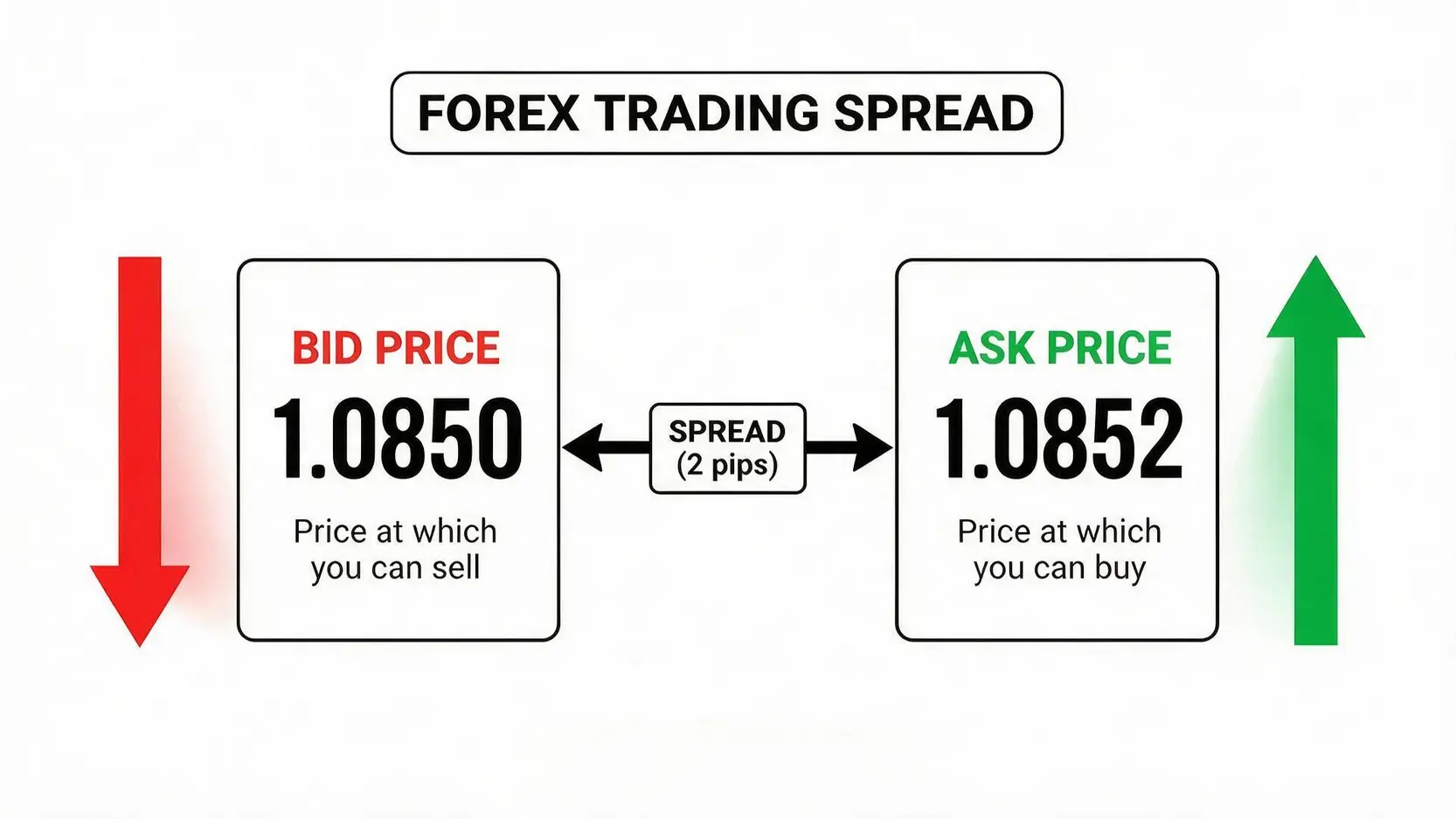
Think of it as the broker’s fee for facilitating the transaction. When you look at a currency pair like EUR/USD, you’ll see two prices quoted. For example, 1.0850/1.0852. The first price, 1.0850, is the bid price—the price at which you can sell the base currency (EUR). The second price, 1.0852, is the ask price—the price at which you can buy the base currency. The difference between these two, which is 0.0002 or 2 pips in this case, is the spread. This is the broker’s revenue and your immediate cost of doing business.
How to Calculate Spreads and Their Impact on Your Profit
Calculating the spread’s cost is a critical skill. It’s not just about the number of pips; it’s about what those pips represent in monetary terms. The value of a pip varies depending on the currency pair and your trade size (lot size).
Let’s use a practical example with the EUR/USD pair:
- Quoted Price: 1.0850 (Bid) / 1.0852 (Ask)
- Spread in Pips: 1.0852 – 1.0850 = 0.0002, or 2 pips.
- Trade Size: 1 Standard Lot (100,000 units of the base currency).
- Pip Value for 1 Standard Lot of EUR/USD: Typically $10 per pip.
- Total Spread Cost: 2 pips * $10/pip = $20.
This $20 is the cost you pay the moment you enter the trade. Your position starts at a $20 loss. The price must move 2 pips in your favour just for you to break even, before any profit can be realised. This is why a trader’s analysis might be correct, but they can still lose money if the transaction costs are too high relative to their profit target. The discussion of fixed spread vs variable spread is central to managing this initial hurdle.
Why Spreads are a Critical Factor in Choosing a Broker
Choosing a broker is one of the most important decisions you’ll make, and their spread structure should be a primary consideration. Spreads are a key revenue source for brokers, especially those operating on a ‘Market Maker’ model. These brokers create their own market, setting their own bid and ask prices, and often offer fixed spreads.
Other brokers, known as ECN (Electronic Communication Network) or STP (Straight Through Processing) brokers, pass your orders directly to liquidity providers (banks, hedge funds, etc.). They typically offer variable spreads that reflect the true interbank market rates, plus a small markup. Their revenue often comes from commissions charged on top of these raw spreads.
Danny’s Insight: I always tell new traders to view the spread as the ‘house edge’. You must overcome this cost before you can be profitable. When I was starting, I didn’t pay enough attention to this. I’d make five small winning trades but one losing trade with a wide spread would wipe out all my gains. Understanding the broker’s model and how they profit from you is not cynicism; it’s essential due diligence. It helps you understand whether their interests are aligned with yours.
Risk Warning: Be wary of brokers advertising ‘no spreads’ without clarifying their commission structure. Furthermore, dealing with an unregulated broker carries the immense risk of spread manipulation. They can artificially widen spreads against your position, especially during volatile moments, to trigger your stop-loss. Always verify a broker’s regulatory status with authoritative bodies like the FCA in the UK or the SC in Malaysia.
Fixed Spreads vs. Variable Spreads: A Head-to-Head Comparison
Pro Tip: Fixed spreads offer cost predictability, making them suitable for beginners and systematic traders who need consistent cost calculation. Variable spreads provide the opportunity for lower costs during high-liquidity market conditions but introduce uncertainty, making them a tool for experienced traders, scalpers, and those who can navigate market volatility.
The choice between a fixed and variable spread is not about finding a universally ‘better’ option. It’s about aligning the cost structure with your trading strategy, risk tolerance, and the market environments you intend to trade in. Let’s break down each type in detail.
Fixed Spreads Explained: Predictable Costs for Stable Trading
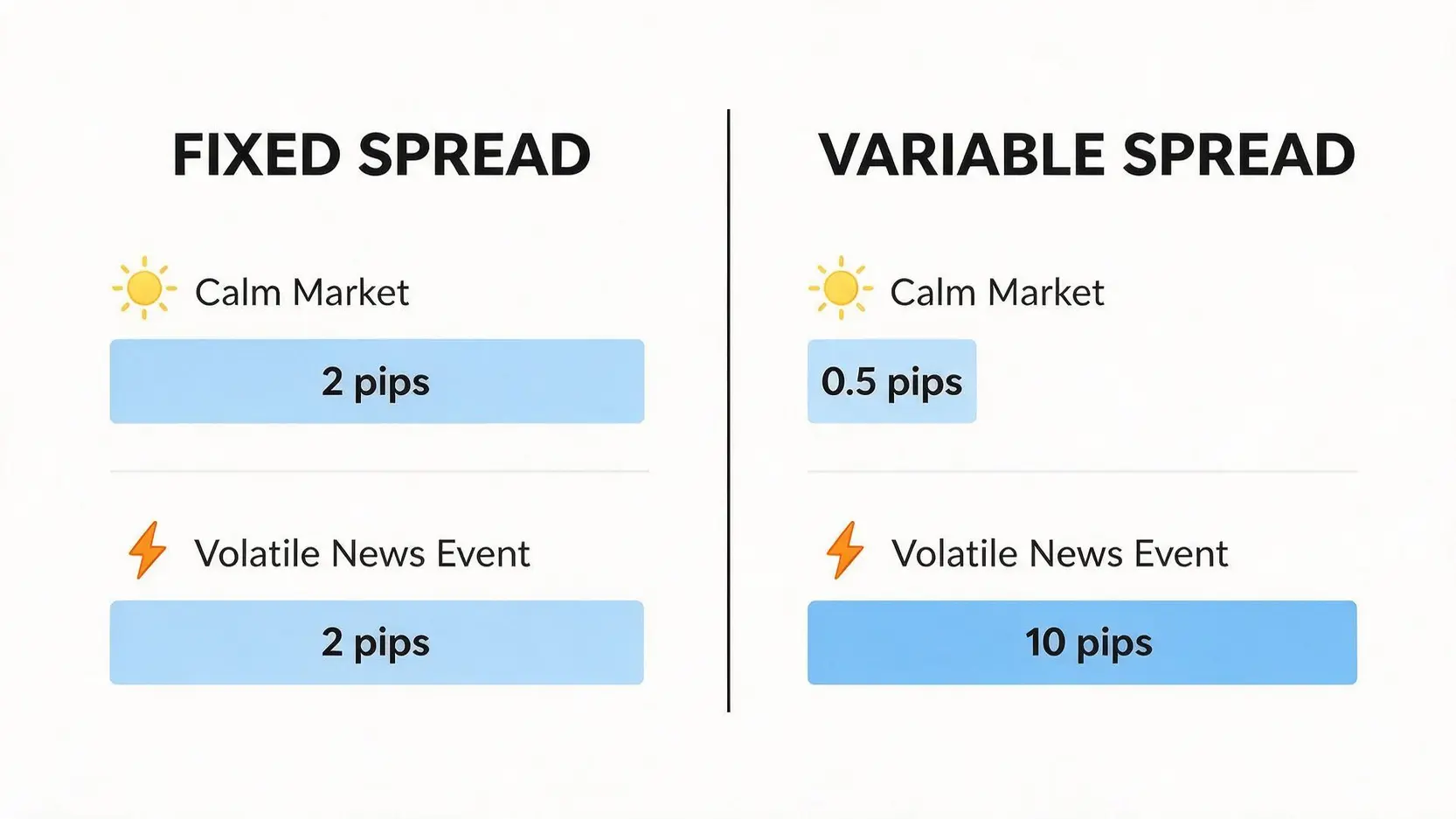
As the name suggests, a fixed spread does not change regardless of market volatility or liquidity. If your broker offers a 2-pip fixed spread on EUR/USD, that is the spread you will pay whether you are trading during the quiet Asian session or during a chaotic US Non-Farm Payrolls (NFP) release. This model is most commonly offered by Market Maker brokers.
Advantages of Fixed Spreads:
- Cost Predictability: This is the single biggest advantage. You know your exact transaction cost before you even place a trade. This simplifies profit and loss calculations and makes financial planning for your trading more straightforward.
- Better for Beginners: When you’re learning to trade, there are many moving parts to manage. A fixed spread removes the variable of fluctuating costs, allowing you to focus on your analysis and execution.
- Effective for Automated Systems: Some Expert Advisors (EAs) or algorithmic strategies are not sophisticated enough to account for variable spreads. A fixed spread ensures the EA’s back-tested performance is more likely to align with live results.
Disadvantages of Fixed Spreads:
- Higher Overall Cost: To offer a fixed spread, the broker must absorb the risk of widening spreads in the underlying market. To compensate for this, they set the fixed spread at a level that is generally wider than the average variable spread. In calm markets, you are effectively overpaying.
- Risk of Requotes: During extreme volatility, a market maker may be unable or unwilling to honour the fixed spread. Instead of widening the spread, they may ‘requote’ you a new price, delaying your execution and potentially causing you to miss your entry point.
- Potential Conflict of Interest: Since a market maker takes the other side of your trade, there is an inherent conflict of interest. They profit when you lose. While regulated brokers must adhere to fair practices, this model lacks the transparency of a direct market access broker.
Variable Spreads Explained: Lower Costs for Dynamic Markets
Variable spreads, also known as floating spreads, fluctuate constantly. They are determined by the supply and demand from liquidity providers in the open market. During times of high trading volume and liquidity (like the London-New York session overlap), these spreads can become incredibly tight, sometimes even dropping to zero on major pairs. Conversely, during low liquidity or major news events, they can widen significantly. This model is typical of ECN/STP brokers.
Advantages of Variable Spreads:
- Potentially Lower Costs: For active traders and scalpers, the ability to trade with spreads under 1 pip is a massive advantage. Over hundreds of trades, the cost savings compared to a fixed-spread account can be substantial.
- Transparent Pricing: Variable spreads reflect the true market conditions. There is no hidden buffer. This transparency is often preferred by professional traders who want to see the raw market dynamics.
- No Requotes: Because the price is coming directly from the liquidity provider, you will not receive a requote. Your order will be filled at the best available price. However, this can lead to ‘slippage’.
Disadvantages of Variable Spreads:
- Unpredictable Costs: The spread can widen dramatically in seconds. A 1-pip spread can jump to 10 or even 20 pips during a major news release. This makes it difficult to calculate your risk precisely if you are trading during these times.
- Risk of Slippage: Slippage occurs when your order is filled at a different price than what you requested. With variable spreads, if the market moves quickly between the time you click ‘buy’ and the order is executed, you might get a worse price.
- Challenging for Beginners: An unsuspecting beginner could have their stop-loss triggered by a sudden spread widening, even if the actual market price did not reach that level. Managing this risk requires experience.
| Feature | Fixed Spreads | Variable Spreads |
|---|---|---|
| Cost Structure | Predictable, unchanging cost per trade. | Dynamic, fluctuates with market liquidity. |
| Typical Width | Wider than variable spreads in normal conditions (e.g., 1.5 – 3 pips on EUR/USD). | Can be very tight (e.g., 0.1 – 1.5 pips) but widens significantly during volatility. |
| Ideal Trader | Beginners, long-term traders, news traders who prefer certainty, some automated systems. | Scalpers, high-frequency traders, discretionary traders who trade during liquid hours. |
| Primary Risk | Higher baseline cost on every trade, risk of requotes during high volatility. | Sudden widening of spreads can increase costs unexpectedly and trigger stops. Risk of slippage. |
| Broker Model | Primarily Market Maker / Dealing Desk. | Primarily ECN / STP / No Dealing Desk. |
| Trading During News | Costs are known, but execution may be rejected (requote). | Costs can become extremely high, making it very risky. Execution is likely but slippage is high. |
How to Choose: Which Spread is Right for Your Trading Style?
Summary: The decision in the fixed spread vs variable spread debate hinges on self-awareness. Assess your experience level, trading frequency, and psychological tolerance for uncertainty. Your strategy dictates your spread type, not the other way around. A scalper cannot survive on wide fixed spreads, and a beginner can be financially crippled by the volatility of variable spreads.
For Beginners & Casual Traders: The Stability of Fixed Spreads
If you are new to the markets, my strong counsel is to begin with a broker offering fixed spreads. Your primary goal as a novice is survival and education. You need to learn how to analyse charts, manage risk, and control your emotions. The last thing you need is the added stress of unpredictable trading costs.
Consider this scenario: You’re a new trader in Malaysia, carefully planning your risk. You decide to risk no more than RM 200 on any single trade. With a fixed spread, you can calculate your position size precisely to ensure that if your stop-loss is hit, your loss remains within that RM 200 budget. With a variable spread, a sudden 15-pip widening during an unexpected news event could turn your planned RM 200 loss into an RM 400 loss, destroying your risk management plan and your confidence.
For Scalpers & High-Frequency Traders: The Advantage of Variable Spreads
Scalpers operate on a completely different philosophy. Their goal is to capture very small price movements, often just a few pips, but they do it many times a day. For this strategy to be viable, transaction costs must be razor-thin. A 2-pip fixed spread would make scalping almost impossible, as the market would need to move significantly just to cover the cost.
Danny’s Insight: I’ve done my fair share of scalping. You live and die by the spread. With a variable spread ECN account, I could enter trades on EUR/USD for a 0.2 pip spread during peak liquidity. My profit target might only be 5 pips. That’s a viable business model. If I had to pay a 2-pip fixed spread, my risk-to-reward ratio would be completely inverted. Scalpers are not guessing; they are experts in market liquidity and only engage when variable spreads are at their absolute tightest.
Experienced day traders and swing traders may also prefer variable spreads. They understand the market rhythms and tend to place their trades during liquid sessions where spreads are competitive. They accept the risk of occasional widening in exchange for lower costs on the majority of their trades.
Beyond Spreads: Considering Commissions and Other Broker Fees
The conversation about fixed spread vs variable spread is incomplete without discussing commissions. Many traders are lured in by brokers advertising ‘raw spreads’ or ‘zero spreads’. This sounds fantastic, but it’s not free. These are almost always commission-based accounts.
Here’s how it works: The broker gives you direct access to the raw variable spread from their liquidity providers (which can be as low as 0.0 pips). In place of a spread markup, they charge a flat-rate commission for every lot traded. For example, a broker might charge $7 per round turn (buy and sell) on a standard lot.
Risk Warning: You must factor in both the spread and the commission to calculate your ‘all-in’ cost. A 0.1 pip spread with a $7 commission might be more expensive than a 0.8 pip all-inclusive variable spread. Do the maths for your typical trade size before committing to an account type.
| Account Type | Spread Example (EUR/USD) | Commission (per Std. Lot) | Total Cost for a 1 Lot Trade |
|---|---|---|---|
| Fixed Spread | 2.0 pips | $0 | 2.0 pips * $10/pip = $20 |
| Variable Spread (Standard) | Averages 1.2 pips | $0 | 1.2 pips * $10/pip = $12 (on average) |
| Variable Spread (Raw/ECN) | Averages 0.2 pips | $7 round turn | (0.2 pips * $10/pip) + $7 = $9 |
As you can see, for an active trader, the Raw/ECN account is often the most cost-effective, but it requires you to be comfortable with variable spreads and commission calculations. The fixed spread account is the most expensive but offers the highest degree of certainty.
Frequently Asked Questions
1. Is a zero spread broker really free?
No, never. This is a marketing tactic. A broker advertising ‘zero spreads’ or ‘raw spreads’ will make their money by charging a fixed commission per trade. As shown in the table above, you must calculate the total cost (spread + commission) to understand the true expense. A seemingly ‘free’ spread can be more expensive than an all-inclusive account if the commission is high.
2. Are fixed or variable spreads better for news trading?
From my perspective, for 95% of traders, fixed spreads are the safer choice for trading around major news events. The primary danger of news trading is not the price direction, but the extreme volatility and liquidity evaporation. A variable spread can widen to insane levels (30, 40, or even 50+ pips on major pairs), instantly stopping you out or creating a massive loss on entry. A fixed spread protects you from this spread risk, though you may face requotes. Experienced professionals who trade news might use variable spreads, but they typically wait for the initial chaos to subside and for spreads to normalise before entering.
3. How do market conditions affect variable spreads?
Liquidity is the single most important factor. High liquidity (many buyers and sellers) means there is a lot of competition, which leads to tight spreads. This is typical during the overlap of the London and New York trading sessions. Conversely, low liquidity means fewer market participants, leading to wider spreads. This occurs during bank holidays, late in the Asian session, or in the moments immediately following a major economic data release when algorithms pull their orders.
4. Can a broker change their spread type on my account?
Generally, no. An account is designated as fixed or variable when you open it. However, you must read your broker’s terms and conditions. Some brokers with fixed spreads may have a clause that allows them to switch to variable spreads under ‘exceptional market conditions’. This is a red flag. A reputable broker will either absorb the temporary loss or issue requotes, but not change the fundamental nature of your account agreement mid-trade.
Danny’s Final Thoughts
In my years of trading, I’ve learned that long-term survival isn’t about hitting one spectacular home run. It’s about diligent, consistent risk management and treating your trading like a business. The fixed spread vs variable spread choice is a core business decision. It’s not about which is ‘best,’ but which is optimal for your specific business model—your trading strategy. A beginner’s model requires predictability, so fixed spreads are logical. A scalper’s model requires minimal overhead, making raw variable spreads essential. Don’t let marketing hype guide this choice. Analyse your strategy, understand your own tolerance for risk and uncertainty, and choose the cost structure that gives you the highest probability of long-term success. Master your costs, and you’re one step closer to mastering the market.
Sources & Methodology
Danny strictly relies on primary regulatory data and authoritative official information to ensure accuracy. Data and concepts cited in this guide are sourced from and cross-referenced with:
*Disclaimer: The content of this article represents the personal views of the author (Danny) and is for educational and reference purposes only. It does not constitute professional investment or financial advice. Trading and investing involve significant risk; proceed with caution.*
