

As a trader who has navigated these markets for over a decade, I’ve seen many aspiring participants fixate on entry and exit signals, yet completely overlook the most fundamental cost of doing business: the bid-ask spread.
Understanding how bid-ask spreads are calculated in derivative markets is not an academic exercise; it’s a critical component of survival and profitability.
This cost, though seemingly small on a per-trade basis, compounds over time and can be the deciding factor between a winning and losing strategy.
In this handbook, we will dissect this concept, exploring not just the basic formula but also the crucial factors that influence the spread in derivatives and the intricate bid-ask spread relationship with market liquidity.
Ignoring this is like trying to sail a ship while ignoring the tide – you’ll be fighting a current you don’t even realise is there.
The Fundamental Calculation of the Bid-Ask Spread
Pro Tip: The bid-ask spread is simply the difference between the highest price a buyer is willing to pay for a derivative (the bid) and the lowest price a seller is willing to accept (the ask). For a trader, this spread represents the immediate, unavoidable cost of executing a round-trip trade (a buy and a sell). It’s the market maker’s compensation for providing liquidity.
Before you can run, you must walk. The most basic element of your trading cost analysis begins with a simple subtraction. But to truly grasp its implications, you must first respect the two prices that define every market.
Defining the Bid Price and Ask Price in Derivatives
In any financial market, including derivatives, you will always see two prices quoted for an instrument. These are not arbitrary numbers; they represent the live, competing interests of buyers and sellers.
- The Bid Price: This is the price at which you, the trader, can sell the derivative contract. It represents the highest price a willing buyer in the market is prepared to pay at that exact moment. If you want to short-sell a CFD or sell an option you hold, you will transact at the bid price.
- The Ask Price (or Offer Price): This is the price at which you can buy the derivative contract. It represents the lowest price a willing seller is prepared to accept. If you wish to go long on a futures contract or buy a call option, you will transact at the ask price.
A simple way to remember this is: you always buy high (at the ask) and sell low (at the bid). The market maker or the collective market of participants sits in the middle. The difference between these two prices is their gross profit for facilitating the trade.
The Basic Formula: Ask Price – Bid Price
The calculation itself is as straightforward as it gets:
Spread = Ask Price – Bid Price
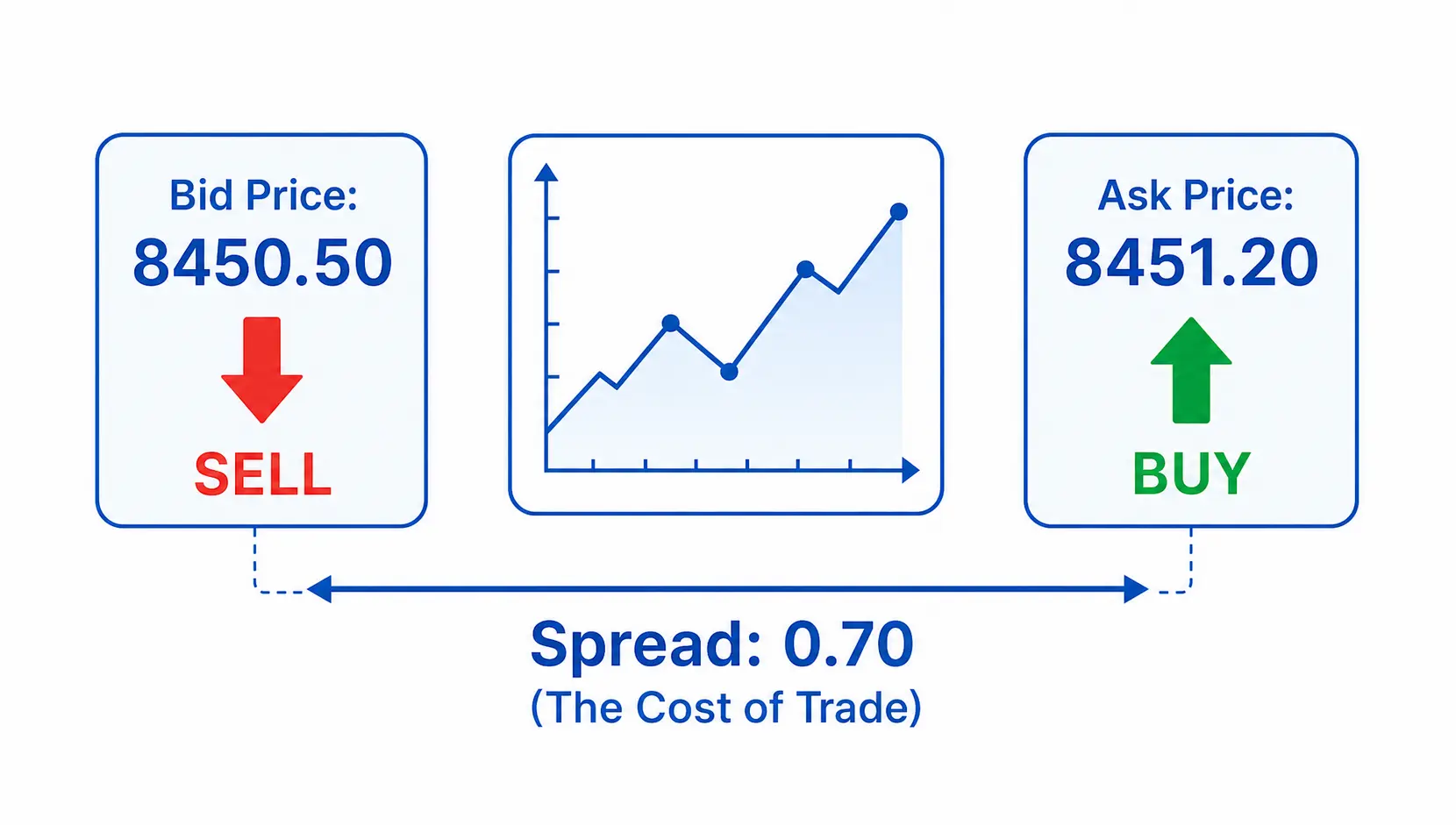
Let’s use a practical example. Imagine you are looking to trade a CFD on the UK 100 index. You see the following quote on your platform:
- Bid Price: 8,450.50
- Ask Price: 8,451.20
Using the formula, the spread is:
8,451.20 – 8,450.50 = 0.70
This 0.70-point spread is the cost you incur for entering the trade. If you were to buy the CFD at 8,451.20 and immediately sell it back without the market price moving at all, you would do so at 8,450.50, instantly realising a loss of 0.70 points per unit traded.
This is why a trade must first overcome the spread to become profitable.
Danny’s Insight: I recall the 2015 Swiss Franc flash crash. In moments of extreme panic, I saw spreads on EUR/CHF widen from a typical 2-3 pips to over 1,000 pips. Those who didn’t understand what was happening and placed market orders were obliterated. The spread isn’t just a cost; it’s a real-time gauge of market fear and uncertainty. Respect it, or it will humble you.
Key Factors Influencing Spreads in Derivative Markets
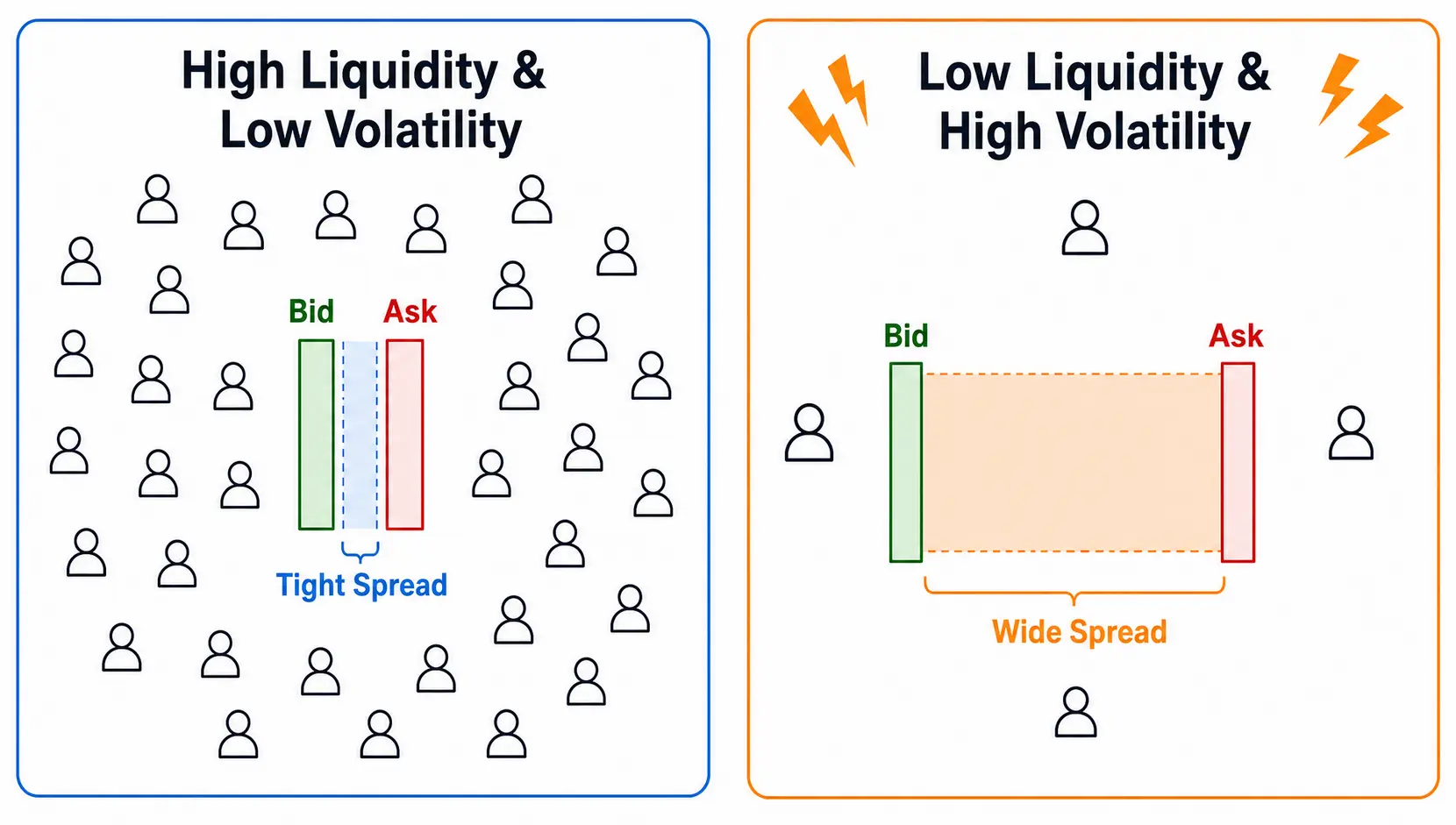
Core Focus: The width of a bid-ask spread is not random. It is primarily determined by three interconnected factors: liquidity, volatility, and trading volume. A professional trader doesn’t just see the spread; they understand why it is what it is. This understanding is key to selecting the right instruments and timing your entries.
The spread on a highly traded instrument like an E-mini S&P 500 futures contract will be razor-thin, often just a single tick. Conversely, the spread on an option for an obscure, small-cap stock might be enormous. This variance is a direct result of the underlying risks and market dynamics.
The Crucial Role of Liquidity and Trading Volume
Liquidity is the lifeblood of any market. It refers to the ease with which an asset can be bought or sold without causing a significant change in its price. High liquidity is characterised by a large number of active buyers and sellers, resulting in high trading volume.
The relationship is direct: Higher Liquidity & Volume = Tighter Spreads.
Think of it like this: A market maker for a high-volume product like a Brent Crude oil future knows they can offload their position almost instantly.
Their risk of holding an unwanted position is minimal. Because thousands of contracts are traded every minute, they can afford to accept a very small profit margin on each transaction.
In contrast, a market maker for an illiquid derivative (e.g., a long-dated option on a non-index stock) faces a much higher risk. It might take them hours or even days to find a counterparty to flatten their position. To compensate for this risk, they must demand a much wider spread.
For a deeper analysis of market liquidity, I often refer my students to established resources. As Investopedia explains, liquidity describes the degree to which an asset can be quickly converted into cash at a price reflecting its intrinsic value.
In illiquid markets, this conversion comes at a higher cost—a wider spread.
| Derivative Instrument | Typical Liquidity | Typical Spread Width | Danny’s Take |
|---|---|---|---|
| EUR/USD Spot Forex CFD | Extremely High | Very Tight (e.g., 0.1 – 1.0 pips) | Ideal for high-frequency strategies, but the low cost can tempt over-trading. |
| At-the-Money SPX Index Option | Very High | Tight (e.g., $0.05 – $0.10) | Reliable for most strategies. Spreads widen into the close and during major news. |
| Single Stock CFD (Small Cap) | Low to Moderate | Moderate to Wide | A hidden cost for those chasing volatile stocks. The spread can eat a significant portion of a small price move. |
| Far Out-of-the-Money Exotic Option | Extremely Low (Illiquid) | Very Wide (Can be 20-50% of the premium) | This is specialist territory. The bid-ask spread itself is a primary risk factor. Entering is easy, exiting can be punitive. |
The Impact of Market Volatility on Spread Width
Volatility is a measure of the magnitude of price fluctuations. While traders are often drawn to volatile markets for their profit potential, it’s a double-edged sword. For market makers, volatility equals risk.
The relationship is again direct: Higher Volatility = Wider Spreads.
When prices are swinging wildly, the risk that a market maker will fill an order and then see the market move sharply against them before they can hedge their position increases exponentially.
To protect themselves, they widen the bid-ask spread. This is why you will always see spreads blow out during major economic data releases (like the US Non-Farm Payrolls), central bank press conferences, or unexpected geopolitical events.
Risk Warning: Never trade derivatives around major news events without understanding that your effective entry price will be significantly worse than the pre-news quote. The spread is a dynamic risk premium. Using market orders during these periods is a recipe for disaster, as you give the market maker a blank cheque to fill you at the worst possible price.
The Gatekeepers: Understanding the Role of Market Makers
You cannot fully understand the bid-ask spread without understanding the entities that create it: the market makers.
These are typically large financial institutions or high-frequency trading firms that are contractually obligated to provide a two-sided market (both a bid and an ask) for a particular instrument.
Their function is essential. As authoritative financial sources explain, market makers stand ready to buy when others want to sell, and sell when others want to buy.
By doing so, they provide the liquidity that allows individual traders like us to enter and exit positions on demand. Their reward for taking on the risk of holding positions is the profit they make from the bid-ask spread.
They aim to buy at the bid and sell at the ask, capturing the difference, while managing their net position to remain as flat as possible.
Advanced Calculation: The Weighted Average Spread
Pro Tip: For retail traders executing small orders, the quoted spread is usually what you get. However, for larger orders that consume multiple levels of the order book, the ‘effective’ spread you pay is wider than the ‘top-of-book’ quote. Calculating the weighted average spread is how institutional traders analyse their true execution costs (slippage).
The simple ‘Ask – Bid’ formula works perfectly when your order is small enough to be filled entirely at the best available prices. But what happens when you need to trade a size that is larger than the volume available at the top level?
When to Use a Weighted Average Calculation
A weighted average spread calculation becomes necessary when you are dealing with:
- Block Trades: Executing a large volume that cannot be satisfied by a single liquidity provider.
- Illiquid Markets: Even a moderately-sized order in an illiquid market can ‘walk the book’, meaning it eats through several price levels.
- Algorithmic Execution Analysis: When analysing the performance of an execution algorithm (like a VWAP or TWAP bot), the weighted average spread is a key metric of its efficiency.
Essentially, any time your order is large enough to receive multiple fill prices, a weighted average calculation is the only way to determine your true cost of trading.
Step-by-Step Example in a Multi-Tier Market
Let’s imagine you want to buy 50 futures contracts of a commodity. You look at the market depth (the order book), which shows the volume available at different price levels.
The Order Book (Ask Side):
- Ask Price 1: $100.05 (Volume: 20 contracts)
- Ask Price 2: $100.10 (Volume: 25 contracts)
- Ask Price 3: $100.15 (Volume: 30 contracts)
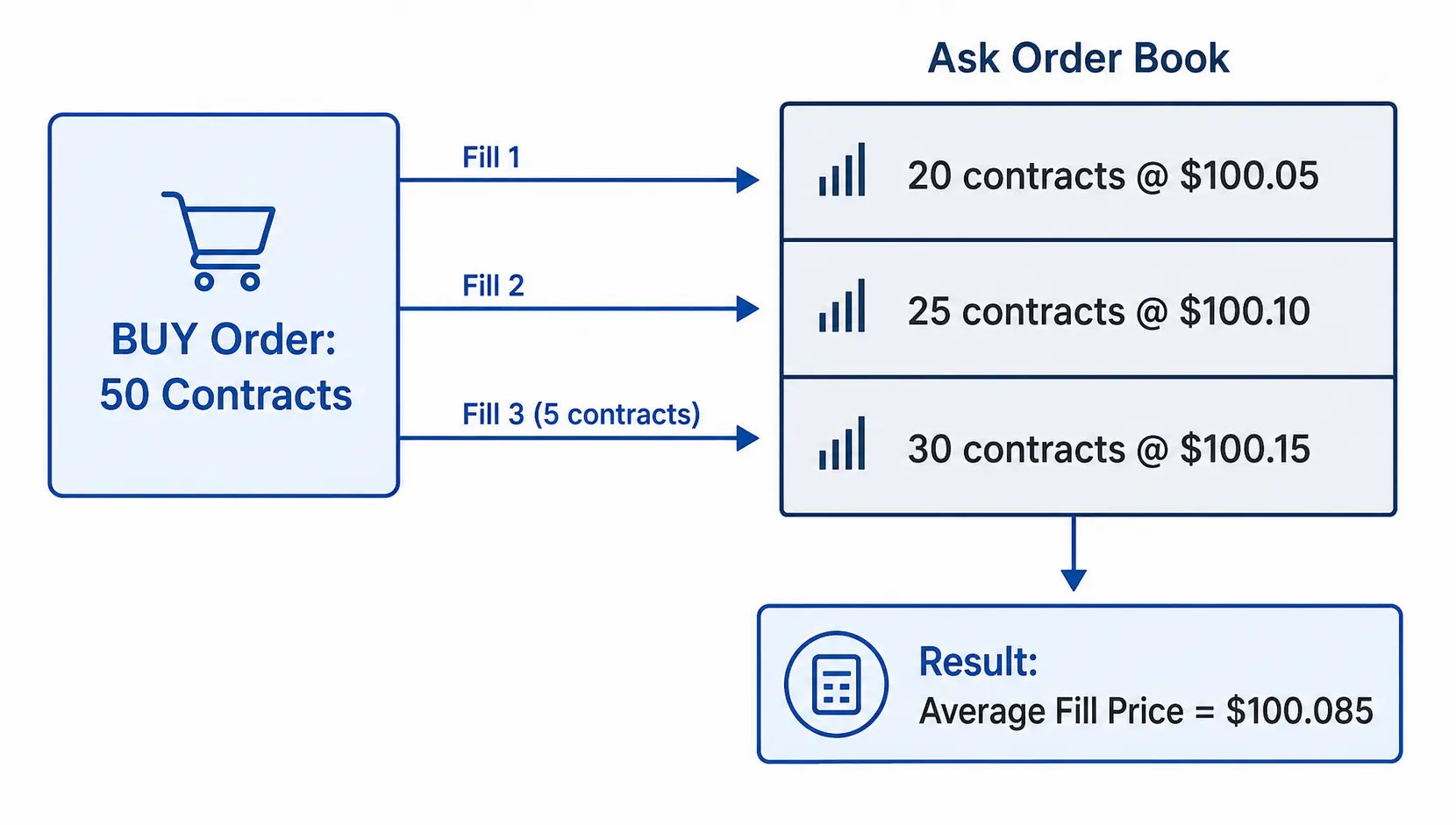
Your order for 50 contracts is too large to be filled at the best ask price of $100.05 alone. Here is how your order would be executed:
- The first 20 contracts are filled at $100.05.
- The next 25 contracts are filled at $100.10.
- The final 5 contracts (to complete your order of 50) are filled at $100.15.
To calculate your average buy price, you perform a weighted average calculation:
Average Price = [(Price1 * Volume1) + (Price2 * Volume2) + (Price3 * Volume3)] / Total Volume
Average Price = [($100.05 * 20) + ($100.10 * 25) + ($100.15 * 5)] / 50
Average Price = [($2001.00) + ($2502.50) + ($500.75)] / 50
Average Price = $5004.25 / 50 = $100.085
Now, let’s assume the top-of-book bid price was $100.00. The quoted spread was just $0.05 ($100.05 – $100.00). However, your effective spread was calculated based on your average fill price:
Effective Spread = Average Ask Price – Top Bid Price = $100.085 – $100.00 = $0.085
This additional cost ($0.035 per contract) is known as ‘slippage’, and it’s a direct result of your order size relative to market depth. This demonstrates how the true cost of trading is more complex than just the top-level quote.
| Factor | Impact on Spread | Trader’s Action / Consideration |
|---|---|---|
| Liquidity | Inverse relationship. High liquidity leads to tight spreads. | Favour highly liquid instruments for active trading. Check average daily volume before engaging. |
| Volatility | Direct relationship. High volatility leads to wide spreads. | Be cautious during news releases. Use limit orders instead of market orders to control your fill price. Factor wider spreads into profit targets. |
| Time of Day | Spreads are tightest during the overlap of major trading sessions (e.g., London/New York). Spreads widen at market open, close, and during overnight sessions. | Identify the peak liquidity hours for your chosen derivative. Avoid placing large orders in thin, after-hours markets. |
| Market Maker Competition | More market makers competing for order flow results in spread compression. | Choose brokers and exchanges with deep liquidity pools and access to multiple providers. This is often more important than the advertised commission rate. |
Frequently Asked Questions
1. What is a good bid-ask spread in derivative markets?
There is no single answer to this. A ‘good’ spread is entirely relative to the instrument being traded. For a major forex pair CFD, a spread of under 1 pip is standard. For a blue-chip stock option, a few cents might be good.
The most practical way to judge is to compare the spread to the instrument’s average daily trading range. If the spread represents a tiny fraction (e.g., less than 1%) of the typical daily movement, it can be considered competitive for that specific asset.
2. Why are spreads for some derivatives wider than for others?
Spreads are wider for derivatives that are less liquid, more volatile, or more complex. An option on a rarely traded stock has a wide spread because the market maker has a difficult time hedging their position.
A binary option has a wide spread because its all-or-nothing payoff structure creates a different risk profile. An index future on the S&P 500 has a razor-thin spread because millions of contracts are traded daily with immense competition among market makers.
The spread is always a direct reflection of the market maker’s risk.
3. How do market makers profit from the bid-ask spread?
Market makers profit by simultaneously offering to buy a derivative at the bid price and sell it at the ask price. Their goal is to facilitate a high volume of both buy and sell orders.
For every round-trip transaction where they buy from a seller at the bid and sell to a buyer at the ask, they capture the spread as their revenue. Their primary risk is not being able to find an offsetting order quickly, forcing them to hold a position that could move against them.
The spread is their compensation for managing this risk and providing the service of constant liquidity.
Danny’s Final Thoughts
After all these years, I view the bid-ask spread not as an enemy, but as a tollbooth on the trading highway. You cannot avoid it, so you must factor it into your journey.
Many traders chase pennies in profit while ignoring the dimes they give away in spreads and slippage. True mastery of execution is understanding that your real entry price is the ask and your real exit price is the bid.
Every strategy, every target, and every stop-loss must be calculated with this reality in mind. Don’t just look at the chart; look at the order book. The spread tells you the real-time cost of participation.
In a game of probabilities and risk management, controlling your costs is one of the few things you have direct power over. It’s not about winning one trade; it’s about surviving long enough to let your strategy play out. The spread is the first hurdle in that marathon.
Sources & Methodology
Danny strictly relies on primary regulatory data and authoritative official information to ensure accuracy. Data cited in this guide is sourced from:
*Disclaimer: The content of this article represents the personal views of the author (Danny) and is for educational and reference purposes only. It does not constitute professional investment or financial advice. Trading and investing involve significant risk; proceed with caution.*
