

As a trader who has navigated the markets for over a decade, I understand the desire for clear objectives. Many new traders believe that the key to success is setting realistic daily goals for EUR/USD day trading.
They ask me, ‘Danny, how much should I aim to make per day?’ While the question comes from a good place, it’s fundamentally flawed. The pursuit of fixed daily profit targets is one of the fastest routes to blowing up an account.
This guide will dismantle that dangerous mindset and provide a sustainable EUR/USD trading strategy built on process, not on arbitrary daily financial goals.
We will explore how to set achievable weekly or monthly profit targets and why focusing on your trading process is the only goal that matters in the long run.
The Problem with Fixed Daily Profit Goals
The idea of making a consistent, fixed amount every single day from trading EUR/USD is a powerful marketing fantasy, but it has little basis in reality. The market is a dynamic environment, not an ATM.
Let’s break down why this approach is so problematic.
The Psychological Pressure of ‘Win-Every-Day’ Targets
When you set a goal like ‘I must make £200 today’, you create immense psychological pressure. What happens on a slow day when the EUR/USD is range-bound with no clear setups?
Your goal forces you to act. You start seeing patterns that aren’t there, taking suboptimal trades just to ‘hit your number’. This is no longer trading; it’s gambling. I’ve seen countless traders fall into this trap.
A small losing day, which is a normal part of the business, turns into a catastrophic one because they engage in ‘revenge trading’ to try and meet their arbitrary target.
This emotional decision-making erodes discipline and is the antithesis of professional trading.
How EUR/USD Volatility Clashes with Rigid Expectations
The EUR/USD is the world’s most traded currency pair, but its volatility is not constant. It is heavily influenced by economic data releases, central bank announcements from the ECB and the Fed, and overall market sentiment.
There are periods of high liquidity and clear trends, often during the London and New York session overlap. Conversely, there are periods of consolidation and low volume, like the late Asian session.
A fixed daily goal completely ignores this reality. Expecting to make the same profit during a quiet public holiday in the US and UK as you would on a Non-Farm Payrolls Friday is illogical.
As analysis from sources like market reports often shows, EUR/USD volatility can decline to multi-year lows, meaning opportunities are scarcer.
A professional trader adapts their expectations to the current market character; an amateur tries to force the market to meet their expectations.
A Better Framework: Process-Oriented vs. Outcome-Oriented Goals
The most significant shift in my trading career occurred when I stopped focusing on the money and started focusing on the process.
An outcome-oriented goal is ‘Make 1% profit today’. A process-oriented goal is ‘Follow my trading plan for every single setup today’. One is outside your control; the other is entirely within it.
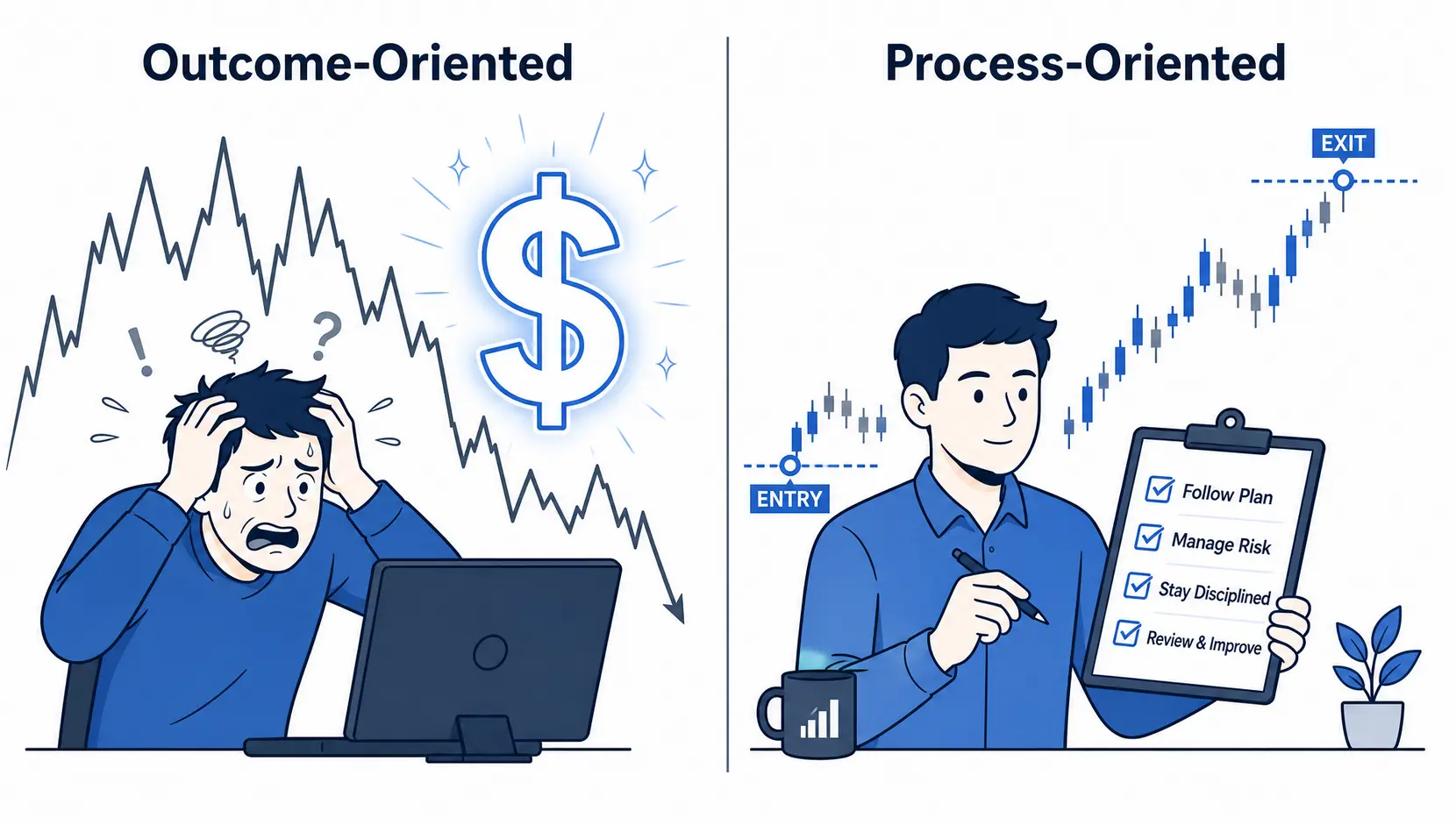
Shifting Focus to What You Can Control: Strategy Execution and Risk Management
Your trading success is determined by factors you manage directly.
These are the pillars of your trading business:
- Your Trading Plan: A detailed document outlining your strategy’s entry signals, exit signals (for both profit and loss), and position sizing rules. Your goal is to adhere to this plan with zero deviation.
- Risk Management: This is paramount. Before you even think about profit, you must define your risk. How much of your capital are you willing to risk per trade? What is your maximum daily loss? These are the numbers that keep you in the game. Authoritative sources like Investopedia provide excellent frameworks for understanding and implementing robust risk management techniques.
- Record Keeping: Every trade should be logged in a journal. Why did you take it? How did you manage it? What was the outcome? This data is the foundation for improvement.
Key Performance Indicators (KPIs) to Track Besides Profit
If not daily profit, what should you track? You should track metrics that reflect the health of your trading *process*. These KPIs give you a true measure of your performance as a trader, independent of the market’s randomness on any given day.
| Process-Oriented KPI | What It Tells You | Why It’s Better Than a Dollar Goal |
|---|---|---|
| Adherence to Plan (%) | The percentage of trades you took that perfectly matched your strategy’s rules. | It measures your discipline, the most critical trait for long-term success. |
| Win Rate | The percentage of trades that are closed in profit. | It helps you understand the nature of your strategy (e.g., high win-rate, small wins vs. low win-rate, large wins). |
| Risk-to-Reward Ratio (RRR) | The potential profit of a trade divided by its potential loss. | Ensures you are taking trades where the potential gain justifies the risk, a cornerstone of professional trading. |
| Average Winning Trade vs. Average Losing Trade | The average size of your winners compared to your losers. | Your winners must be larger than your losers over time for any strategy to be profitable. This KPI tells you if they are. |
How to Define Realistic & Flexible Daily Objectives for EUR/USD
So, how do we create a structured approach that fosters discipline and aligns with market realities? We build a framework based on risk control and performance measurement over a longer time horizon.
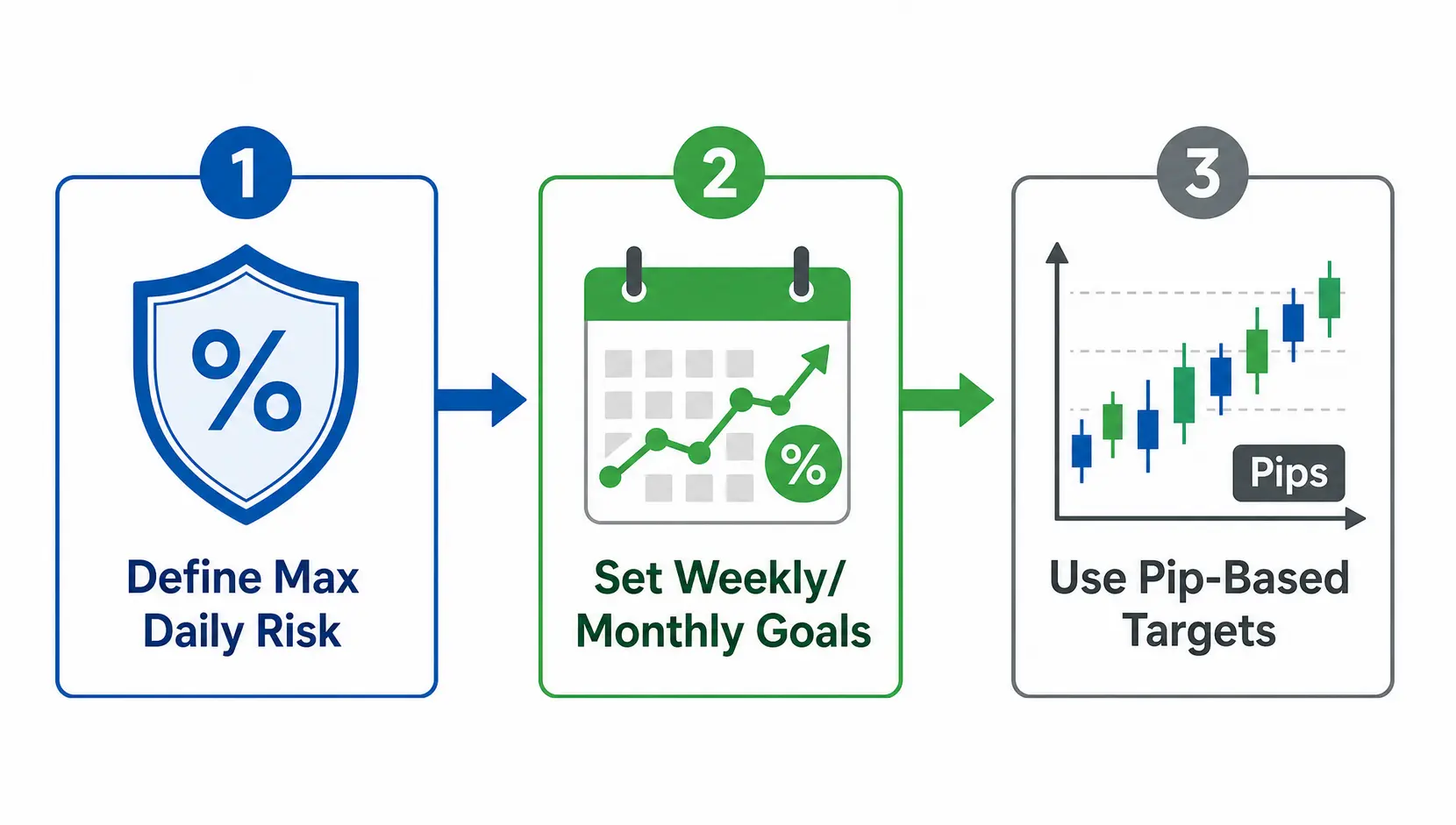
Step 1: Define Your Maximum Daily Risk (Your ‘Stop Trading’ Point)
This is the most important goal you will set. Before the trading day begins, you must know the maximum amount of capital you are willing to lose. This is typically 1% to 2% of your trading account.
For example, on a £10,000 account, your maximum daily loss might be £150. If your net loss for the day hits this figure, you shut down your platform. No exceptions.
This ‘daily stop-loss’ prevents a single bad day from wiping out a week’s worth of gains and protects you from your own emotional reactions.
Step 2: Set Weekly or Monthly Percentage Goals Based on Backtesting
Instead of daily goals, think in terms of weekly or monthly performance. Where does this goal come from? It comes from data. You must backtest your EUR/USD trading strategy over a significant period (at least a year of historical data).
Your backtesting results will show you the strategy’s average monthly return and its maximum drawdown. Your future goals should be based on these historical averages, not on a desired income.
If your strategy historically returns an average of 3-5% per month, setting a goal of 20% is unrealistic and will lead to the same psychological pressures we’ve discussed.
Step 3: Use Pip-Based Targets Instead of Fixed Dollar Amounts
If you must use a target for a single trade, it’s far better to use pips rather than a monetary value. A pip target is directly related to market movement and is independent of your position size.
This approach keeps your analysis objective. A dollar target, however, can be manipulated by changing your leverage. Chasing a specific dollar amount might tempt you to take on a larger position size than your risk parameters allow, which is a cardinal sin in trading.
| Aspect | Pip-Based Target | Fixed Dollar Target |
|---|---|---|
| Focus | Market structure and price action. | Monetary outcome (P&L). |
| Objectivity | High. The target is based on technical analysis (e.g., the next resistance level). | Low. The target is based on personal financial desire. |
| Risk Management | Promotes consistent position sizing based on stop-loss distance. | Can encourage reckless increases in position size to ‘hit the target’ faster. |
| Psychological Impact | Keeps the trader focused on analysis and execution. | Creates anxiety, greed, and a tendency to force trades. |
Frequently Asked Questions
1. Is making 1% per day a realistic goal in forex trading?
No, it is not a realistic or sustainable goal for the vast majority of traders. While you might have days where you make 1% or more, aiming for it consistently creates destructive psychological pressure.
A 1% daily return compounds to an astronomical figure that even the world’s best hedge funds cannot achieve. Focusing on such a goal will force you to over-trade and take unacceptable risks.
The real goal is a solid, data-backed monthly percentage, and even that will come with winning and losing weeks.
2. What is a reasonable daily profit goal for a beginner day trader?
A beginner’s primary goal should be capital preservation and education, not profit. For the first six months, your goal should be to finish the day with your capital intact and to have followed your trading plan with 100% discipline.
A more practical goal is to aim to lose as little as possible while you are learning. Track your process-oriented KPIs.
Once you have a proven, backtested strategy and six months of disciplined execution under your belt, you can then start setting modest weekly or monthly performance goals based on your actual results.
3. Should I stop trading after reaching my daily goal?
This is a common question, and my answer is nuanced. If your ‘goal’ is a predetermined profit target (which I advise against), stopping can be a good way to prevent giving profits back due to overconfidence.
However, a better approach is to assess the market conditions. If you’ve had a good run but your strategy is still presenting valid, high-probability setups, you should follow your plan.
A more robust rule is to stop trading for the day once you’ve hit your maximum daily loss limit. That is non-negotiable.
Another effective rule can be to call it a day after a certain number of trades (e.g., 3-5), regardless of the outcome, to prevent over-exposure and decision fatigue.
Danny’s Final Thoughts
Sources & Methodology
Danny strictly relies on primary regulatory data and authoritative official information to ensure accuracy. Data cited in this guide is sourced from:
*Disclaimer: The content of this article represents the personal views of the author (Danny) and is for educational and reference purposes only. It does not constitute professional investment or financial advice. Trading and investing involve significant risk; proceed with caution.*
