

I’ve seen many traders, full of confidence, get wiped out by a single volatile swing. More often than not, the root cause wasn’t a bad strategy but a misunderstanding of their primary risk tool: margin. The difference between isolated margin and cross margin in trading is not just a technical detail; it’s the fundamental choice that dictates whether you contain a single forest fire or risk burning down your entire portfolio. Understanding the risk management implications of cross vs. isolated margin is paramount, especially when dealing with leveraged instruments like CFDs or perpetual futures. This guide will cut through the noise and give you a clear, practical framework for deciding which margin mode truly fits your trading style.
What is Isolated Margin and Its Risk Implications
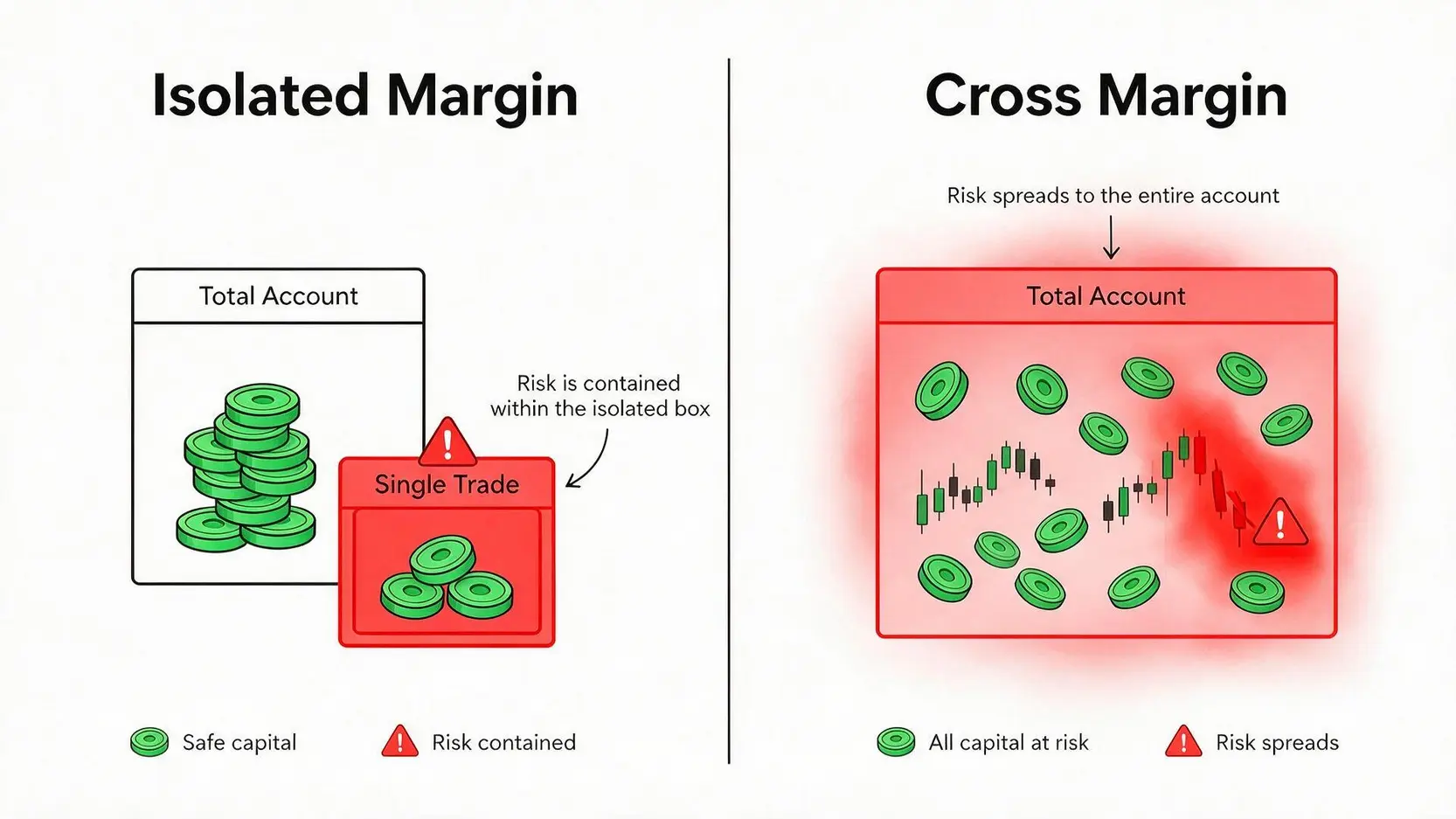
Pro Tip: Isolated Margin acts like a watertight compartment on a ship. It allocates a specific amount of your capital to a single position. If that position floods (gets liquidated), the damage is contained and does not sink your entire account. It is the preferred mode for testing new, speculative strategies or taking on high-risk, high-reward trades without jeopardising your core portfolio.
Definition and How It Works
Isolated Margin allows a trader to dedicate a precise amount of collateral (the ‘isolated margin’) to a single open position. This amount is separate from the rest of the funds in your trading account. The margin ratio and potential liquidation for this position are calculated based solely on this segregated collateral. Any other open positions or available balance in your account will not be automatically used to prevent this specific position from being liquidated.
For instance, let’s say you have a £10,000 account balance. You decide to open a high-leverage long position on BTC/USD worth £20,000. You might allocate £1,000 as isolated margin for this specific trade. The remaining £9,000 in your account is safe; it cannot be touched if this BTC/USD trade goes sour. The platform will only consider the £1,000 you’ve ring-fenced when calculating your liquidation price. You can, however, manually add more margin to this specific position to improve your margin ratio and lower the liquidation price.
Pros and Cons of Using Isolated Margin
| Aspect | Pros (Advantages) | Cons (Disadvantages) |
|---|---|---|
| Risk Control | Excellent. Losses are capped to the margin allocated. Protects the main account from a single bad trade. | Higher risk of liquidation for the specific position as it cannot draw support from the account’s total equity. |
| Strategy Application | Ideal for high-risk, speculative trades or when testing a new strategy with a quantifiable downside. | Inefficient for portfolio-wide hedging or strategies that rely on the interplay between multiple positions. |
| Capital Management | Provides precise control over the capital risked per trade. Simplifies risk/reward calculation. | Requires active management. You may need to manually add margin to a position to prevent liquidation during a downturn. |
What is Cross Margin and How It Impacts Your Portfolio
Pro Tip: Cross Margin pools all the available capital in your account to act as a shared safety net for all your open positions. It provides a larger buffer to prevent liquidation on any single position, making it suitable for diversified, multi-position strategies. However, this shared risk means one catastrophic position could drain your entire account.
Definition and How It Works
Under a Cross Margin regime, all of your available account balance is used as collective collateral to support all of your open positions. If one position starts to incur unrealised losses, the system draws upon the entire available balance—including realised profits from other positions—to prevent that losing position from being liquidated. This continues until the entire account balance is at risk of being depleted, at which point a total liquidation event for all positions may occur.
Revisiting the earlier example: you have a £10,000 account. You open the same £20,000 long position on BTC/USD using cross margin. Now, the entire £10,000 balance is backing this trade. If the market moves against you, your position can sustain a much larger unrealised loss before liquidation compared to the £1,000 isolated margin. The downside? If the loss becomes substantial enough, it doesn’t just close the BTC/USD trade; it can trigger the liquidation of all other open positions and wipe out your entire account equity.
Pros and Cons of Using Cross Margin
| Aspect | Pros (Advantages) | Cons (Disadvantages) |
|---|---|---|
| Risk Exposure | Lower risk of premature liquidation for a single position due to the larger shared collateral pool. | Systemic risk. A single highly leveraged, failing position can drain the entire account balance and liquidate all other trades. |
| Capital Efficiency | More efficient use of capital. Unrealised profits from one position can offset unrealised losses from another, supporting the overall margin. | Less clarity on the exact amount of capital at risk for any single idea. Can obscure poor performance of individual trades. |
| Strategy Application | Excellent for hedging, arbitrage, and multi-leg strategies where positions are designed to offset each other. | Extremely dangerous for beginners or traders who are not meticulously managing the total portfolio risk. |
Key Differences: Isolated Margin vs Cross Margin
Choosing between these two modes fundamentally alters your relationship with risk. It’s not about which is ‘better’ in a vacuum, but which is the correct tool for the specific job at hand. The primary distinctions boil down to how you allocate collateral, how you manage risk, and what happens when a trade goes catastrophically wrong.
Collateral Allocation: Single Position vs Entire Account
This is the most significant divergence. Isolated Margin is a micro-management approach. You decide, with precision, how much capital you are willing to lose on one specific trade. The collateral is partitioned, creating a firewall. Cross Margin is a macro-management approach. It treats your entire account as a single, fluid pool of collateral. This offers convenience and capital efficiency but sacrifices the granular control and risk containment of the isolated method.
Risk Management: Containing Losses vs Shared Risk
With Isolated Margin, your risk management question is simple: ‘How much am I willing to lose on this single idea?’ You define your maximum pain point upfront. With Cross Margin, the question becomes: ‘How much of a drawdown can my entire portfolio sustain before a cascade failure?’ This shared-risk model can be beneficial, as a profitable position can help sustain a losing one, but it also creates a dangerous domino effect if your overall portfolio takes a heavy hit. Effective use of cross margin requires a more holistic view of portfolio correlation and total risk exposure.
Liquidation Process: How Each Margin Type Affects Liquidation
When the market moves against your position, your margin level drops. Once it hits the maintenance margin threshold (the minimum equity required), a liquidation process begins.
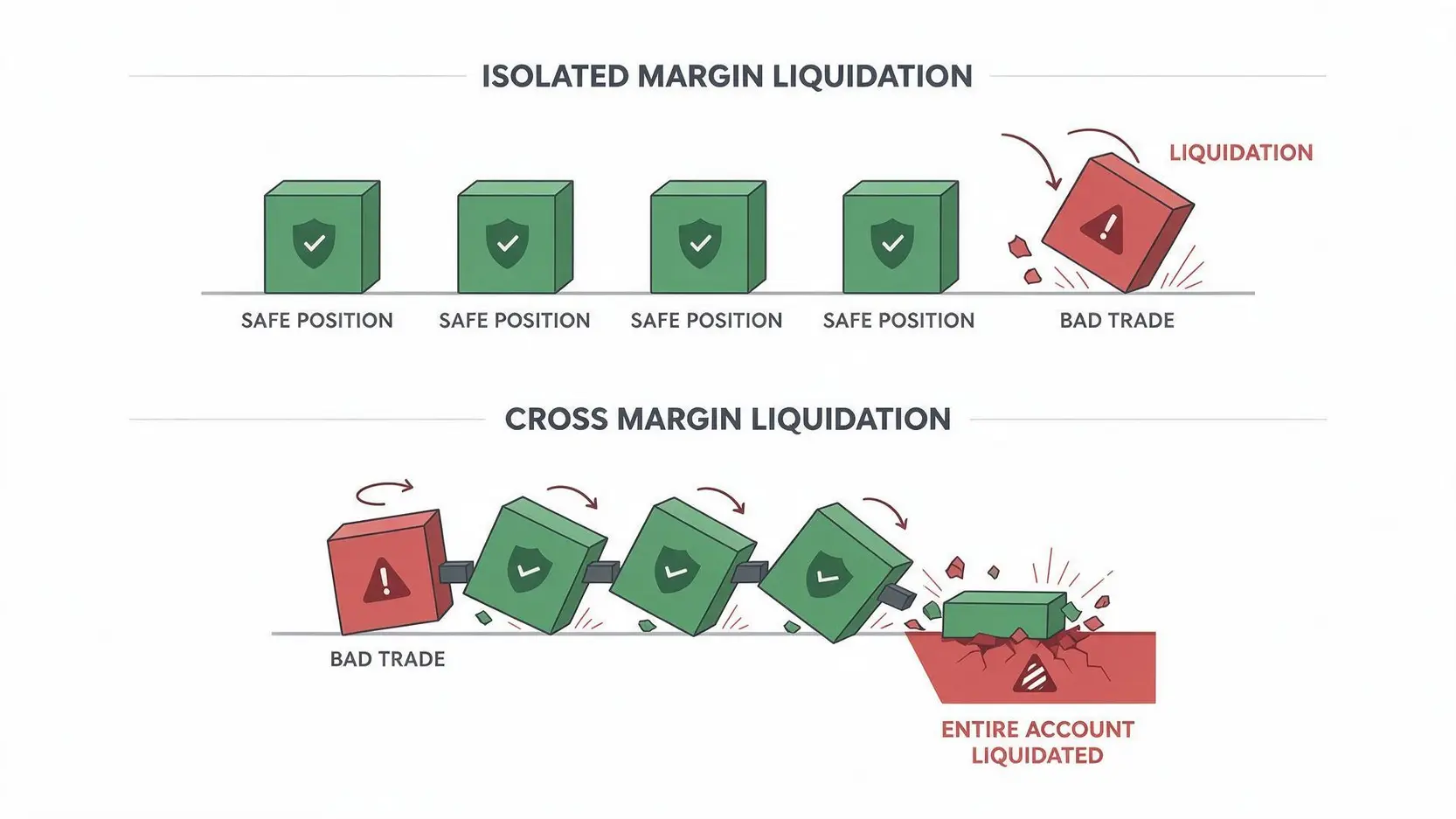
- Isolated Margin Liquidation: The platform’s liquidation engine will automatically close the specific position. The loss is realised, and the amount you dedicated as isolated margin is lost. The rest of your account, including other positions, remains untouched. It’s a clean, surgical cut.
- Cross Margin Liquidation: This is far more complex and dangerous. As your overall margin level for the entire account approaches the maintenance threshold, the system may start liquidating your positions. Often, it will begin by closing the largest losing position to free up margin. However, in a fast-moving market or if the overall leverage is high, it can trigger a cascade where all positions are force-closed, and your entire account balance is wiped out.
When to Use Each Margin Type: Practical Scenarios for Traders
The right choice is dictated by your strategy, experience level, and risk tolerance. Here are some scenarios I’ve encountered where one is clearly preferable to the other.
When to Choose Isolated Margin (e.g., High-risk, speculative positions)
I favour Isolated Margin in several distinct situations:
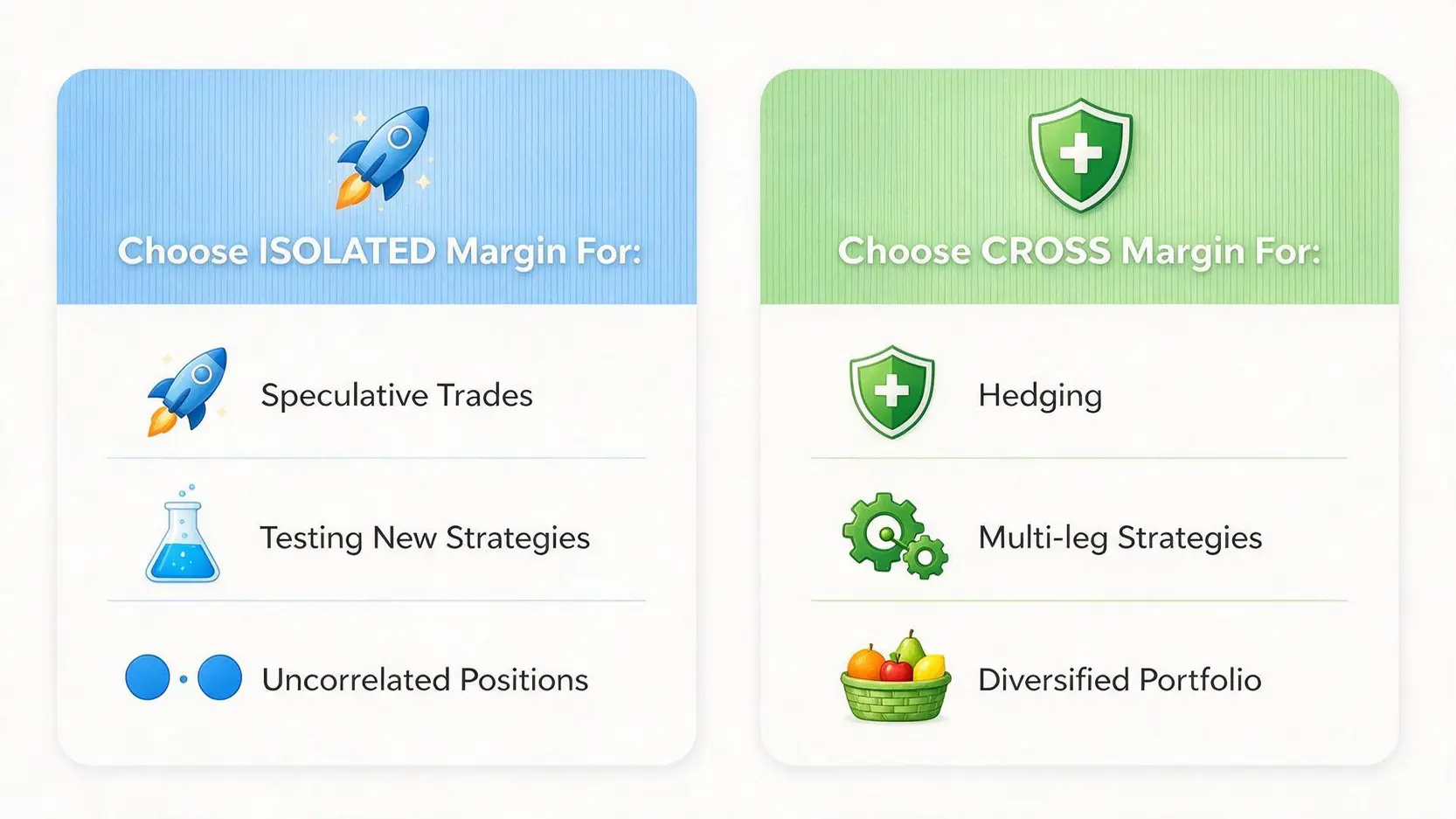
- High-Conviction, High-Risk Trades: If I’m taking a punt on a highly volatile asset or entering a trade based on a short-term catalyst, I want to define my maximum loss with absolute certainty. Isolated margin allows me to do this without worrying that a sudden, violent move will affect my other, more stable positions.
- Testing New Strategies: When experimenting with a new trading system, I always use Isolated Margin. It allows me to allocate a small, fixed amount of ‘research capital’ to see how the strategy performs in a live environment without risking my primary funds.
- Position Decoupling: If I am running two uncorrelated strategies simultaneously (e.g., a long-term trend-following position and a short-term mean-reversion trade), I use Isolated Margin for each to prevent their outcomes from interfering with one another.
When to Choose Cross Margin (e.g., Hedging, multi-position strategies)
Cross Margin becomes the more logical tool when your positions are part of a single, cohesive portfolio strategy:
- Hedging: If you hold a spot portfolio of cryptocurrencies and want to short perpetual futures to hedge against a market downturn, Cross Margin is ideal. The gains on your short hedge can automatically provide margin support for your spot-based positions if the market falls.
- Grid Trading or Averaging In: For strategies that involve systematically adding to a position at different price levels, Cross Margin simplifies the process. The entire balance supports the growing position, providing a wider buffer against volatility.
- Low-Leverage, Diversified Portfolios: If you are running multiple, low-leverage positions across different assets, Cross Margin can be used with relative safety. The diversification reduces the chance of a single catastrophic event, and the shared margin pool provides flexibility.
Frequently Asked Questions
1. Which margin type is better for beginners?
For any trader new to leverage, I would unequivocally recommend starting with Isolated Margin. The learning curve in trading is steep and expensive. Isolated Margin forces you to practice disciplined risk management on a per-trade basis. It builds the crucial habit of defining your risk before entering a position. Starting with Cross Margin is like learning to drive in a lorry on a motorway; a small mistake can lead to a devastating pile-up. Master the go-kart on a closed circuit first.
2. Can I switch between isolated and cross margin for an open position?
On most trading platforms, you cannot switch the margin mode for a position that is already open. The margin calculation and risk parameters are fixed at the moment of execution. You must decide whether to use Isolated or Cross Margin before you place the trade. If you wish to change your approach, you would typically need to close the existing position and open a new one with the desired margin mode.
3. How does leverage affect isolated and cross margin differently?
Leverage is a double-edged sword for both modes, but its effect feels sharper with Isolated Margin. With a high-leverage isolated position, the distance between your entry price and your liquidation price becomes extremely small. Even minor market fluctuations can trigger liquidation. For Cross Margin, high leverage on one position increases the rate at which it can ‘eat’ into your total account balance, thereby increasing the systemic risk to all other positions. In essence, high leverage on an isolated trade risks the position; high leverage on a cross-margin trade risks the entire account.
Danny’s Final Thoughts
Sources & Methodology
Danny strictly relies on primary regulatory data and authoritative official information to ensure accuracy. Data cited in this guide is sourced from:
*Disclaimer: The content of this article represents the personal views of the author (Danny) and is for educational and reference purposes only. It does not constitute professional investment or financial advice. Trading and investing involve significant risk; proceed with caution.*
