
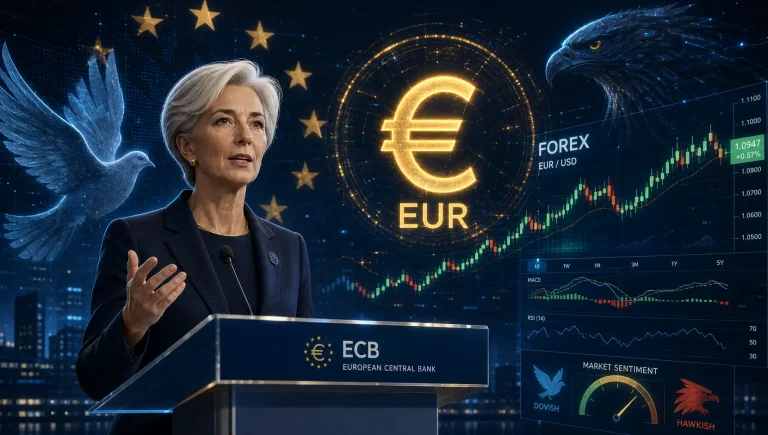
As a market analyst focusing on macroeconomic drivers, I’ve consistently observed that European Central Bank (ECB) press conferences are pivotal events for the Euro.
For the prepared trader, understanding how to approach the art of interpreting ECB Lagarde speeches for short-term EUR trading is not just an academic exercise—it is a core competency.
These events inject significant liquidity and volatility into the market, creating distinct opportunities.
This guide provides a professional framework for dissecting the nuances of monetary policy communication, moving beyond the headlines to understand the underlying signals that influence the impact of ECB announcements on EUR volatility and learning to differentiate between Hawkish vs Dovish monetary policy tones to inform your trading strategy for 2026.
Understanding the Language of the ECB: Hawkish vs Dovish Tones Explained
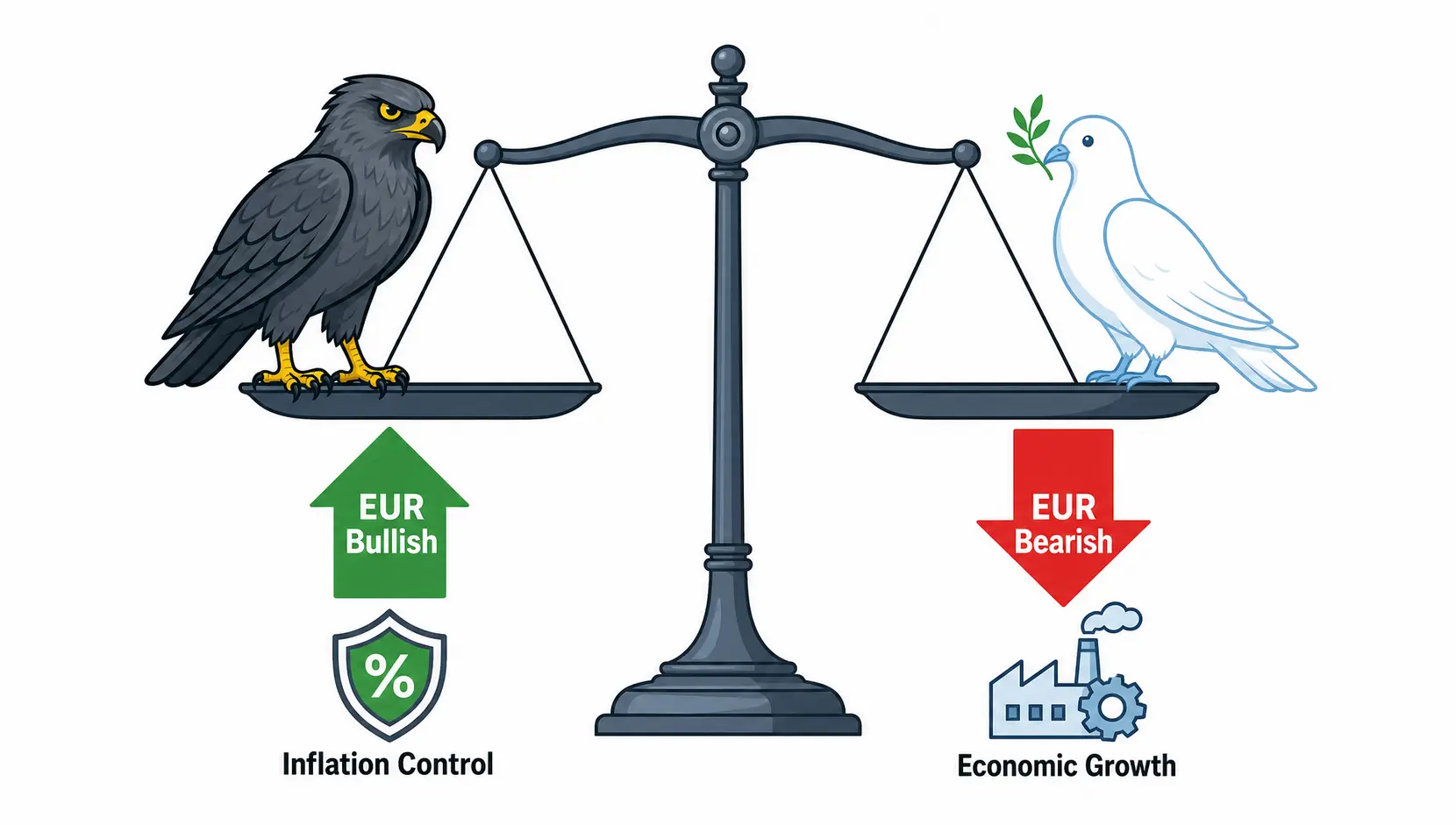
Pro Tip: The essence of interpreting ECB language lies in identifying the direction of policy bias. A ‘hawkish’ tone signals a tighter monetary policy to combat inflation, which is typically bullish for the EUR. Conversely, a ‘dovish’ tone suggests a looser policy to stimulate growth, which is generally bearish for the EUR. Your primary task is to categorise the speech into one of these two camps.
Central bank communication is a carefully choreographed performance. Every word is scrutinised by algorithms and human traders alike. The terms ‘hawkish’ and ‘dovish’ are fundamental to this analysis, representing the two opposing ends of the monetary policy spectrum.
Misinterpreting this tone is one of the most significant risks a short-term trader faces during these high-stakes announcements.
What a Hawkish Stance Means for the EUR
A hawkish stance is defined by a central bank’s focus on controlling inflation. When President Lagarde adopts a hawkish tone, it implies that the ECB is prepared to prioritise price stability, even at the expense of short-term economic growth.
This is typically communicated through specific phrases and data references.
- Key Indicators: Emphasis on upside risks to inflation, rising wage growth data, and strong GDP figures. The ECB will signal that the Harmonised Index of Consumer Prices (HICP) is unacceptably high or trending above their 2% target.
- Market-Moving Language: Look for phrases like “vigilant on inflation,” “prepared to act decisively,” “monetary tightening,” or any suggestion that interest rate hikes are being actively considered or are imminent. The removal of previously used ‘dovish’ phrases is also a powerful hawkish signal.
- Expected EUR Impact: A hawkish message typically leads to an appreciation of the EUR. Higher anticipated interest rates make the currency more attractive to foreign investors seeking better yields, increasing demand and driving up its value against other currencies like the USD or GBP.
What a Dovish Stance Means for the EUR
A dovish stance prioritises economic growth and employment over strict inflation control. When the ECB leans dovish, it signals a willingness to maintain or increase monetary stimulus to support the Eurozone economy.
This approach is often adopted during periods of economic weakness or low inflation.
- Key Indicators: Focus on downside risks to the economic outlook, rising unemployment, and inflation projections that are below the target. President Lagarde might highlight external uncertainties or weak consumer demand.
- Market-Moving Language: Dovish signals include phrases like “policy accommodation remains appropriate,” “monitoring incoming data,” “downside risks have intensified,” or any hint that interest rate cuts or an expansion of asset purchase programmes are on the table.
- Expected EUR Impact: A dovish statement generally causes the EUR to depreciate. The prospect of lower interest rates or increased money supply reduces the currency’s yield appeal, leading traders to sell the EUR in favour of currencies with a more robust economic outlook.
| Characteristic | Hawkish Stance | Dovish Stance |
|---|---|---|
| Primary Goal | Control Inflation | Stimulate Economic Growth |
| Interest Rate Bias | Higher (or prospect of) | Lower (or prospect of) |
| Typical EUR Reaction | Appreciation (Bullish) | Depreciation (Bearish) |
| Example Phrase | “We will take all necessary measures to ensure inflation returns to our 2% target.” | “The governing council will remain data-dependent and flexible in its approach.” |
A Trader’s Framework for Analysing ECB Speeches and Their Impact on EUR Volatility
Pro Tip: Successful analysis is not a reactive process; it is a structured, three-stage operation. It involves pre-speech preparation, real-time phrase identification, and post-speech validation against market consensus. The bulk of the work is done before President Lagarde even begins speaking.
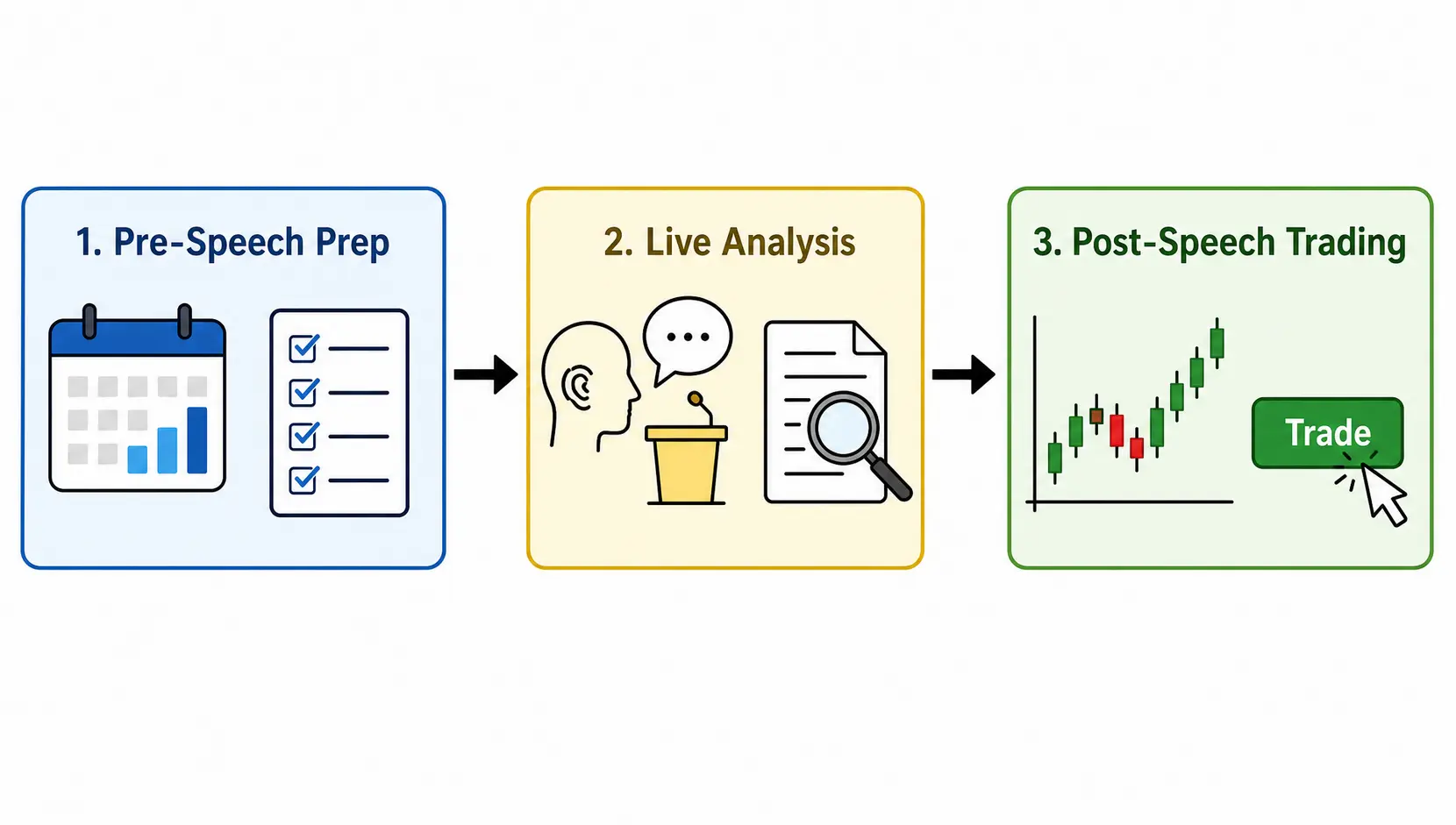
Pre-Speech Preparation: Setting Up Your Analysis
The outcome of your trade is often determined by the quality of your preparation. Going into an ECB announcement ‘blind’ is financial gambling, not professional trading. A systematic approach is required.
- Establish the Market’s Baseline Expectation: What is the consensus? Are analysts expecting a hawkish, dovish, or neutral statement? Review reports from major financial news outlets (Bloomberg, Reuters) and bank research. The market’s reaction will be magnified if the ECB delivers a surprise against this consensus.
- Identify Key Economic Data Points: Before the speech, review the latest Eurozone HICP (inflation), GDP growth, and PMI (Purchasing Managers’ Index) data. Has inflation been trending up? Is manufacturing sentiment weakening? Knowing these figures provides context for Lagarde’s statements. You can find this data on the official Eurostat website.
- Analyse the Previous Statement: Obtain the text from the last ECB press conference. Highlight key phrases and the overall tone. The most powerful signals often come from changes—words added, removed, or modified—from one statement to the next.
- Define Your Trading Scenarios: Based on the baseline, create ‘if-then’ scenarios. For instance: ‘If Lagarde upgrades the inflation forecast and removes the phrase about ‘downside risks’, then the probability of a hawkish reaction is high, and I will look for EUR/USD long entries.’
Live Analysis: Identifying Key Market-Moving Phrases
The live press conference is divided into two main parts: the prepared monetary policy statement and the subsequent Q&A session. Both are critically important.
- The Statement Reading: This is the most scripted part. The market reaction is often instant as trading algorithms parse the text for changes from the previous statement. Pay attention to any modification in the description of the economic outlook, inflation risks, or future policy path.
- The Q&A Session: This is where the unscripted, and often most valuable, information emerges. President Lagarde’s off-the-cuff answers to journalists’ questions can reveal the Governing Council’s true convictions. A pointed question about the timing of rate hikes might elicit a response that is far more revealing than the prepared text. Does she push back strongly against a hawkish question (a dovish sign) or a dovish question (a hawkish sign)?
From Words to Trades: Practical Short-Term Strategies for Trading the EUR
Pro Tip: There is no single ‘best’ strategy. The correct approach depends on your risk tolerance, experience, and platform capabilities. The two primary approaches are trading the initial volatility spike or positioning for the more sustained post-speech trend. The latter is generally more suitable for non-institutional traders.
Strategy 1: Trading the Initial Volatility Spike
This high-risk, high-reward strategy attempts to profit from the immediate, knee-jerk reaction to the monetary policy statement’s release. It is the domain of algorithmic trading and highly experienced manual traders with low-latency execution platforms.
- Methodology: Placing pre-set buy-stop and sell-stop orders (a ‘straddle’) on either side of the current price moments before the announcement. The goal is to capture the initial price explosion in one direction, with a tight stop-loss on the opposing order.
- Execution: This is extremely difficult to execute manually. The price can move dozens of pips in milliseconds, leading to severe slippage (where your order is filled at a much worse price than intended). Spreads also widen dramatically, increasing transaction costs.
Strategy 2: Positioning for the Post-Speech Trend
This is a more methodical and, in my view, sustainable approach for most traders. It involves waiting for the initial dust to settle and making a trading decision based on a comprehensive reading of the statement and the Q&A session.
- Methodology: Wait for the first 15-30 minutes of the press conference to conclude. By this point, the initial volatility has often subsided, and a clearer directional bias has emerged. Use your pre-speech analysis to judge whether the overall tone was more hawkish or dovish than the market expected.
- Execution: If the tone was surprisingly hawkish, look for a technical entry point to go long on the EUR (e.g., buying a dip or a breakout from a consolidation pattern on a 5-minute or 15-minute chart). Conversely, if the tone was surprisingly dovish, look for an opportunity to go short. Your stop-loss should be placed at a logical technical level, such as below the session’s low for a long trade. The resulting trend can often last for several hours or even into the next trading day.
| Strategy | Pros | Cons | Best Suited For |
|---|---|---|---|
| 1. Initial Spike Trading | Potential for very rapid profit | Extremely high risk of slippage, whipsaws, and spread costs | Algorithmic funds, professional traders with institutional-grade execution |
| 2. Post-Speech Trend Following | Based on considered analysis, lower risk of execution issues | May miss the initial, most explosive move; requires patience | Most retail and independent traders |
Frequently Asked Questions
1. How quickly does the EUR react to Lagarde’s speeches?
The reaction can be instantaneous, often occurring within milliseconds of the electronic release of the policy statement. Algorithmic trading systems are programmed to scan the text for key word changes, leading to an immediate price spike.
The more substantive, trend-following move often builds over the course of the subsequent 30-60 minutes as human traders and analysts digest the full context of the Q&A session.
2. What are the most important parts of an ECB press conference for a trader?
From a macro analyst’s perspective, there are two pivotal moments. First, the release of the written statement, where you must compare it line-by-line against the previous month’s statement. Any deviation is a signal.
Second, President Lagarde’s responses to questions about future policy and inflation forecasts during the Q&A. These impromptu remarks often provide the clearest insight into the Governing Council’s true thinking, away from the carefully scripted text.
3. How can I learn the difference between a hawkish and dovish tone?
The best way is through experience and study. Go back and review the past 12 ECB policy statements and the corresponding EUR/USD charts. Identify which statements were labelled ‘hawkish’ or ‘dovish’ by financial news outlets.
Read the text and see what specific language prompted that label and how the market reacted. You can find excellent primers on the topic from financial educators like Investopedia.
4. How should I manage risk when trading around ECB announcements?
Risk management is paramount. Firstly, reduce your standard position size. Volatility will be amplified, so a smaller position can still result in a significant P&L swing.
Secondly, know your invalidation level before entering a trade; place a hard stop-loss and respect it. Do not trade if you cannot afford the loss.
Thirdly, consider waiting for the first 15-30 minutes to pass to avoid the worst of the volatility, spread widening, and potential slippage. Trading the aftermath is often a more prudent strategy than trading the event itself.
Andrew Wong’s Final Thoughts
Sources & Methodology
Andrew Wong strictly relies on primary regulatory data and authoritative official information to ensure accuracy. Data cited in this guide is sourced from:
*Disclaimer: The content of this article represents the personal views of the author (Andrew Wong) and is for educational and reference purposes only. It does not constitute professional investment or financial advice. Trading and investing involve significant risk; proceed with caution.*
