
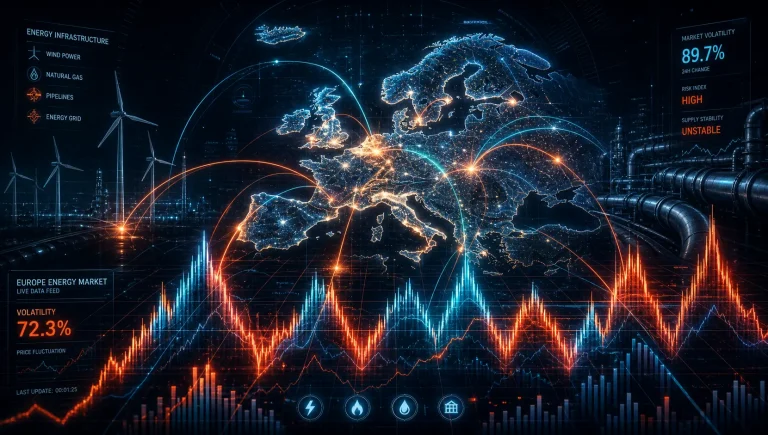
As a trader who’s navigated everything from flash crashes to pandemic meltdowns, I’ve learned that ignoring the news ticker is a luxury we can’t afford.
The direct line connecting geopolitical events in Europe to energy market volatility has never been clearer, or more critical to understand.
Whether it’s a diplomatic standoff or a shift in cross-border trade policy, the impact of geopolitical events on European energy markets can be immediate and severe.
This guide is built from years of experience, designed to help you understand how European geopolitics drive energy market volatility and how to analyse the resulting shockwaves.
The Core Mechanisms: How Geopolitical Shocks Affect European Energy Prices
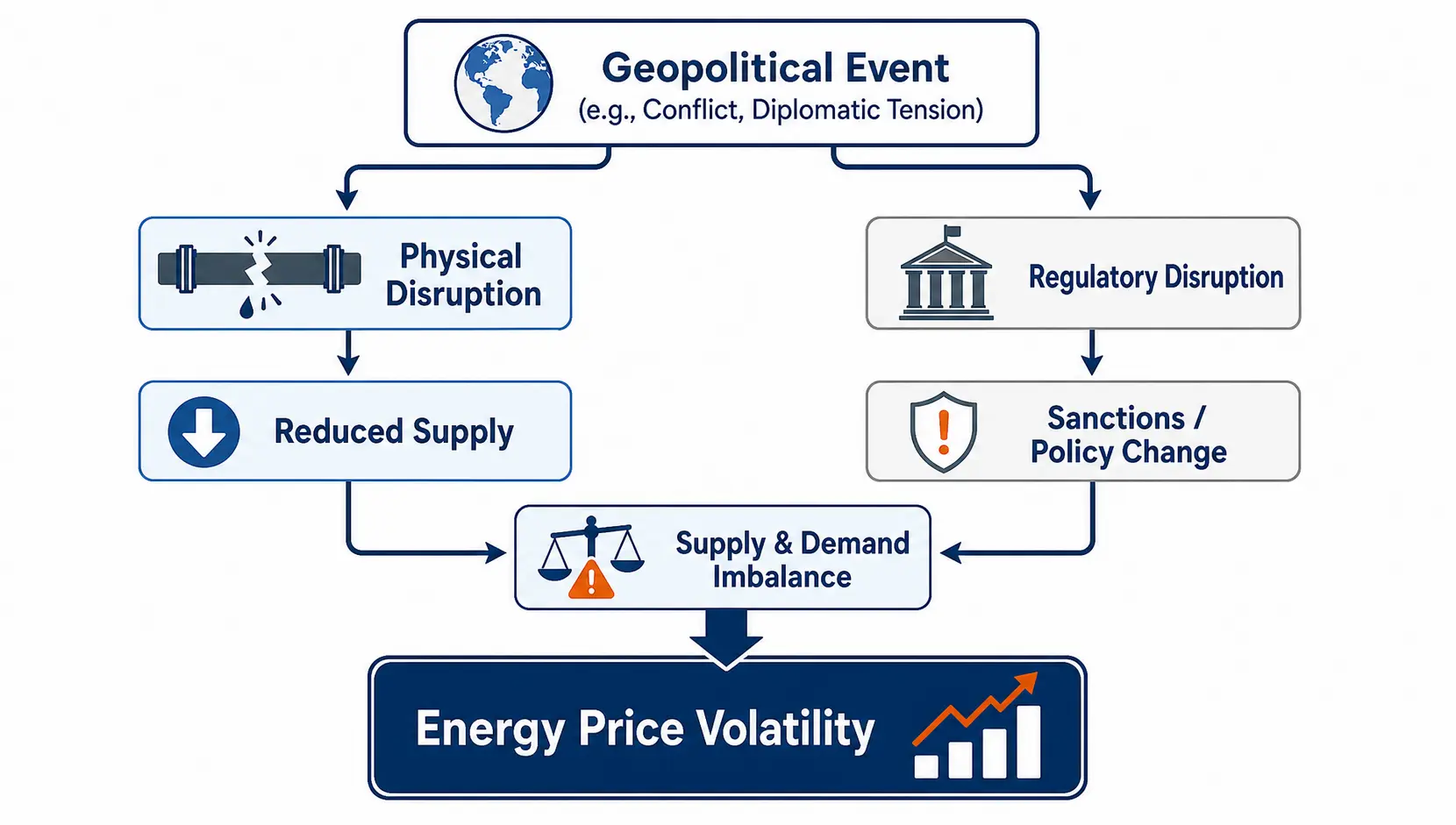
Pro Tip: Geopolitical events primarily impact energy prices through two channels: the physical disruption of supply chains (like pipelines and shipping routes) and the regulatory disruption of markets (through sanctions and policy changes). The market’s reaction speed and magnitude depend on the severity and perceived duration of the event.
Understanding the transmission from a headline to a price chart is fundamental. It isn’t magic; it’s a chain reaction of cause and effect rooted in the physical and financial infrastructure of Europe’s energy system. Let’s break down these mechanisms.
1. Supply Chain Disruptions and Sanctions Explained
The most direct impact comes from a sudden halt or reduction in energy flow. This can be a deliberate act, such as a supplier state turning off a pipeline, or an indirect consequence, like maritime insurance rates skyrocketing in a conflict zone, making LNG tanker transit unviable.
When supply is constrained against constant or rising demand, prices must rise. This is basic economics, but in the energy market, the speed is brutal.
Sanctions are a more complex tool. They are policy-driven weapons that aim to restrict a nation’s ability to trade. For example, the EU may impose sanctions on a major oil and gas producer.
These aren’t just symbolic; they have tangible effects:
- Asset Freezes: Preventing the sanctioned country’s energy companies from accessing their funds in European banks.
- Technology Bans: Prohibiting the export of critical equipment needed for energy extraction or refinement, degrading the producer’s long-term capacity.
- Import Bans: Directly forbidding the purchase of oil, gas, or coal from the sanctioned state, forcing a continent-wide scramble for alternative sources.
2. The Influence of Sudden Shifts in National and EU Energy Policy
Policy is the invisible hand that can redirect billions in capital and reshape markets. A single announcement can have consequences that last for decades.
For instance, a major European economy announcing an accelerated phase-out of nuclear power creates a massive, long-term demand for natural gas or renewables to fill the gap. This structural shift gets priced into forward curves immediately.
Conversely, coordinated policy action, like the EU’s mandates on minimum gas storage levels, is a direct response to geopolitical risk.
While designed to stabilise the market, the initial process of filling those storage facilities can create intense, short-term buying pressure, ironically driving up prices.
These policies, while stabilising in the long run, often introduce significant short-term volatility. Authoritative information on these measures can be found directly from official sources like the European Union’s official page on sanctions.
| Geopolitical Event Type | Primary Market Impact | Example Timeframe | Affected Instrument |
|---|---|---|---|
| Pipeline Disruption | Immediate price spike in regional natural gas futures. | Hours to Days | TTF Gas Futures, Regional Power Prices |
| Economic Sanctions Announced | Increased volatility, wider spreads, impact on long-term forward curves. | Weeks to Months | Brent Crude, Carbon Permits (EUAs), Gas Forward Curves |
| National Election (Hung Parliament) | Policy uncertainty, deferred investment, potentially lower long-term prices but higher short-term risk premium. | Months to Years | Power Purchase Agreements (PPAs), Energy Stocks |
Key European Factors That Amplify How Geopolitics Drive Energy Market Volatility
Pro Tip: Europe’s vulnerability isn’t just a matter of circumstance; it’s structural. Decades of policy, infrastructure development, and trade relationships have created a system with several key stress points that magnify the impact of external shocks. High import dependency is the continent’s Achilles’ heel.
It’s one thing for an event to happen, but it’s another for it to cause a market earthquake. In Europe, several underlying factors act as volatility multipliers. A trader must be acutely aware of these structural weaknesses.
1. Dependence on Imports: The Critical Role of LNG and Pipeline Security
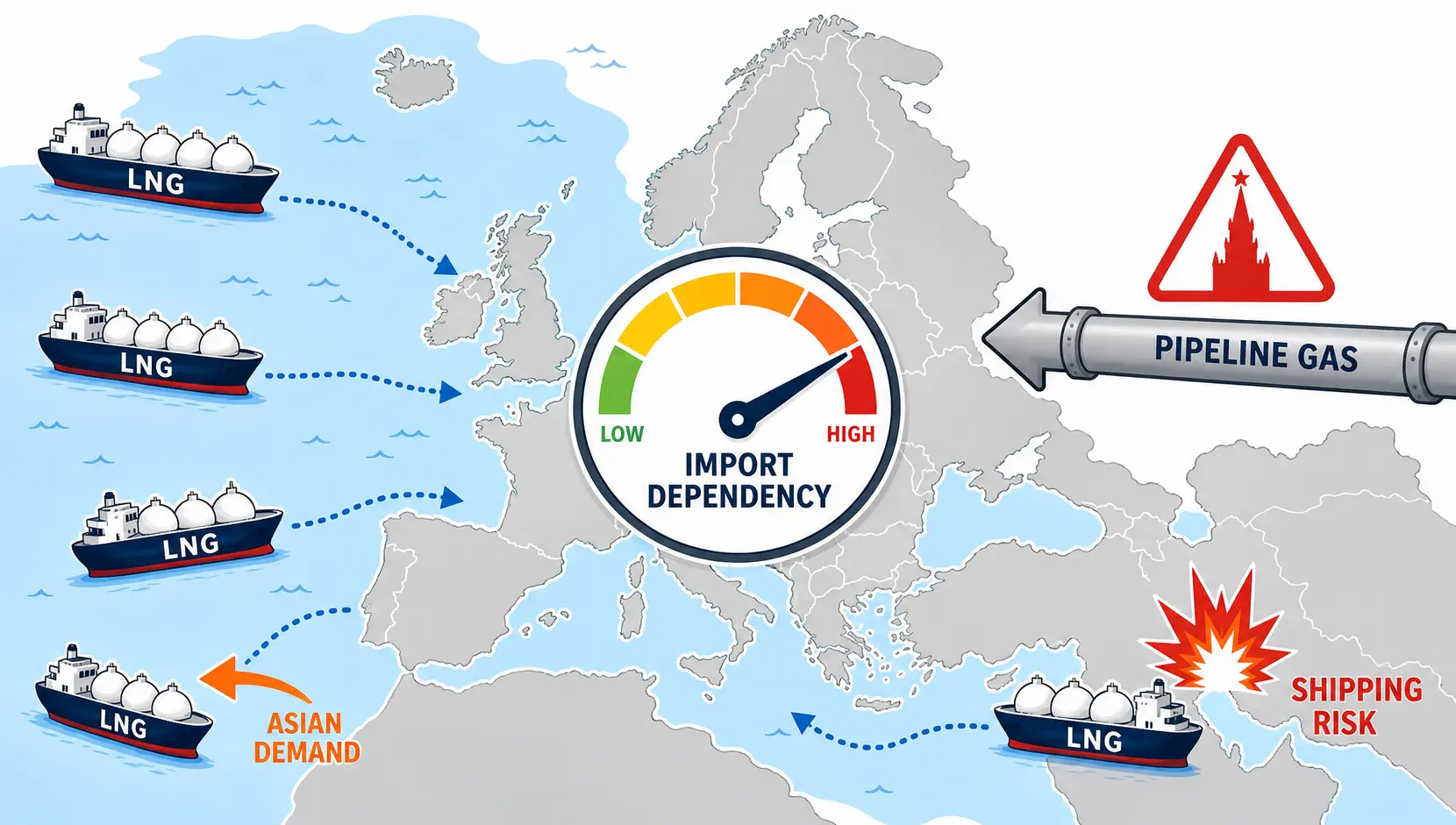
Europe is not self-sufficient in energy. For decades, it has relied on a network of pipelines from the East and, more recently, on a global fleet of Liquefied Natural Gas (LNG) tankers.
According to 2025 data from Eurostat, the EU’s natural gas import dependency rate remains stubbornly high, hovering around 85-90%.
This structural deficit means any disruption to these inbound flows has an outsized price impact. There is no large buffer of domestic production to absorb the shock.
The pivot towards LNG to reduce pipeline dependency simply swaps one set of risks for another. LNG is a global commodity. A heatwave in Asia can pull LNG cargoes away from Europe, forcing European buyers to bid higher.
A conflict in the Middle East can threaten key shipping lanes like the Strait of Hormuz, adding a significant risk premium to every tanker’s journey. You can track these flows through datasets provided by organisations like Bruegel.
2. Regional Differences: How Geography and Interconnection Affect Prices Across Europe
It’s a mistake to view ‘Europe’ as a single, unified energy market. It’s a patchwork of national grids with varying levels of interconnection.
Spain and Portugal, for example, have limited pipeline connections to the rest of Europe, a situation sometimes called an ‘energy island’. This means a gas shortage in Germany may have a less direct impact on Iberian power prices.
Conversely, countries in Central and Eastern Europe, with high historical dependence on a single supplier, are far more sensitive to specific geopolitical events.
The UK, with its significant offshore wind capacity and LNG import terminals, has a different risk profile again. Its prices are often more correlated with global LNG benchmarks and carbon prices.
Understanding these nuances is key to identifying relative value trades across different European energy hubs.
| Factor | Germany | United Kingdom | Implication for Traders |
|---|---|---|---|
| Primary Import Source | Pipeline Gas (Historically Russia, now Norway) | LNG, Norwegian Pipelines | German prices are more sensitive to pipeline outages; UK prices more tied to global LNG freight and supply. |
| Nuclear Power | Phased out | Active fleet, with new projects planned | Germany has higher baseline demand for gas/renewables, making it more vulnerable to fuel price shocks. |
| Interconnection | High (Central Europe) | Moderate (to France, Belgium, Netherlands) | Price contagion can spread faster through the German market. UK prices can sometimes disconnect from the continent. |
Analysing the Market Impact: From Forward Curves to Intraday Swings
Summary Paragraph: A professional approach requires you to differentiate market reactions across timeframes. News-driven intraday spikes are a test of nerve and risk management, while shifts in the forward curve reveal the market’s deeper, long-term reassessment of risk. Your analysis framework must incorporate both quantitative data (e.g., storage levels) and qualitative judgment on political stability.
Watching prices jump on a news alert is only the first step. A seasoned trader needs to look deeper, analysing the structure of the market’s reaction to understand its true conviction.
1. Short-Term vs. Long-Term Market Reactions to Geopolitical News
A headline about a pipeline explosion will cause the front-month gas contract to spike dramatically. This is a short-term, fear-driven reaction to an immediate supply loss. However, the real story for a strategist is in the forward curve.
Does the contract for delivery in two years also move up? If it does, the market believes the disruption is not temporary but structural. If it remains stable, the market expects the problem to be resolved relatively quickly.
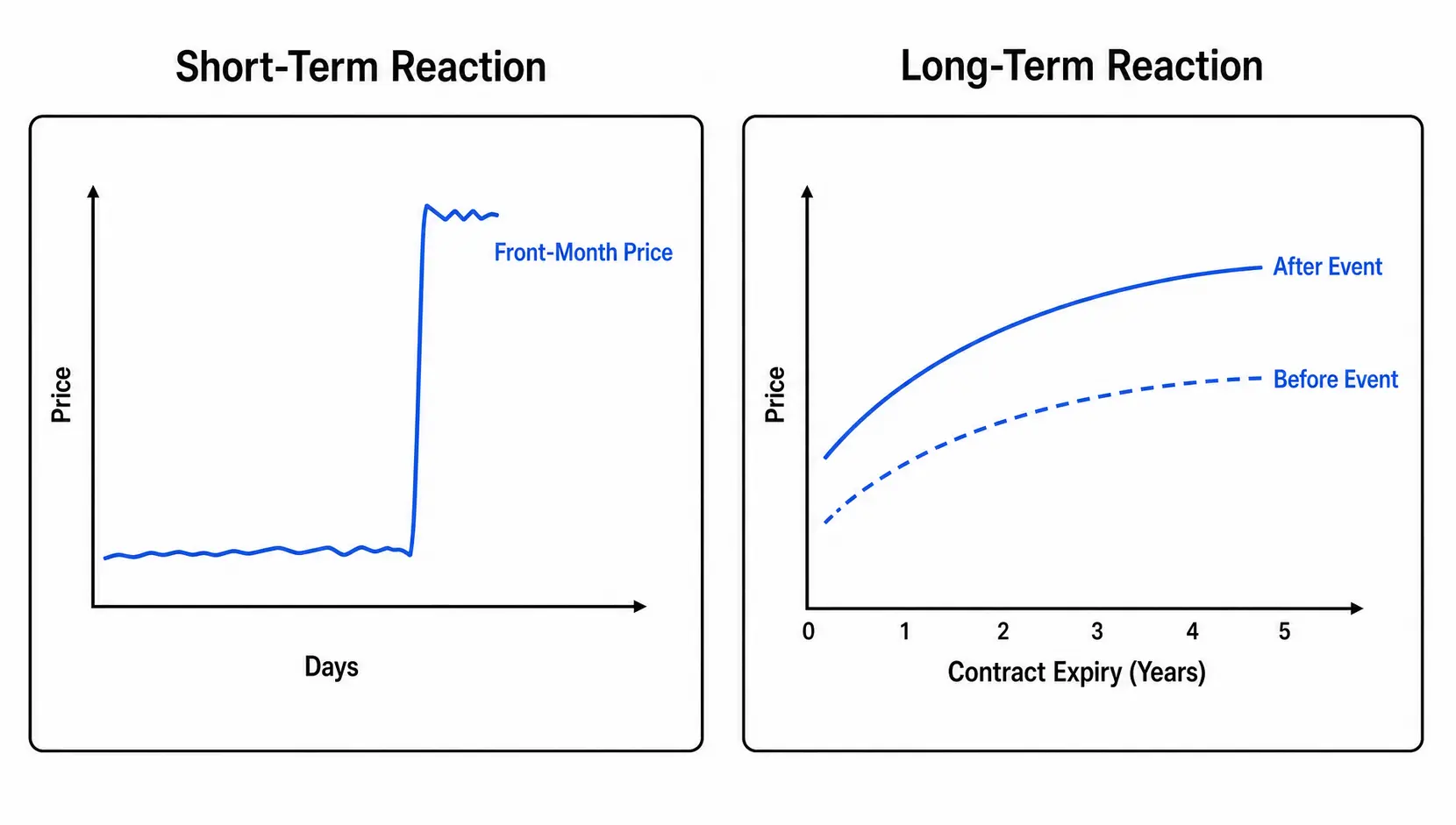
- Short-Term Reaction (Hours/Days): Driven by algorithms and intraday traders reacting to headlines. High volatility, often overshooting fundamental value. Focus is on spot and front-month futures.
- Long-Term Reaction (Weeks/Months): Driven by portfolio managers, utilities, and industrial consumers reassessing long-term supply security. Reflected in the entire forward curve, options pricing (implied volatility), and credit default swaps (CDS) for energy companies.
2. Building Geopolitical Risk into Your Analysis Framework
You cannot simply react. You must have a system. My framework involves a blend of quantitative and qualitative inputs:
- Monitor Key Metrics: Track daily LNG import flows, European gas storage levels (vs. 5-year average), and interconnector utilisation rates. These are your fundamental health indicators.
- Track Risk Indices: Use indicators like the Bloomberg Geopolitical Risk Scores or other similar indices to get a quantified measure of political tension in key regions. A rising index is a warning sign.
- Scenario Analysis: Don’t just trade what’s happening. Ask ‘What if?’. What if the conflict widens? What if a key election has a surprise result? Map out potential impacts on supply and price for at least two or three plausible scenarios. This prepares you mentally and strategically.
- Risk Management First: In a geopolitically driven market, you will be wrong. The key is ensuring that when you are, the loss is survivable. Always define your maximum acceptable loss before entering a trade. Never trade based on hope.
Frequently Asked Questions
1. What is the most direct link between a geopolitical event and energy prices?
The most direct link is the physical disruption of a major supply route.
An attack on a pipeline, the closure of a strategic strait like Hormuz or the Suez Canal, or a sudden halt in exports from a major producer has an instantaneous impact because it creates an immediate supply-demand imbalance that can only be resolved by price.
2. How do events outside Europe, like Sino-US tensions, affect its energy markets?
Europe’s energy market is globally connected, especially through LNG. If Sino-US tensions escalate, it could impact global trade flows and economic growth.
A slowdown in China’s economy might reduce its demand for LNG, freeing up cargoes that could then head to Europe, potentially lowering prices.
Conversely, if the tensions disrupt shipping lanes in the South China Sea, it could increase freight costs and risk premiums for LNG tankers globally, raising the cost of imports for Europe.
3. Why are European power markets particularly vulnerable to geopolitical risk?
Their vulnerability stems from a high dependency on imported natural gas, which is often the marginal fuel source that sets the price for electricity. When the gas price spikes due to a geopolitical event, power prices are forced to follow suit.
The phase-out of predictable, non-fuel-dependent generation like nuclear in some key countries has increased this leverage, making the entire power system more sensitive to volatility in a single commodity.
4. How can a retail trader manage these immense risks?
Firstly, by acknowledging them. Don’t oversize your positions. Use instruments with defined risk, like options, or ensure you have strict stop-loss orders in place on CFD or futures trades.
Secondly, focus on diversification. Don’t have your entire portfolio exposed to one energy commodity.
Lastly, stay informed but don’t get caught in the noise. Make decisions based on your framework, not on every breaking news headline.
Danny’s Final Thoughts
Connecting the dots between a political headline and a tick on a price chart is the core skill for survival in today’s markets. The European energy sector is the chessboard, and geopolitical events are the moves that change the entire game.
You don’t need a crystal ball, but you do need a framework built on a solid understanding of supply chains, policy levers, and, most importantly, risk.
Treat every position as a calculated risk, not a bet on a certain outcome. That’s how you stay in the game long enough to profit from the inevitable volatility.
Sources & Methodology
Danny strictly relies on primary regulatory data and authoritative official information to ensure accuracy. Data cited in this guide is sourced from:
*Disclaimer: The content of this article represents the personal views of the author (Danny) and is for educational and reference purposes only. It does not constitute professional investment or financial advice. Trading and investing involve significant risk; proceed with caution.*
