
As a financial planner, I often find clients are eager to participate in the growth of the market but feel overwhelmed by the prospect of picking individual stocks.
This is where index trading comes into the picture. It allows you to gain exposure to the performance of an entire section of the market, such as the FTSE 100 or the S&P 500, without needing to analyse hundreds of separate companies.
This guide will explain how to start index trading from a household planning perspective, focusing on building a sustainable strategy and understanding the key factors that influence index prices.
My goal is to demystify the process, helping you make informed decisions that align with your long-term financial goals.
What Is an Index and How Does Index Trading Work?
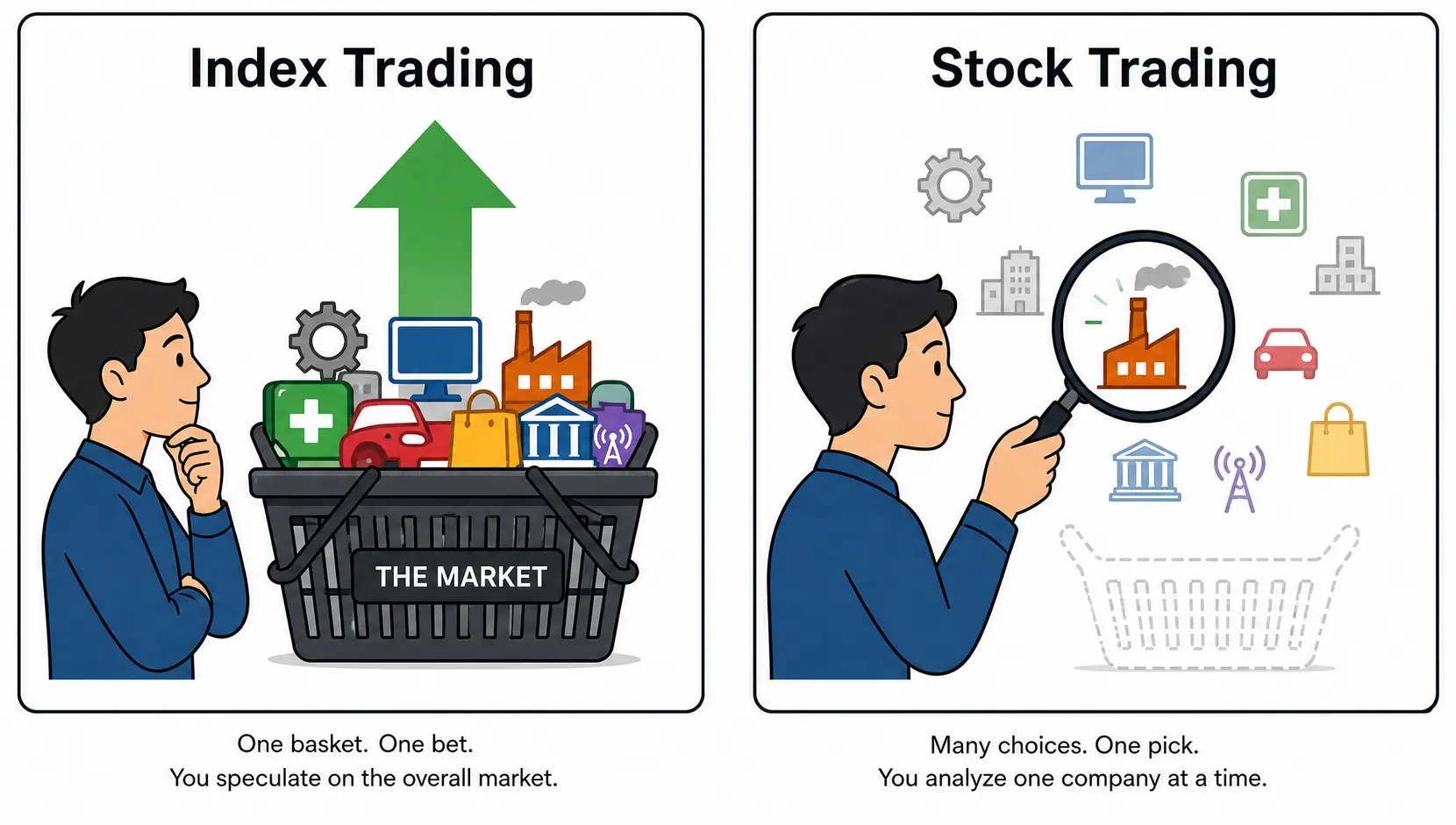
Pro Tip: An index is a curated list of stocks that serves as a benchmark for a specific market or sector. Think of it as a ‘market basket’. When you engage in index trading, you are speculating on the change in the total value of this basket, rather than buying the individual assets within it. It’s a method for trading the forest, not the individual trees.
Defining a Stock Market Index
A stock market index is a statistical measure of the change in a portfolio of stocks representing a portion of the overall market.
For example, in the United Kingdom, the Financial Times Stock Exchange 100 Index (FTSE 100) represents the 100 largest companies listed on the London Stock Exchange by market capitalisation.
In the United States, the S&P 500 is a benchmark for the 500 largest publicly traded companies.
For my clients in Malaysia, we often look at the FTSE Bursa Malaysia KLCI (FBM KLCI), which tracks the 30 largest companies on the local exchange.
Each index has its own calculation methodology, but its purpose remains the same: to provide a snapshot of market performance.
The Core Mechanics: Speculating on Price Movements, Not Owning Shares
This is a crucial distinction that trips up many beginners. Unlike investing in an index fund or an ETF where you own a small piece of each company in the index, most forms of index trading do not involve ownership.
Instead, you are using financial derivatives, such as a Contract for Difference (CFD), to speculate on the index’s price direction.
If you believe the FTSE 100 will rise, you would ‘buy’ or go long on a FTSE 100 CFD. If your prediction is correct and the index value increases, your position’s value rises.
Conversely, if you believe it will fall, you would ‘sell’ or go short. If the index drops, you profit. This ability to profit from both rising and falling markets is a key feature of index trading, but it also amplifies risk.
How to Start Trading Indices: A Step-by-Step Guide for 2026
“A solid financial plan is the foundation for any investment activity. Before you place a single trade, you must have a plan. My approach is always methodical, focusing on preparation and discipline. Let’s walk through the practical steps I recommend to all my clients who are considering index trading.”
Step 1: Choose a Regulated Broker and Trading Platform
Your first and most important step is selecting a broker. Your capital is at risk, so it’s paramount to use a firm that is regulated by a top-tier authority.
For residents in the UK, this means ensuring the broker is authorised and regulated by the Financial Conduct Authority (FCA). You can and should verify this on the FCA’s Financial Services Register.
For Malaysians, the equivalent is the Securities Commission Malaysia (SC). Regulation provides a degree of protection and ensures the broker adheres to strict standards of conduct, including the segregation of client funds.
Step 2: Understand the Different Ways to Trade Indices
There are several instruments available for index trading, each with its own structure, benefits, and risks. The three most common are CFDs, Futures, and Exchange-Traded Funds (ETFs).
Understanding the difference is vital for aligning your trading activity with your financial situation and risk tolerance.
| Instrument | Best For | Pros | Cons |
|---|---|---|---|
| Contracts for Difference (CFDs) | Short-term speculation, both long and short positions. | High leverage, can profit from falling markets, no stamp duty in the UK. | High risk due to leverage, subject to overnight funding charges, you don’t own the underlying asset. |
| Index Futures | Experienced traders with significant capital. | Traded on a centralized exchange, transparent pricing, no overnight funding fees. | Large contract sizes require more capital, fixed expiry dates, more complex for beginners. |
| Exchange-Traded Funds (ETFs) | Long-term investors looking for broad market exposure. | Lower risk than CFDs/Futures, diversified, can be held in tax-efficient accounts (e.g., ISA, pension). | Typically requires share dealing account, cannot easily go short, subject to management fees (expense ratio). |
Step 3: Develop a Trading Strategy and Manage Your Risk
Entering the market without a strategy is akin to navigating a storm without a compass. A robust trading strategy defines your approach to the market. Will you be a day trader, closing positions before the market closes, or a swing trader, holding for several days or weeks?
What technical indicators or fundamental analysis will inform your decisions? More importantly, how will you manage risk?
This involves setting a stop-loss order for every trade to define your maximum acceptable loss, and a take-profit order to lock in gains. A common rule of thumb I suggest for beginners is the 1% rule: never risk more than 1% of your trading capital on a single trade.
| Concept | Index Trading | Stock Trading |
|---|---|---|
| Focus | Speculating on the direction of an entire market or sector. | Investing in or speculating on the performance of a single company. |
| Diversification | Inherently diversified at the index level. | Requires purchasing multiple different stocks to achieve diversification. |
| Risk Profile | Spread across many companies, but still subject to systemic market risk and high leverage risk (with CFDs). | Concentrated risk in a single company (e.g., poor earnings, management issues). |
What Key Factors Affect Stock Market Index Prices?
Pro Tip: Index prices reflect the collective wisdom—and fears—of the market. They are primarily driven by macroeconomic data and overarching sentiment. A good trader is also a keen observer of the global economic landscape. Always keep an eye on central bank announcements and geopolitical news.
The Role of Economic Data
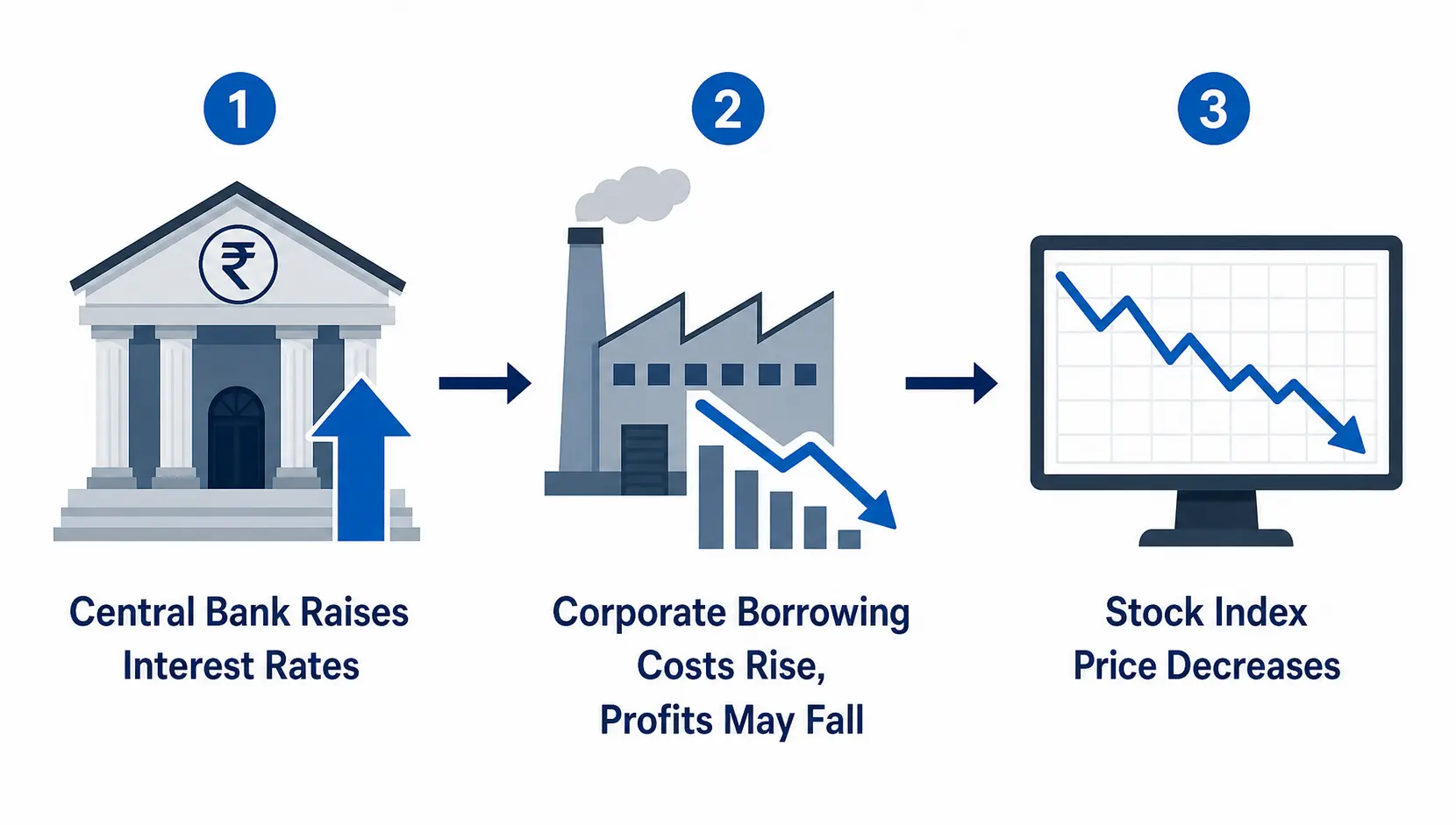
Major economic announcements act as catalysts for market movement. For instance, higher-than-expected inflation figures (Consumer Price Index) may prompt central banks like the Bank of England or the US Federal Reserve to raise interest rates.
This makes borrowing more expensive for companies and consumers, which can negatively impact corporate profits and, consequently, stock prices, causing an index to fall.
Conversely, strong employment data (like the US Non-Farm Payrolls report) can signal a robust economy, boosting investor confidence and driving index values higher. Authoritative data from sources like Bloomberg is essential for staying informed.
Impact of Geopolitical Events and Market Sentiment
Markets detest uncertainty. Unforeseen geopolitical events—such as trade disputes, elections with uncertain outcomes, or international conflicts—can cause significant volatility.
This is driven by ‘market sentiment’, the overall attitude of investors toward a particular market or asset.
When sentiment is fearful, investors may sell assets indiscriminately, leading to broad market declines (a ‘risk-off’ environment). When sentiment is optimistic (‘risk-on’), investors are more willing to buy, pushing indices higher.
As a trader, you must be prepared for sudden shifts in sentiment that can override purely economic data in the short term.
Frequently Asked Questions
1. What is the difference between index trading and stock trading?
From my perspective as a planner, the key difference lies in breadth versus depth. Stock trading focuses on the individual fortunes of a single company, which requires deep research into that specific business.
Index trading is about taking a view on the broader economy or a market sector. It offers instant diversification, as the index’s performance is a weighted average of many stocks, which can reduce company-specific risk.
2. Is index trading profitable for beginners?
It can be, but profitability is not guaranteed and depends entirely on the individual’s preparation. I always tell my clients that ‘profitability follows discipline.’
A beginner who takes the time to get educated, develops a solid trading plan, masters risk management, and starts with a demo account is in a much better position than someone who jumps in looking for quick profits.
The high-risk nature, especially with leveraged products, means beginners can also lose money very quickly.
3. How much money do I need to start index trading?
This is a common question. With CFD brokers, you can often open an account with a relatively small amount, perhaps £100 to £200.
However, I caution against this. Trading with insufficient capital is a common mistake because it forces you to take on too much risk relative to your account size.
A more practical starting point, which allows for proper risk management (like the 1% rule), would be in the range of £1,000 to £3,000. Most importantly, never invest money you cannot afford to lose, especially when starting out.
4. Can I hold an index trade overnight?
Yes, you can hold positions overnight, which is known as swing trading. However, when trading CFDs, this will incur an ‘overnight funding’ or ‘rollover’ fee. This is a charge based on the interest rate of the index’s currency.
For short positions, you may sometimes receive a credit. It’s a small percentage but can add up over time, making CFDs more suitable for short- to medium-term trades rather than long-term holds.
David Lim’s Final Thoughts
“Throughout my years of financial planning, I’ve seen many investment trends come and go. Index trading, however, is a durable concept because it’s tied to the fundamental principle of market participation. But participation must be responsible. Success in this field isn’t about hitting one spectacular home run; it’s about consistent, disciplined execution of a simple, sustainable plan. Start small, educate yourself continuously, and always, always prioritise the management of risk. A well-managed trading plan is just another component of a healthy, long-term financial life.”
Sources & Methodology
David Lim strictly relies on primary regulatory data and authoritative official information to ensure accuracy. Data cited in this guide is sourced from:
*Disclaimer: The content of this article represents the personal views of the author (David Lim) and is for educational and reference purposes only. It does not constitute professional investment or financial advice. Trading and investing involve significant risk; proceed with caution.*
