
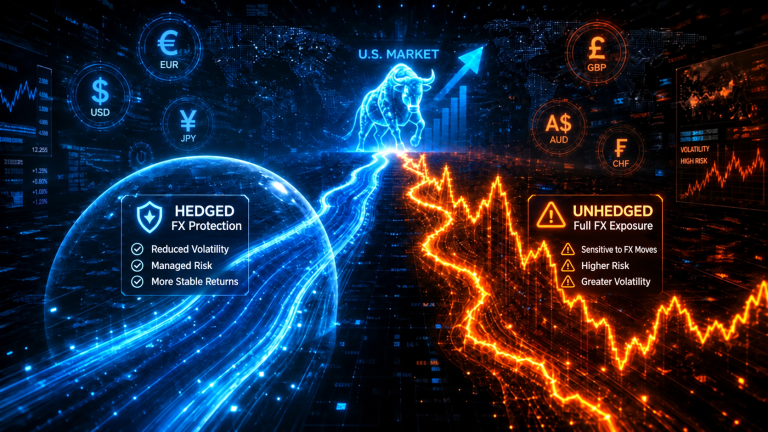
As a fund research analyst, I constantly field questions from UK and Malaysian investors about structuring their US equity exposure. The decision between currency hedged vs unhedged US ETFs is a critical one, particularly in 2026’s volatile forex landscape.
For those of us investing from a non-USD home currency, the impact of currency fluctuations on ETF returns can be just as significant as the performance of the underlying assets.
Understanding which type of ETF is suitable for your portfolio is not merely a technical detail; it is a fundamental pillar of international investment strategy.
This guide will provide a data-driven breakdown to help you navigate this choice with analytical precision.
Core Concepts: A Technical Look at Hedged vs. Unhedged ETFs
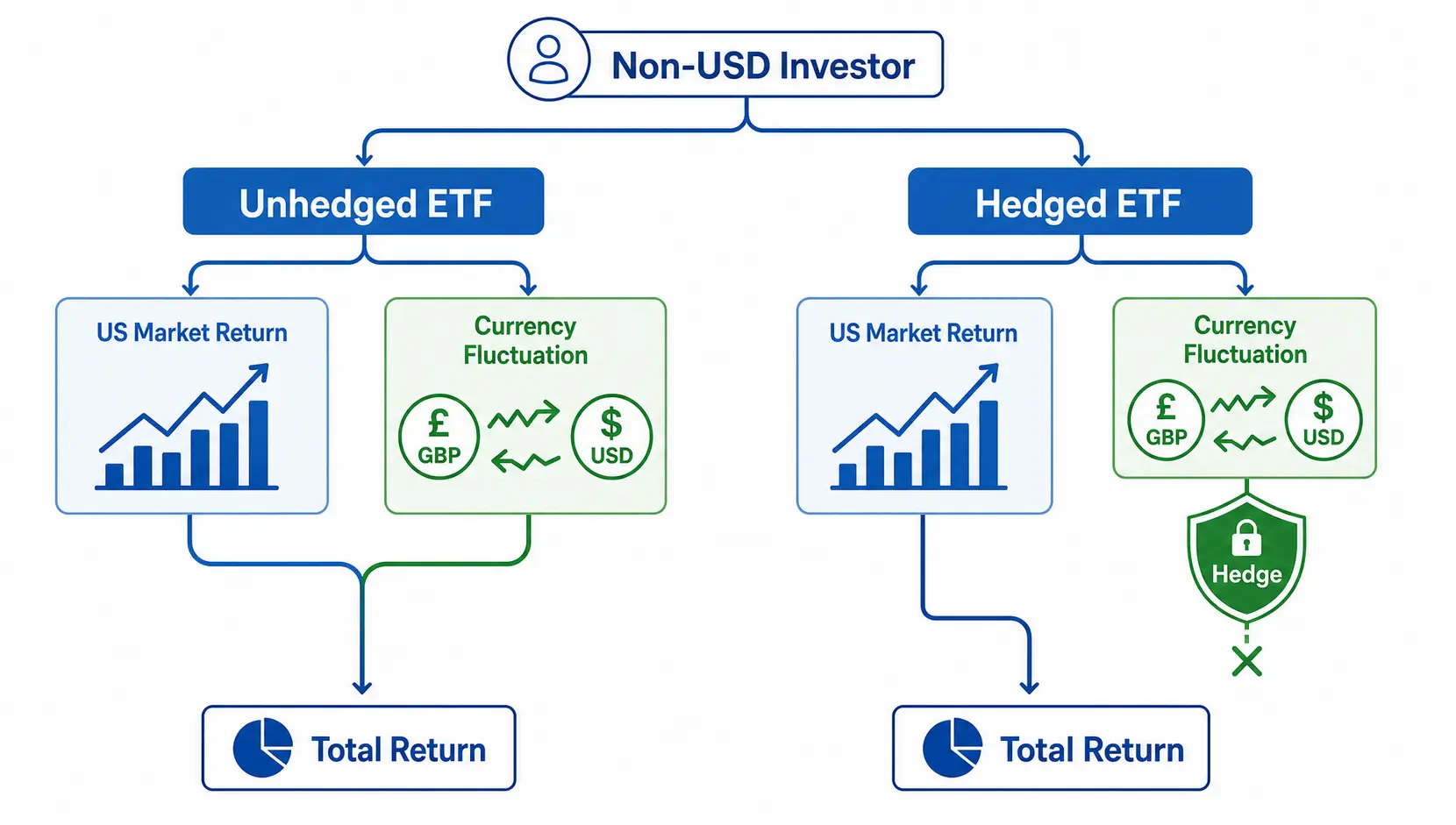
Pro Tip: The core difference lies in what you are exposed to. An unhedged ETF gives you raw, unfiltered exposure to both the US stock market and the USD-to-your-currency exchange rate. A hedged ETF attempts to surgically remove the currency variable, leaving you with purer exposure to just the US stock market, albeit at a cost.
What Are Unhedged US ETFs and How Are They Affected by Currency?
An unhedged US Exchange-Traded Fund (ETF) is the most straightforward instrument for foreign investors.
When you purchase shares in an unhedged ETF, such as one tracking the S&P 500, you are making two bets simultaneously: one on the performance of the US companies in the index and another on the strength of the US dollar (USD) relative to your home currency (e.g., British Pound or Malaysian Ringgit).
The mechanism is simple: the fund’s assets are priced in USD. To calculate your return, the ETF’s performance in USD is converted back to your local currency.
- If the USD strengthens against your currency, your returns are magnified.
- Conversely, if the USD weakens against your currency, your returns are diminished, even if the US market itself performed well.
For example, if the S&P 500 ETF gains 10% but the USD falls 5% against the pound, a UK investor’s net return is approximately 5%. The currency movement has eroded half of the asset’s gain.
What Are Currency Hedged US ETFs and How Do They Mitigate Risk?
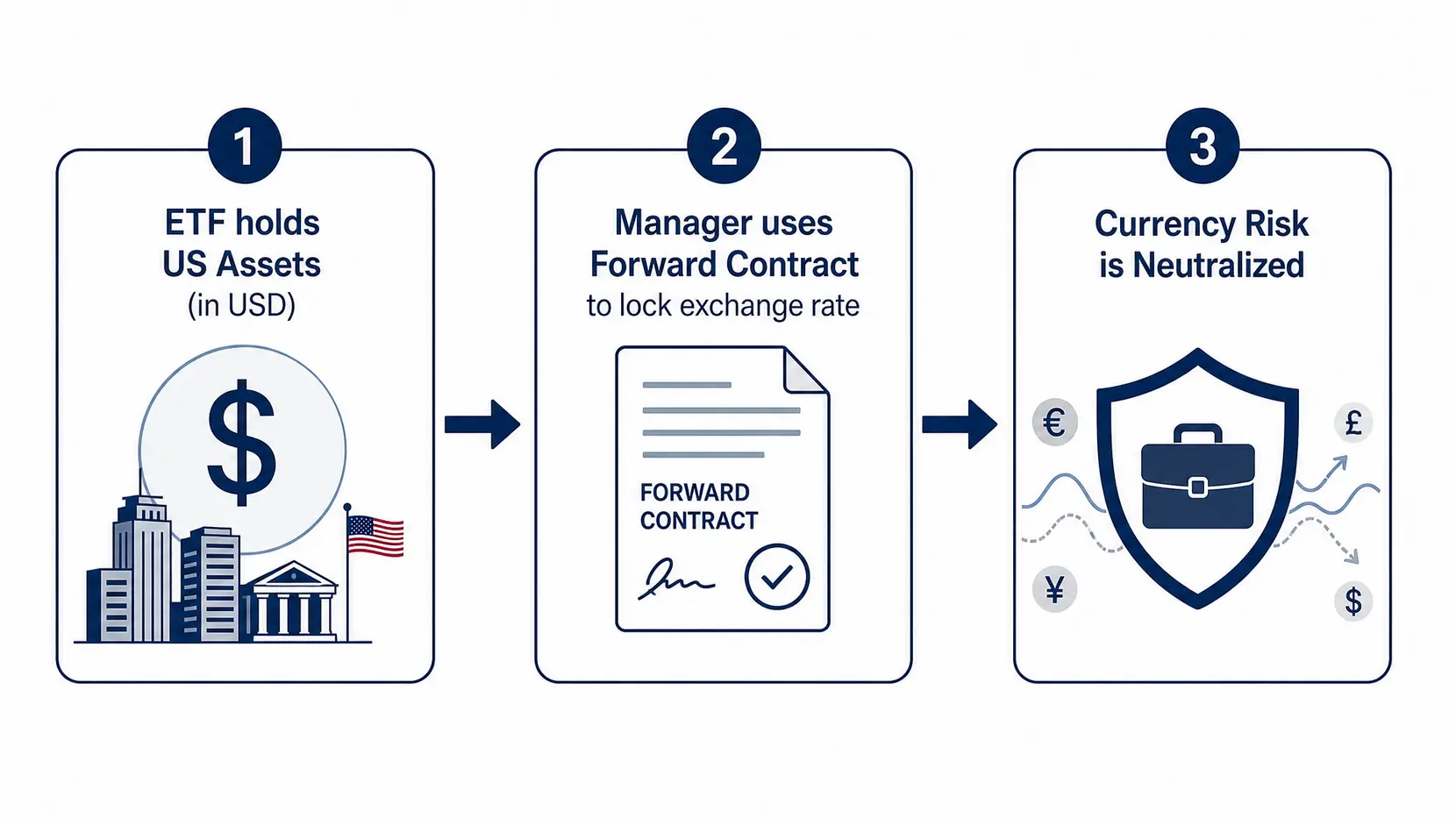
A currency-hedged US ETF is engineered to solve the problem of exchange rate volatility. The fund manager actively works to neutralise the impact of currency fluctuations, aiming to deliver a return that closely matches the local-currency return of the underlying US index.
How is this achieved? The fund employs derivative instruments, most commonly forward contracts. In essence, the fund manager pre-agrees to sell the USD exposure at a future date at a predetermined exchange rate.
This ‘locks in’ the rate, removing the uncertainty of day-to-day forex movements. As explained by financial education platform Investopedia, these contracts are typically rolled over on a monthly basis.
This process effectively strips out the currency component from the investment return.
Key Decision Factors: Analysing the Pros and Cons of Hedged vs Unhedged ETFs
Choosing between these two structures requires a quantitative and qualitative assessment of their respective trade-offs. The optimal choice is contingent on your investment horizon, cost sensitivity, and macroeconomic outlook.
| Feature | Currency-Hedged US ETF | Unhedged US ETF |
|---|---|---|
| Primary Goal | Isolate asset return, minimise currency volatility. | Capture both asset and currency return. |
| Cost Structure | Higher Expense Ratios (TER) due to hedging costs. | Lower Expense Ratios (TER). |
| Complexity | Higher, uses derivatives. Potential for tracking error. | Lower, simple direct investment. |
| Best For | Short-term investors, risk-averse individuals, or those expecting their home currency to strengthen. | Long-term investors, cost-sensitive individuals, or those with a neutral/positive view on the USD. |
Pros and Cons of Hedged ETFs (Costs, Complexity, and Stability)
Advantages:
- Volatility Reduction: The primary benefit is the dampening of portfolio volatility. By hedging, you protect your US asset gains from being erased by a falling USD.
- Predictable Returns: Returns are more closely correlated to the underlying US index, making performance attribution clearer. This is useful for tactical asset allocation.
- Protection in a Strong Home Currency Environment: If you anticipate your local currency (GBP, MYR) will appreciate against the USD, a hedged ETF is a defensive tool to preserve capital.
Disadvantages:
- Higher Costs: Hedging is not free. Hedged ETFs carry higher Total Expense Ratios (TERs), typically adding 0.05% to 0.30% in annual fees. Furthermore, the cost of the forward contracts (the ‘cost of carry’) depends on interest rate differentials between the two currencies, which can be a significant drag on performance. A recent Bloomberg analysis highlights that hedging activity has increased, reflecting market concern but also underscoring the associated costs.
- Forfeited Gains: Hedging is a two-way street. If the USD strengthens, you will not benefit from the currency upside. Your returns will be capped at the asset’s performance.
- Tracking Error: The hedging process is not perfect. Imperfect hedges or the cost of rolling contracts can lead to a ‘tracking error’, where the fund’s return does not perfectly match the underlying index’s return.
Pros and Cons of Unhedged ETFs (Simplicity, Cost, and Growth Potential)
Advantages:
- Lower Costs: Unhedged ETFs are simpler to manage and therefore almost always have lower expense ratios. Over a long investment horizon, this cost difference can compound significantly.
- Simplicity: They are transparent and easy to understand. The return is a simple function of asset performance and currency movement.
- Potential for Currency Gains: If the USD appreciates against your home currency, you benefit from a performance tailwind, boosting your total return.
Disadvantages:
- Currency Risk: The most significant drawback is the direct exposure to adverse currency movements, which can erode returns or even create losses.
- Increased Volatility: The added variable of currency rates makes the investment’s value fluctuate more, which can be psychologically challenging for some investors.
How to Choose: Which ETF Strategy Is Right for Your Portfolio?
Summary Paragraph: The decision hinges on your investment timeline and risk tolerance. For long-term investors (10+ years), my analysis suggests that the costs of hedging often outweigh the benefits, as currency fluctuations tend to revert to the mean over time. For short-term or highly risk-averse investors, the stability offered by a hedged strategy may be worth the additional expense, especially if you have a strong view on impending currency movements.
Scenarios Favouring a Currency-Hedged Strategy
A hedged approach is tactically superior in several specific situations:
- Short Investment Horizon: If you plan to invest for only 1-3 years, a sharp, adverse currency swing could devastate your returns with little time for recovery. Hedging provides valuable certainty over this period.
- High Risk Aversion: If you are an investor who prioritises capital preservation and prefers a smoother return profile, the ‘insurance’ provided by hedging aligns with your goals.
- Bearish Outlook on USD: If your analysis leads you to believe the USD is poised for a significant decline against your home currency, hedging is a prudent defensive manoeuvre.
| Investor Profile | Recommended Strategy | Rationale |
|---|---|---|
| The Long-Term Accumulator (15+ years) | Unhedged | Costs of hedging compound and erode long-term returns. Currency impacts tend to even out over decades. |
| The Pre-Retiree (2-5 years from retirement) | Hedged | High need for capital preservation. Cannot afford a major currency-driven drawdown right before retirement. |
| The Tactical Trader (6-18 months) | Hedged or Unhedged (Based on View) | Choice depends entirely on the trader’s directional bet on the USD vs. their home currency. |
When an Unhedged Strategy Makes More Sense
For the majority of retail investors focused on long-term wealth creation, an unhedged strategy often proves to be the most efficient path.
- Long Investment Horizon (10+ years): Academic studies and historical data suggest that over long periods, the impact of currency fluctuations tends to be a ‘wash’. Cycles of strengthening and weakening currencies often cancel each other out. In this context, paying a persistent hedging cost becomes a guaranteed drag on performance.
- Cost-Consciousness: As a fund analyst, I place immense weight on costs. The seemingly small difference in expense ratios between hedged and unhedged ETFs creates a significant performance gap when compounded over decades. Keeping costs low is one of the most reliable ways to maximise long-term returns.
- Portfolio Diversification: For some, holding assets in a different currency is a form of diversification. If your home economy and currency face trouble, having USD-denominated assets can act as a natural hedge.
Frequently Asked Questions
1. What are the costs associated with currency-hedged ETFs?
From my analysis, there are two primary costs. First, a higher management fee (TER) to compensate the fund for the operational complexity of managing the hedge, typically 0.05% to 0.30% higher than the unhedged version.
Second, the implicit ‘cost of carry’ embedded in the forward contracts, which is determined by the short-term interest rate differential between the USD and your home currency.
If US interest rates are higher, this can result in a positive carry, but if they are lower, it creates a cost drag.
2. Does currency hedging matter for long-term investments?
My professional view is that for truly long-term horizons (over 15 years), the importance of currency hedging diminishes significantly. Economic theories like Purchasing Power Parity suggest currencies revert to a mean over time.
The persistent, compounding cost of hedging often outweighs the temporary volatility reduction benefits. An unhedged strategy is generally more cost-effective for long-term accumulation.
3. How does a strong vs. weak local currency impact my returns on these ETFs?
It has an inverse effect on unhedged ETF returns. If your local currency (e.g., GBP) strengthens against the USD, the value of your US assets decreases when converted back, thus lowering your total return.
If your local currency weakens, the value of your US assets increases, boosting your total return. For a hedged ETF, this impact is designed to be neutralised, so your return should primarily reflect the performance of the US assets themselves.
4. Are hedged ETFs 100% effective at removing currency risk?
No, they are not. While highly effective, the hedging process is subject to minor imperfections. This can be due to the cost of rolling the forward contracts, or intra-month currency movements that are not perfectly captured by the typical month-end hedge.
This results in a small ‘tracking error’, but for most practical purposes, the majority of the currency risk is successfully mitigated.
William Lee’s Final Thoughts
“After analysing countless funds, my philosophy remains grounded in data: numbers don’t lie. For the vast majority of investors building a portfolio for the long term, the most reliable path to success is to focus on what you can control: costs. Unhedged ETFs offer a structurally lower-cost entry into the US market. While currency fluctuations will introduce volatility—a factor you cannot control—the historical evidence suggests that over decades, the drag of hedging fees is a higher price to p than the risk of temporary currency swings. Choose simplicity and low cost unless you have a specific, short-term tactical reason not to.”
Sources & Methodology
William Lee strictly relies on primary regulatory data and authoritative official information to ensure accuracy. Data cited in this guide is sourced from:
*Disclaimer: The content of this article represents the personal views of the author (William Lee) and is for educational and reference purposes only. It does not constitute professional investment or financial advice. Trading and investing involve significant risk; proceed with caution.*
