

As a fund research analyst, my focus is perpetually fixed on identifying sources of potential alpha and portfolio diversification.
In a market often dominated by large-cap narratives, a comprehensive US Small Cap ETFs Russell 2000 analysis for long term growth reveals a compelling, albeit more volatile, frontier for capital appreciation.
This analysis for 2026 will dissect the landscape of US small-cap ETFs, specifically those benchmarked against the Russell 2000 Index.
We will explore the critical divergence between small-cap value vs. growth strategies and conduct a granular comparison of the primary investment vehicles available to discerning investors looking to enhance their portfolio’s growth trajectory.
Understanding US Small Cap ETFs and the Russell 2000
Pro Tip: Before allocating capital, it is imperative to understand the mechanics of the small-cap universe. The Russell 2000 Index is not merely a list of small companies; it is a rules-based, float-adjusted, market-capitalisation-weighted index that provides the most accurate and unbiased barometer of the US small-cap equity market.
What Defines a Small-Cap Stock?
From an institutional perspective, the term ‘small-cap’ refers to publicly traded companies with a market capitalisation that falls within a specific, lower-end range of the market spectrum.
While definitions can vary slightly between brokerage houses, a widely accepted band places small-caps between approximately $250 million and $2 billion in market value.
According to financial authority Investopedia, these companies are typically younger, possess higher growth potential than their large-cap counterparts, but also exhibit greater price volatility.
This growth-risk paradigm is central to any US Small Cap ETFs Russell 2000 analysis for long term growth.
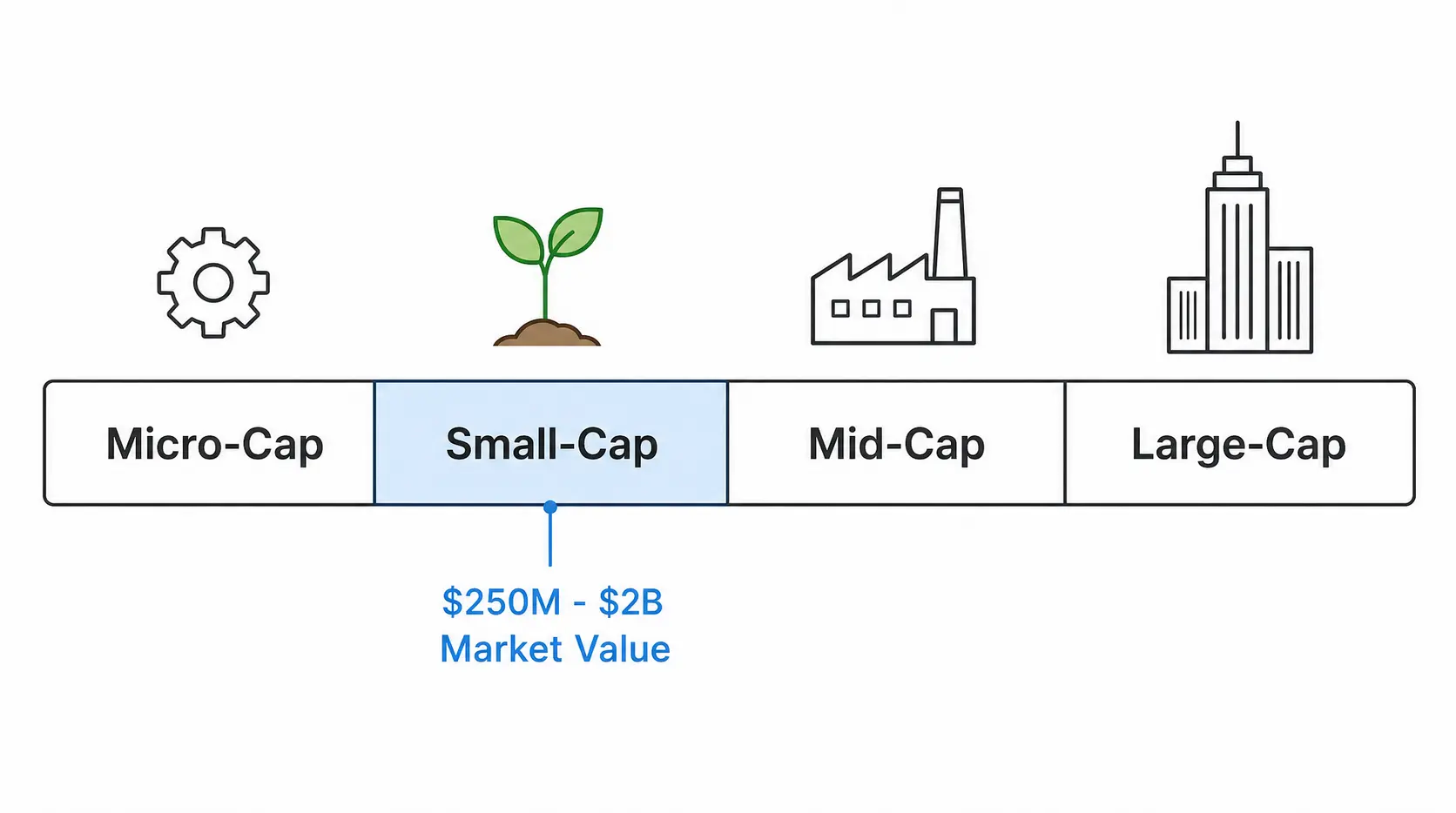
As I often remind my clients, ‘small-cap’ is not synonymous with ‘unknown’. Many of these firms are leaders in niche industries or are innovative disruptors on a path to becoming the large-caps of tomorrow. The analytical challenge lies in sifting the enduring growers from the transient players.
The Russell 2000 Index: The Definitive Small-Cap Benchmark
The Russell 2000 Index is the cornerstone of US small-cap investing. Maintained by FTSE Russell, it represents approximately 2,000 of the smallest-cap companies within the broader Russell 3000 Index.
The construction is purely quantitative; it is reconstituted annually to ensure it accurately reflects the current state of the small-cap market.
Unlike indices like the S&P 500, which involves a selection committee, the Russell 2000’s rules-based methodology provides an objective and comprehensive benchmark.
This makes it an ideal underlying index for ETFs aiming to provide pure exposure to this market segment. Understanding its construction is vital for any serious Russell 2000 analysis.
Analysing the Case for Long-Term Growth in Small-Cap ETFs
Summary Paragraph: Historically, small-cap stocks have offered periods of significant outperformance relative to large-caps, often driven by economic expansion cycles. However, this potential for higher returns comes with commensurately higher volatility. The data suggests that while the S&P 500 has dominated in recent years, the valuation gap may present a strategic entry point for long-term investors in 2026.
Historical Performance: A Look Back at Small-Cap Returns
A quantitative analysis of long-term performance presents a nuanced picture. Over multi-decade periods, small-caps have demonstrated the ability to generate superior returns.
This is often attributed to the ‘size premium’, where smaller, more agile companies can grow their earnings at a faster rate. However, this is not a linear path.
For instance, a July 2026 report from Bloomberg noted that small caps were experiencing their largest performance lag behind the S&P 500 in nearly two decades.
Conversely, this very underperformance, as highlighted by CME Group analysis, has led to valuations that appear attractive relative to their large-cap peers, suggesting potential for a reversion to the mean.
For an investor focused on long term growth, such periods of underperformance can represent strategic accumulation opportunities.
Small-Cap Value vs. Growth: Which Performs Better Over Time?
The distinction between value and growth styles is particularly pronounced in the small-cap space.
Small-cap growth stocks are often found in innovative sectors like technology and biotechnology, offering explosive growth potential but with high valuations and significant downside risk if they fail to meet lofty expectations.
Small-cap value stocks, conversely, are mature businesses in traditional sectors that trade at lower multiples relative to their intrinsic worth.
Historically, academic research has shown that small-cap value has delivered a performance premium over small-cap growth over very long time horizons, though this relationship can invert for extended periods.
A diversified approach, perhaps holding both a value and a growth ETF or a core blended ETF, is often the most prudent strategy for capturing the benefits of both styles.
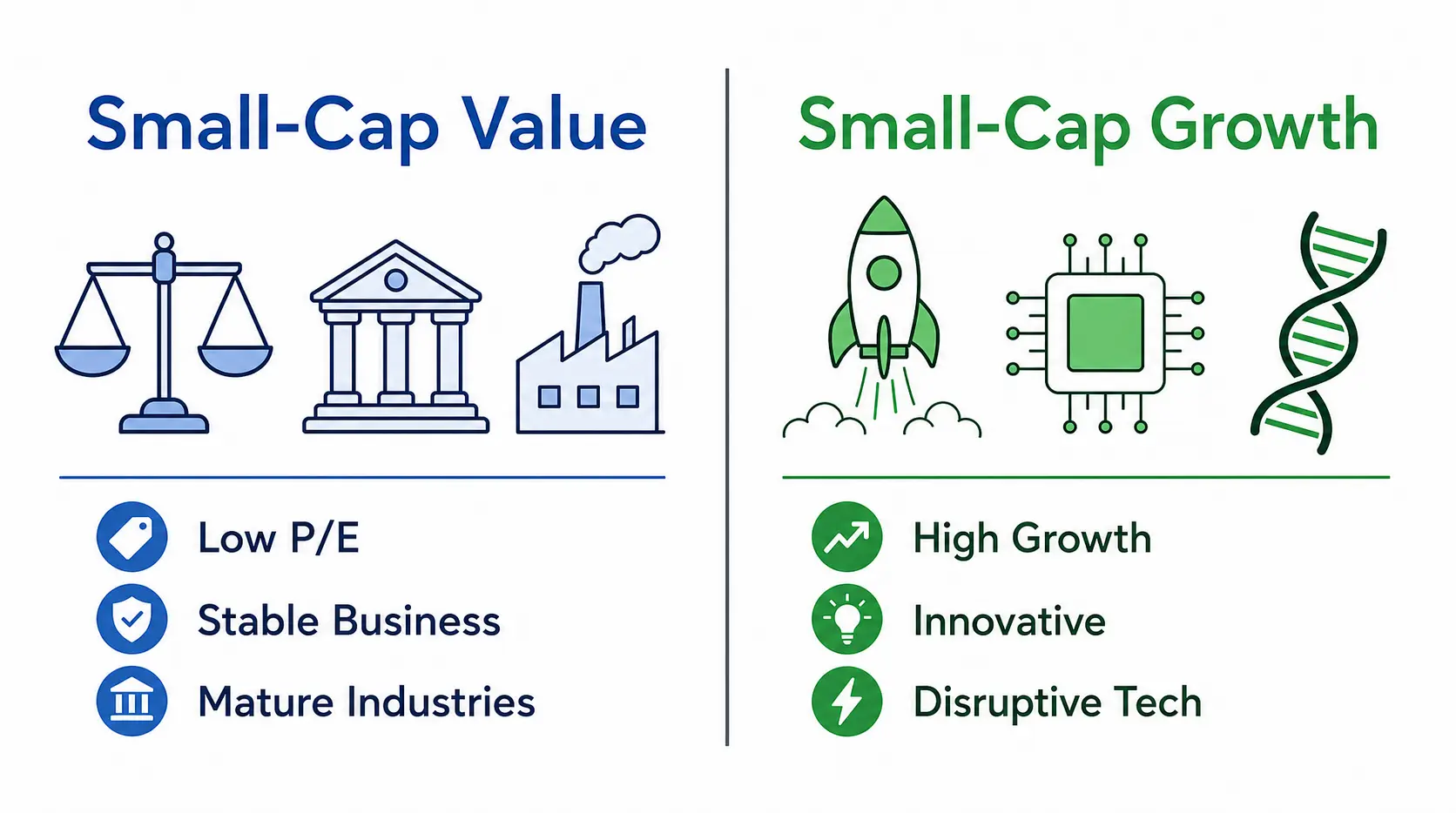
| Factor | Small-Cap Value | Small-Cap Growth |
|---|---|---|
| Typical Sectors | Financials, Industrials, Real Estate | Technology, Healthcare, Consumer Discretionary |
| Valuation Metrics | Low P/E, Low P/B Ratios | High P/E, High Revenue Growth |
| Risk Profile | Lower volatility than growth, but susceptible to economic downturns | Higher volatility, sensitive to interest rate changes and sentiment |
| Long-Term Thesis | Mean reversion of undervalued assets | Capitalising on disruptive innovation |
Top Russell 2000 ETFs for Your Portfolio
Pro Tip: When selecting an ETF, the expense ratio is a critical starting point, but not the only factor. For frequently traded indices like the Russell 2000, tracking difference and bid-ask spreads can have a more significant impact on total return. Liquidity is paramount.
iShares Russell 2000 ETF (IWM): The Popular Choice
The iShares Russell 2000 ETF (IWM) is the oldest and most liquid small-cap ETF on the market. Its high average daily trading volume makes it a favourite for institutional traders and those who prioritise ease of execution.
This liquidity results in tight bid-ask spreads, minimising transaction costs. However, its expense ratio, while competitive, is notably higher than some of its main rivals.
For a long-term buy-and-hold investor, this seemingly small difference in fees can compound into a significant performance drag over time.
Vanguard Russell 2000 ETF (VTWO): A Low-Cost Alternative
True to its brand, the Vanguard Russell 2000 ETF (VTWO) offers a compelling proposition for the cost-conscious investor. Its expense ratio is one of the lowest in the category.
While its trading volume is substantially lower than IWM’s, it is more than sufficient for most retail and many institutional investors, ensuring reasonable liquidity.
The key trade-off is the potentially wider bid-ask spread compared to IWM. My analysis suggests that for a long-term strategic allocation, the lower management fee of VTWO is likely to result in superior net performance.
| Metric (as of Q3 2026) | iShares Russell 2000 ETF (IWM) | Vanguard Russell 2000 ETF (VTWO) |
|---|---|---|
| Expense Ratio | 0.19% | 0.10% |
| Assets Under Management (AUM) | ~$60 Billion | ~$10 Billion |
| Average Daily Volume | ~25 Million Shares | ~500,000 Shares |
| Tracking Error | Low | Very Low |
| Ideal Investor | Short-term traders, institutions needing high liquidity. | Long-term strategic investors focused on minimising costs. |
Key Risks and How to Mitigate Them
From a portfolio construction standpoint, risk is not something to be avoided, but to be managed. The higher standard deviation of small-cap equities is the very reason they offer a potential return premium. The key is to size the allocation appropriately within a diversified portfolio to avoid an unacceptable level of drawdown risk.
Understanding Small-Cap Volatility
Small-cap stocks are inherently more volatile than their large-cap peers.
This is due to several factors:
- Economic Sensitivity: Smaller companies often have less diversified revenue streams and are more sensitive to the domestic economic cycle.
- Lower Liquidity: Their shares trade less frequently, which can lead to larger price swings on buying or selling pressure.
- Financial Fragility: They may have less access to capital markets and weaker balance sheets, making them more vulnerable during credit crunches or recessions.
Risk Warning: Investing in small-cap ETFs involves significant risk, including the potential for substantial loss of principal. These instruments exhibit higher volatility than broad market indices. As regulatory bodies like the UK’s Financial Conduct Authority (FCA) consistently warn, past performance is not an indicator of future results. Investors should ensure such an investment aligns with their risk tolerance and time horizon.
Portfolio Allocation: How Much Small-Cap Exposure is Right for You?
There is no one-size-fits-all answer. The appropriate allocation to small-cap ETFs depends entirely on an investor’s individual risk tolerance, investment timeline, and overall financial goals.
A younger investor with a multi-decade time horizon might comfortably allocate 10-20% of their equity portfolio to small-caps to maximise growth potential.
In contrast, an investor nearing retirement might limit their exposure to 5% or less, or avoid it altogether, to preserve capital.
The most prudent approach is to start with a modest allocation and only increase it after gaining experience with the asset class’s volatility profile.
Frequently Asked Questions
1. Are small-cap ETFs a good investment for beginners?
From my analytical viewpoint, while not strictly ‘for experts’, small-cap ETFs should be approached with caution by beginners.
Their high volatility can be unsettling. A novice investor would be better served by first building a core portfolio around broad market indices (like an S&P 500 or global equity ETF) before adding a smaller, satellite allocation to small-caps.
2. What is the main difference between the Russell 2000 and the S&P 500?
The primary difference is market capitalisation. The S&P 500 tracks 500 of the largest US companies, representing the large-cap segment. The Russell 2000, on the other hand, tracks 2,000 of the subsequent smaller companies.
This results in vastly different sector exposures, risk profiles, and growth characteristics. The S&P 500 is a barometer for the overall US economy, while the Russell 2000 is a gauge of the health of smaller, domestic-focused businesses.
3. How often is the Russell 2000 index rebalanced?
The Russell 2000 Index undergoes a full reconstitution once per year, typically at the end of June. This is a significant market event where companies are added or deleted based on the updated market capitalisation rankings.
Additionally, the index is rebalanced quarterly to adjust constituent weightings. This disciplined, rules-based process ensures the index remains a timely and accurate reflection of the small-cap market.
William Lee’s Final Thoughts
My analysis indicates that US small-cap ETFs tracking the Russell 2000 present a valid, data-supported avenue for long-term growth, provided the allocation is made with a clear understanding of the associated volatility. The current valuation gap relative to large-caps may indeed offer a favourable entry point for the patient, long-term investor in 2026. When selecting a vehicle, the numbers point towards a low-cost option like VTWO for strategic holdings, while IWM maintains its dominance for tactical, liquidity-driven mandates. Ultimately, a successful investment here is less about timing the market and more about time in the market, structured within a disciplined and diversified portfolio framework.
Sources & Methodology
William Lee strictly relies on primary regulatory data and authoritative official information to ensure accuracy. Data cited in this guide is sourced from:
*Disclaimer: The content of this article represents the personal views of the author (William Lee) and is for educational and reference purposes only. It does not constitute professional investment or financial advice. Trading and investing involve significant risk; proceed with caution.*
